For Kenya’s top athletes, proving they are clean is increasingly becoming an expensive undertaking, as shoe sponsors step in to finance additional anti-doping tests in a bid to restore confidence in the sport.
Kenya’s doping crisis has created a credibility problem that extends beyond athletes caught breaking the rules. Even those who have done nothing wrong can find their achievements clouded by suspicion.
Now, some of the sport’s biggest names and their shoe sponsors are responding with a new weapon in the fight for credibility -- more testing, more transparency and crucially, more money.
The emerging model goes beyond the routine anti-doping controls imposed by the sport’s authorities within that country.
Athletes are voluntarily signing up for enhanced testing programmes, with sponsors helping foot the bill in an effort to demonstrate that exceptional performances can be achieved without prohibited substances.
The approach gained prominence with marathon star Sabastian Sawe ahead of his Berlin Marathon debut in September 2025.
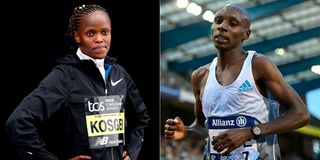
It has since been extended to Kenya’s Brigid Kosgei and Uganda’s Jacob Kiplimo, underlining a growing willingness among elite runners and their commercial partners to invest in clean sport.
Kenya remains in Category “A” of the Athletics Integrity Unit (AIU), together with Belarus, Bahrain, Ethiopia, India, Morocco, Nigeria and Ukraine. This category of countries requires heightened anti-doping attention.
Although doping cases in Kenya have declined from their peak in 2022 and 2023, the damage to the country’s image has proved harder to reverse.
It is against this backdrop that shoe manufacturers are increasingly becoming part of the conversation about integrity in distance running.
Kenya's Brigid Kosgei smiles after winning the elite women's race at the Bank of America Chicago Marathon in a world record time on October 13 2019.
Photo credit: File | AFP
Kosgei, the former women’s marathon world record holder, and Kiplimo have voluntarily joined an enhanced AIU testing programme following their spring marathons in 2026. They are both managed by Rosa Associati and sponsored by Nike.
Kosgei returned to Chicago after seven years, having set a world record of 2:14:04 there in 2019. On Sunday, she finished third behind Ethiopia’s Hawi Feysa and fellow Kenyan Sharon Lokedi.
Kosgei is determined to make a statement that clean athletes should not have to live under a permanent cloud of suspicion.
“They've been testing me three times per week, sometimes two times per week, in Kenya,” Kosgei said ahead of the Chicago Marathon.
Under the enhanced programme, the athletes are expected to undergo at least 25 unannounced out-of-competition tests, alongside an estimated 100 to 120 laboratory analyses and the frequency and scope of the testing go well beyond the routine monitoring faced by many elite distance runners.
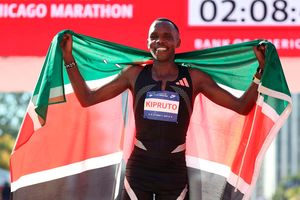
Kenya's Sabastian Sawe celebrates with a shoe after winning the men's elite race and setting a new world record with a time of 01:59:30.
Photo credit: Reuters
For Sawe, the decision to undergo additional testing was driven by frustration with the suspicion that has followed Kenyan performances.
Ahead of his Berlin Marathon debut in 2025, the marathoner and his agent, Eric Lilot, approached the AIU to propose a special anti-doping regime.
Working with his management and coach Claudio Berardelli, Sawe wanted to demonstrate that his ambitions rested on training, talent and hard work rather than prohibited substances.
“In light of recent and notable doping cases concerning Kenyan athletes, Sawe wants to send a strong message that while doping is definitely a huge issue in Kenyan sport, there are still many clean and talented athletes who can do incredible things based on hard work and their own legs,” Lilot said at the time.
Sawe was equally candid about the problem facing his country and he wanted to tell the world that it is possible to train hard and win easily.
“I am tired of reading what people write on social pages. There is always doubt when the athlete is a Kenyan and I recognize doping is a big problem in our country, and denying it would be a mistake.”
His sponsor, Adidas, reportedly committed about Sh6.5 million ($50,000) to finance the enhanced testing programme ahead of Berlin. Sawe underwent 25 unannounced out-of-competition tests over approximately two to three months, with both blood and urine samples collected.
In 2026, ahead of his historic 1:59:30 at the London Marathon, the same 25-test model was spread across 12 months, a longer-term approach intended to make enhanced testing more sustainable.
The financial commitment is significant. A single World Anti-Doping Agency-compliant test can cost between Sh90,000 and Sh259,000 ($700-$2,000), depending on the procedures involved, including sample collection, transportation and laboratory analysis.
Additional testing for erythropoietin (EPO) can cost another Sh52,000 to Sh104,000 ($400-$800), while blood testing for the Athlete Biological Passport is more expensive than urine testing.
By comparison, an elite marathoner in the AIU's registered testing pool might undergo about six out-of-competition tests annually, with 12 to 16 laboratory analyses
Since 2019, Nike, Adidas and Asics, followed by On, have contributed to the Road Running Integrity Programme.