Merriam-Webster Dictionary defines doping as the use of substances (such as anabolic steroid or Erythropoietin) or technique (such as blood doping) that are typically banned in competitive sports to improve an athletic performance and gain undue advantage over opponents.
According to the Athletics Integrity Unit (AIU), the independent arm of World Athletics which is charged with keeping the sport free from doping, manipulation and other ills, Kenya, India and Russia lead the 481-deep list of ineligible athletes for worldwide track and field between December 2017 and December 31, 2024.
The 481 athletes are from 75 national track and field federations and are temporary or permanently ineligible to compete in the sport.
Kenya’s tally has shot up by more than 100 percent to 119 offenders as of December 31, 2024 up from 54 as at December 31, 2022. This is an increase of 65 cases. India follows with 108 cases registered in December 31, 2024, up from 65 cases as at December 31, 2022. This represents an increase of 43 cases.
Kenya's Jemima Sumgong celebrates after winning the women's marathon race at the Rio Olympic Games at Sambodromo in Rio de Janeiro on August 14, 2016
Photo credit: File | AFP
But Russia, the pariah nation of doping that has been banned since 2016 from international championships, had the most ineligibles – 92 – as at December 31, 2022, is down to 73 cases as at end of 2024.
Russia’s scenario represents positive strides in the fight against doping compared to Kenya, whose athletes once represented the sport of athletics at its purest form but are now viewed with suspicion whenever they compete.
The Kenyan case is peculiar, and has been classified as stealing money by deception in view of the growing list of athletes caught cheating in the lucrative world of marathon running which has generated more than US$20 million (Sh2.6 billion) in prize money, endorsements and bonuses in the post Covid-19 period, according to official published prize money structures.
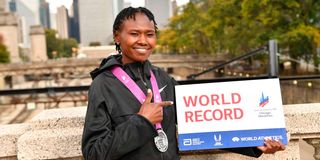
The latest to be nabbed is world marathon record holder Ruth Chepng’etich who became the first woman to break the two hours and 10 minutes barrier in women’s marathon running while competing in the streets of Chicago last year, where she posted 2 hours, 9 minutes 56 seconds, a world record leap which raised more eyebrows than celebrations not only in Chicago but globally. She shattered Ethiopian runner Tigst Assefa’s previous world record time of 2:11.53.
For her exploits, Chepng’etich earned a guaranteed US$200,000 (Sh26 million) in prize money and world record bonus, excluding endorsements and bonuses from her shoe endorsing company Nike, and salary top ups.
The desire to bag the huge payout in marathon running through hook and crook has become the motivating factor for doping in Kenya, a country which has hundreds of world-class runners.
At the moment, Kenya is celebrating its 37th year in WADA’s list of shame. The first reported case of doping in Kenya involved Cosmas Ndeti, twice Boston Marathon champion, who got a three-month ban after failing a test for ephedrine at the 1988 IAAF World Cross Country Championships (now renamed World Athletics Cross Country Championships). It was a case of negligence over use of a common sore throat lozenge without declaring that he had a common cold.
In 1993, five times world cross country champion and 1988 Olympic Games 5000m gold medallist John Ngugi was suspended for four years for refusing to take an out-of-competition dope test. His sentence was reduced on compassion by the then International Amateur Athletics Federation (IAAF), which has now re-branded to World Athletics, although a test a few days later turned negative.
The first major case of doping by a Kenyan athlete came in 2003 when Pamela Chepchumba, 2001 world cross country long race champion, tested positive for Erythropoietin (EPO), a hormone that stimulates red blood cell production. She was handed a four-year suspension.
Triple world 1,500m champion Asbel Kiprop
Photo credit: File Picture
But in the last one decade, established Kenyan athletes have been nabbed. They are former marathon world record holder Wilson Kipsang, former half marathon world record holder Abraham Kiptum, 2016 Olympics marathon champion Jemima Sumgong, former London Marathon winner Daniel Wanjiru, triple world 1,500m champion Asbel Kiprop, and his successor Elijah Manangoi.
Peer pressure, unrealistic societal expectations, limited employment opportunities, and the desire for quick success are forcing young Kenyans to take shortcuts through doping in athletics. In the process, they have tainted the sport and the image of the country.
But they are also increasingly being nabbed due to a stricter and more rigorous test regime, and the Athlete Biological Passport (ABP). ABP monitors selected biological variables over time that indirectly reveal the effects of doping, rather than attempting to detect the doping substance or method itself.
On July 17 this year, AIU announced Chepng’etich’s provisional suspension after her urine sample was found to have a presence of Hydrochlorothiazide (HCTZ), a diuretic banned by the World Anti-Doping Agency (WADA).
HCTZ is commonly used as a masking agent and has a minimum reporting level of 20 nanograms per millilitre (ng/mL) in urine. Chepngetich’s sample showed 3,800 ng/mL.
A sample taken from her on March 14, 2025, triggered the positive test. The head of the AIU, Brett Clothier, said that Chepng’etich, 30, was notified of the result on April 16 and cooperated with the investigation. She requested to immediately take her suspension. Chepng’etich’s admission has opened further investigations by AIU to determine what the “diuretic” masking agent HCTZ hid.
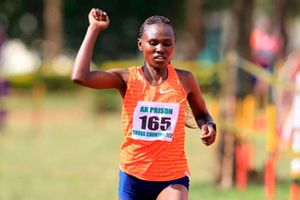
Ruth Chepng'etich crosses the finish line in the 10km senior women's race during the Kenya Prisons National Cross Country Championship at the Kenya Prisons Staff Training College on December 17, 2024.
Photo credit: Chris Omollo | Nation Media Group
A “diuretic” is a substance, usually a medication, that causes the kidneys to produce more urine. Diuretics are commonly used to treat conditions like high blood pressure, oedema (excess fluid), and heart failure.
They are also known as “water pills”, according to WADA. Use of diuretics is banned both in competition and out of competition and diuretics are routinely screened for by anti-doping laboratories and agencies, AIU says in its website.
Barnaba Korir, a member of the multi-agency Enhanced Anti-Doping Programme that brings together the Anti-Doping Agency of Kenya (ADAK), Athletics Kenya (AK), AIU and the Ministry of Sports, says the process of investigations has just started. Adak and AIU will dig deeper into the root cause of Chepng’etich’s case.
Two more Kenyan athletes joined the growing list of offenders on July 23 when AIU provisionally suspended the National champion and African Championships 10,000m bronze medallist, Roncer Kipkorir Konga, after testing positive for testosterone, a substance prohibited by WADA.
The other runner is Morine Gesare Michira, a 22-year-old half-marathoner, banned for two years, effective from June 26, 2025, after testing positive for two banned substances: higenamine and octodrine.
Korir said authorities will further investigate the circumstances of Chepng’etich’s offence, who supplied her with the banned substances, where it was sourced from, and everybody who was involved in the matter. This is a standard procedure used by AIU, ADAK, and in some circumstances, the DCI.
Rita Jeptoo of Kenya celebrates as she crosses the finish line to win the 118th Boston Marathon on April 21, 2014 in Boston, Massachusetts.
Photo credit: File | AFP
“Authorities corroborated the findings and weighed in all mitigating factors because in certain circumstances, athletes use medication to treat underlying medical factors. But they must declare their medical status under the Therapeutic Use Exemption (TUE) as per the World Anti-Doping Agency (WADA) procedure,” Korir said.
TUE is an official medical document giving an athlete permission to take a medication that is ordinarily prohibited for the treatment of a legitimate condition. It is only valid for a given period of time.
In a bid to stop athletes from using crooked doctors to manipulate or falsify medical records, ADAK now collaborates with all medical professional bodies in Kenya.
“The fact that we are catching them means that we are winning the war against doping.
The enhanced anti-doping programmes are now biting. Payment of athletes’ earnings is spread in some cases up to three years to deter doping.
Other measures include offenders being banned from competing at any level of competition, banning offenders from interacting with clean athletes in training camps, and loss of earnings. Testing agents can summon an athlete, or call him or her at any given time to request for a sample without fail.
The explanation of the doping procedure is elaborate and expensive, too. It all starts with the Doping control (testing) by Anti-Doping Organisations (ADOs) to level the playing field and protect clean sport.
WADA says it its website that any athlete competing at the national or international level is subject to doping control and can be tested anytime or anywhere by relevant National Anti-Doping Organizations (NADOs), International Federations (IFs) and Major Event Organisations (MEOs).
The athlete is notified by a doping control officer (DCO) or chaperone that they have been selected for doping control (testing), and they are informed under which ADO's authority they are being tested.
This is followed by reporting to the Doping Control Station immediately, although they may be excused for medal ceremonies once they’ve checked in.
The athlete will then choose a urine sample collection vessel from a selection made available by the doping control personnel. If a blood sample is collected, the athlete will choose a blood collection kit from a selection made available by the doping control personnel.
WADA explains further that the DCO or chaperone will witness the passing of the urine sample when the athlete is ready to provide it.
A blood collection officer (BCO) will then draw blood from the athlete using two vials (which will become the A and B samples).
The athlete will divide their urine into the ‘A’ and ‘B’ bottles, saving a residual amount of urine in the sample collection vessel. The ‘B’ sample affords the athlete the opportunity to have a second analysis performed in the event their ‘A’ sample returns an adverse analytical finding (a ‘positive’ result).
If a blood sample is collected, the blood vials will be placed in the ‘A’ and ‘B’ blood sample collection bottles. Only one vial may be necessary if the blood sample is collected as part of an Athlete Biological Passport programme.
The athlete will then seal the ‘A’ and ‘B’ bottles, and the DCO measures the specific gravity of the athlete’s urine to determine whether it meets laboratory standards. If the sample is too dilute, the athlete will be asked to provide additional samples.
The athlete completes the Doping Control Form (DCF)either in paper or digital format, with the DCO. The athlete is asked to provide personal information, a list of substances or methods used, and any comments they may have related to the doping control process. The athlete receives a print or digital copy of the DCF.
The athlete’s sealed sample is then secured and sent to a WADA-accredited laboratory (South Africa and Qatar in Kenya’s case) depending on the geographical location.
A blood sample collected as part of the ABP programme may be analysed by a WADA-approved laboratory. The laboratory copy of the DCF that accompanies the sample is anonymised, indicating only the sample bottle number, sport and the athlete’s gender.
WADA introduced a document called the Athlete Biological Passport in 2009 which carries their physiological and medical records digitally and this can determine a lot of things, said Korir. It is like a motor vehicle diagnostics.
It monitors a series of biological parameters through a dedicated software programme to pick up on indications of doping. The ABP is an informative tool that sits alongside direct testing, whereabouts and performance monitoring.
Finally when results turn positive, AIU steps in provisionally suspends an offender, and accords them a lawyer on a pro bono basis in the hearing before handing over a sentence.