In 2024, Beatrice Chebet made headlines globally, winning the women’s 10,000 metres and 5,000m races at the 2024 Olympic Games.
A year later at the 2025 World Athletics Championships, she won gold in both races, joining an elite group of athletes to have completed an Olympics and world championship double.
In between, she broke Gudaf Tsegay’s 5000m world record of 14 minutes, and 0.21 seconds, running 13:58.06 on July 5, 2025 at the Prefontaine Classic in USA to become the first woman to break the 14-minute barrier in the race. She was on top of the world.
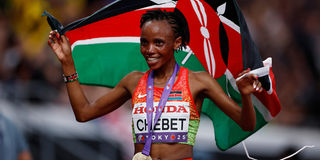
Kenya's Beatrice Chebet celebrates winning the women's 10,000m Final at the World Athletics Championships Tokyo on September 13, 2025.
Photo credit: Reuters
But like other successful female athletes, she was grappling with one question: When does an athlete at the peak of her powers step away from sports to start a family before resuming her sporting career?
It is a decision that requires an intricate balance, and perfect timing. For Chebet, the timing couldn’t have been more practical. She chose 2026, a year with a rare break in an athletics calendar free of the Olympic Games, and the World Athletics Championships.
At the age of 26 and fresh from competing at the 2025 World Athletics Championships in Tokyo, she stepped away from the track to start a family.
“I have really pushed myself to the limit in the last two years. After competing at the 2025 World Athletics Championships, I thought I should take time off to recover and start a family,” Chebet told Nation Sport on Wednesday.
“I had planned for that. I knew there wasn’t much to do this year other than the World Athletics Ultimate Championships, and Diamond League races. After winning at the (2024) Olympics and (2025) world championships, taking a break to start a family was the best idea,” Chebet, who is employed by the Kenya Police Service, explained.
As an athlete accustomed to structured training, intense physical activity, and pushing her body to the limit, she admits in retrospect that motherhood has been a race like no other.
Yet Chebet’s decision demonstrates that athletes can pursue elite sports and motherhood concurrently. Her desire is to return to competition in 2027, and be at the 2028 Olympic Games in Los Angeles.
“I made the decision before start of the 2025 season. The idea was to go for maternity leave after the 2025 World Athletics Championships, and get back in time for the 2027 season, with an eye on 2028 Olympic Games in Los Angeles, where I hope to defend my titles,” said Chebet, who holds the rank of Sergeant.
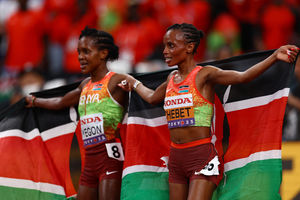
Kenya's Beatrice Chebet celebrates with her medal and national flag after winning gold in the 10,000m final at the World Athletics Championships in Tokyo, Japan, on September 13, 2025.
Photo credit: Aleksandra Szmigiel | Reuters
She first discussed the idea with her husband and coach Peter Bii, then brought her management team into the conversation. Her representatives had already mapped out a busy programme for her after the 2025 World Athletics Championships, including appearances at major races, and competing at the January 10, 2026 World Athletics Cross Country Championships. She put everything on hold.
On June 11, 2026 she gave birth to a baby boy, and named him Kiprop. Motherhood comes with physiological and physical body changes, and Chebet was not spared these.
“Motherhood came with a lot changes for me. The body reacts in different ways. One adds weight and it reaches a point where you ask yourself a lot of questions. It requires a lot of mental shift,” she explains, adding that support from her husband and the entire family made the situation bearable.
As athlete accustomed to structured training, intense physical activity, and pushing her body to its limit, she admits that motherhood has been unlike any race she has run in her career.
“Pregnancy came with its own challenges. Each day came with different set of challenges. I had to accept that I was running a different race. In many ways, it was like chasing the gold medal in athletics. In the end, I gave birth to Kiprop,” said Chebet.
During pregnancy, her activity was largely dictated by how she felt each morning. Walking rather than running became part of her routine. Jogging was possible in the early stages of her pregnancy, but that soon gave way to walking.
She urges female athletes not to view motherhood as a disruption to their careers. She points to Hellen Obiri, Faith Kipyegon, Peres Jepchirchir and Vivian Cheruiyot as athletes who have successfully juggled motherhood with athletics.
“We have a lot to learn from the athletes who went on maternity leave but came back stronger than before and became world beaters. Hellen Obiri, Faith Kipyegon, and Vivian Cheruiyot are some of the athletes who have done it,” she says.
“Having kids is a blessing and we work hard in races because of them,” she adds.
“Having kids is the best motivation ever,” she says. “When you are out there competing and you know they are watching; it pushes you to work harder. I’m coming back to training, and I will start slowly, with easy jogging to shed off excess weight. My target is to come back stronger in the near future,” Chebet says.