There is a need for a national conversation if the country is to have good representation at the 2028 Olympic Games after World Athletics released stringent qualifying standards.
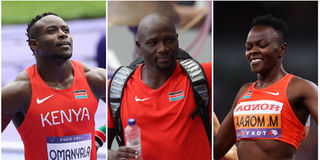
Olympic and world medallists Julius Yego (javelin), Mary Moraa (800m) and Reynold Cheruiyot (1,500m) reckoned that the set standards will be hard to attain with few events happening in the country.
Africa’s fastest man, Ferdinand Omanyala said that they must now put in more effort if they are to achieve the standards, which are high.
World Athletics announced the high qualification standards for track and field events for the Summer Olympics, set to be held from July 15-30 in Los Angeles.
For instance, the men’s standards in 100m are 9.93 seconds compared to 2024 Paris (10.00) and 2020 Tokyo (10.05) Olympics while women’s 800m has 1:57.00, which is high compared to 2024 Paris (1:59.30) and 2020 Tokyo (1:59.50).
The men have to beat the time of 3:30.00 in 1,500m and 12:50.00 in 5,000m where 2024 Paris had 3:33.50 and 13:05.00 respectively and 2020 Tokyo 3:35.00 and 13:13.50 in that order.
Moraa, the 2023 world 800m champion and 2024 Paris Olympic bronze medallist, noted that the 1:50.00 and 1:43.00 qualifying standards for women and men respectively are took high.
Moraa noted that quite a handful of athletes will meet the standards with nine athletes running under 1:57 last year and 12 this year.
Only two Kenyan women ran under that time last year- the 2025 world 800m champion, Lilian Odira (1:54.62) and Sarah Moraa (1:55.74) while only Odira (1:56.19) attained that time this year.
“That means we must have Kenyan athletes running races outside to either attain the time or qualify through the world ranking where athletes from Africa are disadvantaged,” said Moraa. “Without the benefit of the world ranking, the semi-final places won’t even be full.”
While javelin standards of 85.50m were set in December 2022, Yego said having two qualifying events in Kenya-the National Athletics Championships and Kip Keino Classic will leave local athletes disadvantaged.
“I personally have no issue in qualifying but the rest will have a big problem hence we must have a conversation as a country.
“We shall see Americans and European athletes dominate both in the world rankings and qualifying times,” warned Yego, the 2016 Rio Olympics silver medallist and 2015 world champion.
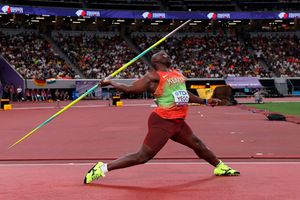
Julius Yego competes in javelin during Absa Kipkeino Classics at Nyayo National Stadium on April 20, 2024.
Photo credit: File | Nation Media Group
Yego noted that the javelin standards were set in 2022 following the surge of good javelin throwers outside Europe.
“Fe athletes met that time the last two seasons but again the challenge has been thrown at us and we have to achieve the standards,” said Omanyala, who has run 27 times sub-10 seconds since 2021 in inducing eight sub-9.93.
Cheruiyot, the 2024 world 1,500m bronze medallist, said the standards in 1,500m (3:30.00) and 5,000m (12:50.00) will be tough to attain. “Those times are crazy and one has to be in their best form but can only hit once,” said Cheruiyot, the 2022 2olrd under-20 1,50m champion.
Only 14 athletes comprising five Kenyans hit sub 3:30 in 2025 while only five athletes with no Kenyan managed to run under that time this year. In 5,000m only 10 athletes managed 12:50.00.
Kenya's Ferdinand Omanyala after winning the second heat of the 100m race at the Paris Olympics on August 3, 2024 at Stade de France.
Photo credit: Joan Pereruan | Nation Media Group
“That is where Athletics Kenya has to step in and help athletes or World Athletics mist review some of these times,” said Cheruiyot.
Only one Kenyan woman was among 10 athletes that met the women’s 5,000m standard time of 2:34.00 this year-the world and Olympic 1,5000m champion, Faith Kipyegon (12:24.14).
This year, only world 1,500m silver medallist Dorcas Ewoi ran sub 3:57.00 while at least four managed last year.
The qualification system was approved by the World Athletics Council includes details of the qualification windows, total quota places per discipline and entry standards.
The programme will include 23 women’s events and 23 men’s events as well as two mixed events – the 4x100m mixed relay, making its Olympic Games debut, and the 4x400m mixed relay.
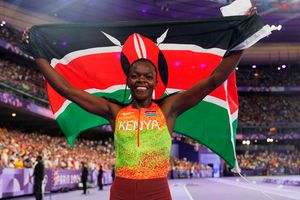
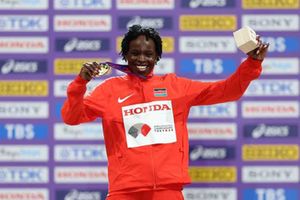
Mary Moraa of Kenya celebrates with her medal on the podium
Photo credit: Reuters | Aleksandra Szmigiel
As has been the case for recent outdoor global championships, the qualification system is based on a dual pathway. Rather than the previous 50-50 model, 40 percent of athletes are expected to qualify through entry standards and the remaining 60 percent are expected to qualify through world rankings.
Should more athletes than the quota by event achieve the entry standard, qualification will be limited to those with the best performance in the qualification period, and within the quota number.
“In this case no athletes will be qualified by world rankings,” said a statement from World Athletics.
For the marathon, the qualification and ranking period runs from November 1, 2026 to April 30, 2028. For the 10,000m, combined events, race walks and relays, the window is from December 19, 2026 to June 18, 2028.
All other events, the qualifying period runs from June 19, 2027 to June 18, 2028 with each country required to pick three qualified athletes per event.
Results from competitions for which the last day falls within the applicable qualification and ranking periods will count entirely towards the qualification.
Results from national senior outdoor championships that start within the applicable qualification and ranking periods will count towards the qualification.
Unlike for the World Athletics Championships, where defending champions and Diamond League champions are considered automatic qualifiers, there are no such privileges in Olympic qualification.