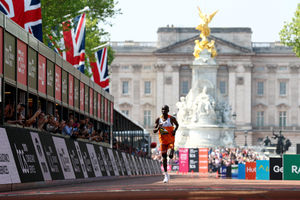
Former marathon record holder Eliud Kipchoge at Old Trafford ahead of the English Premier League match between Manchester United and Liverpool on September 1, 2024.

Appearance fees, not prize money or bonuses, are where the real money lies for elite athletes. Consider the case of Kenyan distance running legend Paul Tergat.
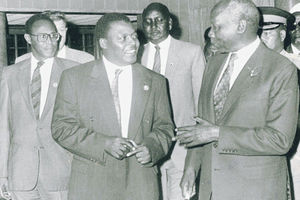
The world was abuzz when Tergat, the five-time World Cross Country Championships winner who also won the World Half Marathon Championships thrice, announced in 2000 that he would run his maiden 42 kilometres race at the 2001 London Marathon.
Tergat then 31, signed a one-year deal believed to be worth a total of US$300,000 (Sh23.4 million at the exchange rate then) in appearance fee with London Marathon organisers, making it the most lucrative deal in the history of road running. At the time, a dollar was exchanged at Sh78.

Kenya’s double Olympic marathon champion Eliud Kipchoge during a training session in Kaptagat earlier this year.
Under the London Marathon system of cumulative time bonuses, had Tergat broken the world record of two hours, 05 minutes and 42 seconds at the time, he would have got a bonus of $100,000 (Sh7.8m then) on top of the appearance fee.
No one had registered a sub-2:05 performance at the London course at the time. Antonio Pinto of Portugal had run a course record 2:06:36 for his third victory in the British capital city.
According to World Athletics (formerly International Association of Athletics Federations - IAAF), London Marathon organisers wanted their race to be known as the fastest and the biggest, and Tergat was to compete in the streets of London against Moroccan Khalid Khannouchi who had set the world record of 2:05:42 from 1999 Chicago Marathon.
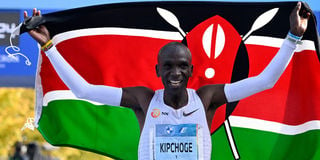
Kenya's Eliud Kipchoge celebrates after winning the Berlin Marathon race on September 25, 2022 in Berlin.
Dave Bedford who was the London Marathon race director and had been chasing after Tergat’s signature for 18 months, admitted he had already spent more than Sh117m (£1 million or $1.5m at the time) from the race budget to sign up Tergat for his maiden marathon.
On the day of the race, another Moroccan called Abdelkader El Mouaziz won in 2:07:09 as Tergat came second in 2:08:15, and Pinto clocked 2:09:36 for third place. Khannouchi, who failed to compete, returned in 2002 to win in London in a world record time of 2:05:38. That was the last time the course produced a world record.
Fast forward to last Sunday, two-time Olympic champion Eliud Kipchoge, who is considered the greatest marathoner of all time, was attempting to win the London Marathon gong for the fifth time, having won it in 2015, 2016, 2018 and 2019. Kipchoge won the 2019 race in a course record 2:02:37.
However on Sunday, he finished sixth in a time of 2:05:25 as his fellow countryman, Sabastian Sawe who was running only his second marathon, won in the second fastest time on the course of 2:02:27, which is also the fastest time this season over 42km.
That saw Kipchoge take home US$ 7,500 (Sh975,000) in race winnings as Sawe pocketed US$ 55,000 (Sh7.16m). Sawe got an additional US$100,000 (Sh13m) in bonuses for running the race in a sub-2:03 time. However, the real money is in appearance fees.
Kipchoge, being the fastest athlete in the field with a good profile, ended up earning more money than race winner Sawe, who was only making his second appearance in a marathon.
According to internet sources, appearance fees for a World Marathon Majors race like the London Marathon can be as high as US$150, 000 (Sh19.5m) for an elite athlete like Kipchoge. All the elite athletes fetch an appearance fee, but this varies from athlete to athlete based on their performances.

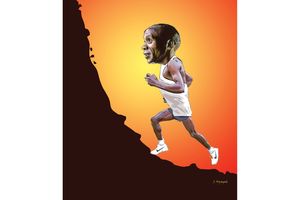
A caricature of Eliud Kipchoge.
Kipchoge, 40, who has broken the world record twice; first at the 2018 Berlin Marathon when he clocked 2:01:39, and at the 2022 Berlin Marathon in 2:01:09, was worth an estimated Sh500m in 2023 according to Forbes Magazine, while Tergat was worth Sh121m.
Athletics Kenya’s director of Youth and development, Barnaba Korir, said the appearance fee is a private matter between the athlete, his management and the race organisers.
“Unlike in the past, race organisers nowadays only make public the prize money and bonuses but not what athletes are paid to appear in races,” said Korir, adding that in most cases, race organisers only sign one-year contracts with elite athletes for appearance.