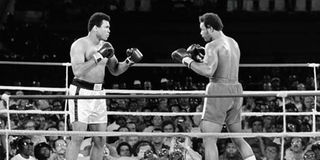
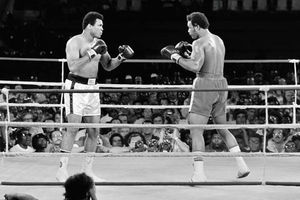
On October 30, 2025 the world marked the 51st anniversary of “Rumble in the Jungle”, one of the most talked about ring battles in the history of boxing pitting then world heavyweight boxing champion George Foreman, and his challenger, former champion Muhammad Ali. The venue was Kinshasa, Zaire (now the Democratic Republic of Congo).
The fight took place on October 30, 1974 at the 20th of May Stadium in Kinshasa, and it was the first time a world title was held in Africa, thanks to then Zairean President Mobutu Sese Seko who took personal initiative and resources to market his country and Africa in general, proving to the world that the continent had capacity to hold major events.
Kenya was among the countries honoured with invitations by the organisers of the big fight. The country was already well established in the world of boxing, having done quite well in Africa and internationally, including at the Commonwealth Games.
US heavyweight boxer Muhammad Ali drives around Kinshasa ahead of the 'Rumble in the Jungle' bout against George Foreman in 1974.
Photo credit: File | AFP
Between 1962 and 1974, Kenya showed progressive performance, particularly in boxing, at the Commonwealth Games. In 1962 Commonwealth Games held in Perth, Australia, Ali Juma won Kenya a silver medal in bantamweight category, while Philip Waruinge won a bronze in featherweight category. Kenya did better in the 1966 Commonwealth Games held in Kingston, Jamaica, where featherweight Philip Waruinge won a gold medal.
Bantamweight Nderu Mwaura, and lightweight Stephen Baraza, both from Kenya, won bronze medals. At the 1970 Commonwealth Games held in Edinburgh, Scotland, Kenya improved on her medals tally. Waruinge won gold medal, Samuel Mbugua and John Olulu took silver while Moses Mbogwa and David Attan won a bronze each.
The 1974 Commonwealth Games held in Christchurch, New Zealand witnessed a rare breed in boxing from Kenya. Two brothers – lightflyweight Stephen Muchoki and flyweight Michael Irungu, each won a gold medal for Kenya. Isaac Maina, lightweight Samuel Mbugua and Philip Mathenge took home bronze medals. Among those who were selected from Kenya to travel to Kinshasa to watch the 1974 fight was flyweight Stephen Muchoki, bantamweight Isaac Maina, and middleweight Peter Dula.
The three boxers had represented Kenya in the inaugural World Boxing Championships in Havana, Cuba from August 17 to 30, 1974, where Muchoki won silver in a controversial decision that favoured the home boy Jorge Hernandez. Four years later in Belgrade, Yugoslavia, where the Championships were held from May 6 to 20, 1978, Muchoki avenged his earlier defeat to become the first and only Kenyan and African to win a world boxing title as an amateur. This week, I asked Muchoki what he remembers about this memorable fight he witnessed from the ringside, 51 years ago.
“I felt greatly honoured to be among those invited to attend the fight. Despite being the underdog, I had rooted for Ali to beat the powerfully built Foreman. Ali neutralised Foreman’s power and by the eighth round, Foreman was so exhausted, he was knocked out in an amazing fashion as Ali circled him. Ali regained his title and the world was amazed,” Muchoki says.
I was working at Nyeri Central Garage in 1974, and I could read newspapers during my free time. I predicted that Ali would win the fight, and he did. In February 1980, I met Ali during his visit to Kenya, and again in September 1984 in Sudan.
Muhammad Ali and Waigwa Kiboi at Intercontinental Hotel, Kenya early February 1980 during Ali's tour of Africa. Ali was in Kenya for three days.
Between October 18 and 24, 2025, former undisputed world heavyweight boxing champion Mike Tyson completed what was described as a “deeply personal and public visit to Democratic Republic of Congo (DRC).” The boxing legend described his time in Kinshasa as “a life-changing experience.”
The visit had a dual purpose: to take part in the 51st anniversary celebrations of the historic “Rumble in the Jungle” fight, and to explore his personal ancestry.
Tyson’s trip included what was described in the social media as a high profile meeting with President Felix Tshisekedi. The former boxing champion shared a photograph from the meeting on his social media. The meeting underscores the significance of Tyson’s visit, which was supported by the Congolese government. It positioned the former champion not just as a celebrity, but as a respected figure welcomed at the highest level.
George Foreman arrives for the world premiere of "Big George Foreman: The Miraculous Story of the Once and Future Heavyweight Champion of the World," at Regal LA Live in Los Angeles, California, on April 26, 2023.
Photo credit: File | AFP
“My trip to Congo was a life-changing experience. The people there are beautiful and I look forward to returning, Very thankful to have met the president,” Tyson is quoted to have said. Background information suggests that Tyson’s visit was partly an emotional quest. The former champion has previously discussed his Congolese origins, claiming a strong percentage of his ancestry traces back to the Central African nation. For Tyson, the trip was a homecoming moment.
Tyson’s official reason for the visit was to participate in the anniversary of the “Rumble in the Jungle.” He held a press conference at the 20th of May Stadium in Kinshasa, now renamed “Ali- Foreman Stadium”, a gesture that linked the current boxing generation directly to the legacy of two giants of the sport.
American boxers (from left) Joe Frazier, George Foreman and Muhammad Ali, raise fists at the launch of the film Champions Forever in London on October 17, 1989.
Photo credit: File Picture
Had Ali and Foreman been alive today and in good health to travel, they would most likely have been invited as special guests to a venue renamed after them in appreciation of a mark they left behind 51 years ago. Tyson views himself as a spiritual successor of Ali. His presence in Kinshasa provided a physical connection to one of the most famous events in global sports history.
While DRC continues to enjoy world limelight through Rumble in the Jungle’s 51st anniversary celebrations where both Ali and Foreman were honoured posthumously through “Ali-Foreman Stadium”, Kenya has fallen down the pecking order as witnessed in the just concluded Africa Zone 3 Boxing Championships (AFBC) held in Kasarani weeks ago.
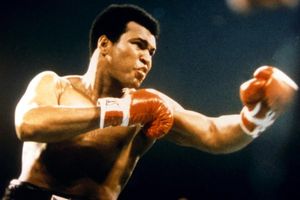
US boxing heavyweight champion Muhammad Ali during the 'Rumble in the Jungle' bout against George Foreman in Kinshasa on October 30, 1974.
The results of that boxing tournament where DRC had 12 gold and retained their title and Kenya was a distant second with 5 gold show clearly Kenya has a long way to go to recapture its lost glory. Out of the five gold medals Kenya won, 3 were by women.
They emulated their sisters who did wonders during the recent World Athletics Championships in Tokyo, where six out of the seven gold medals Kenya won were by women. Special salute to our women and congratulations to our teams who represent Kenya in various competitions.
What now remains is a post-mortem by relevant sports bodies to get to the bottom of the matter and get solutions - and on time. Kenyan boxing seems to be experiencing many problems going by the comments from those in the knowhow.