As the world mourns the death of George Foreman, a two-time world heavyweight boxing champion who passed on peacefully at a Houston hospital in Texas on March 25 while surrounded by close family members aged 76, I had a number of things to ponder given the status of the great boxer whose transformational life went beyond boxing.
The reaction of the American people told it all.
US President Donald Trump led the long list of those who condoled with the family. President Trump took to social media the next day to offer his condolences.
Trump is quoted as saying: “George Foreman is dead. What a great fighter!!! He had, without question, the heaviest and biggest punch in the history of boxing. With the exception of Muhammad Ali, when you got hit, you went down. He was something really Special, but above all, he was a Great Person, with a personality that was bigger than life. I knew him well and he will be missed. Warmest condolences to his wonderful family!!!”
A number of Kenyans shared the view that Foreman’s life went beyond boxing. Kenya Professional Boxing Commission (KPBC) Chairman Reuben Ndolo has diverse views on Foreman.
Says Ndolo: “As I look back at the history of George Foreman’s boxing career, I find a lot to learn from a man who went through so many challenges to become one of the greatest boxers. His punching power was awesome and that was why many thought Muhammad Ali was in real danger when the two met in the then Zaire (now DRC) where Rumble in the Jungle took place on October 30, 1974. This is where Foreman learnt for the first time, that speed can kill power which Ali displayed to punch and tire Foreman knocking him out in the eight round to recapture the world heavyweight title.
“Foreman’s setbacks after losing the title took him back to the drawing board that surprised the world when he recaptured the world title from Michael Moorer by knock-out on November 5, 1994 in Las Vegas, Nevada to become the oldest heavyweight to hold a world title at 45.”
Ndolo remembers that over the years, Kenya has produced some of the best boxers in the world who end up completely forgotten by the government they have supported over the years, flying the Kenyan flag high during regional, continental and international tournaments.
“I feel bitter and disgusted to see how the government has completely neglected its own heroes during the times of their need. When Philip Waruinge was being buried at Lare Location in Njoro Sub- County, Nakuru County on October 28, 2022, not a single government official from the Ministry of Sports, local administration or Nakuru County Government attended. This is the boxer who had won so many medals for Kenya over the years including a bronze medal during the 1968 Mexico Olympic Games where he was also awarded the Val Barker Trophy for The Most Outstanding Boxer at the 1968 Olympic Games. This was where George Foreman, aged 19, won a gold medal for the United States of America. As America and the world mourn and celebrate the life of Big George Foreman, here in Kenya, Philip Waruinge, with all his accomplishments, is forgotten in life and death,” Ndolo says.
Stephen Ongaro, a veteran sports journalist who passed away on Thursday, shared similar sentiments. Nicknamed ‘Don King’, perhaps the world’s best boxing promoter who was behind some of the most famous boxers like Muhammad Ali and Mike Tyson, Ongaro was seen as the main hope for boxers when it came to media coverage. He was so committed to boosting boxers’ morale through the many stories he wrote about them, they ended up calling him “Don King” as a show of respect.
Turning to the world of the late George Foreman, Ongaro remembers vividly when the world waited eagerly the much hyped ‘Rumble in the Jungle’ world heavyweight boxing fight between champion George Foreman and the challenger Muhammad Ali and being beamed via satellite from Kinshasa, Zaire ( DRC).
Says Ongaro: “The late Philip Ndoo who was my editor at the time assigned me to cover ‘Rumble in the Jungle’ from Kenyatta International Conference Centre (KICC) on October 30, 1974. I was very inspired to get such an opportunity, and felt as if I was at the ringside in Kinshasa. Having closely followed George Foreman’s boxing career and the way he demolished his opponents including former champions Joe Frazier and Ken Norton who had earlier defeated Muhammad Ali, I never expected Ali to win. I was wrong. However, I came to admire Foreman, as a boxer of few words who transformed himself from the many setbacks he encountered to become heavyweight boxing champion again at an unbelievable age 45 in 1994 after waiting for 20 years!”
Philip Mainge, an accomplished retired amateur boxer who trained closely with the late Philip Waruinge in 1960s and 1970s, has a lot of respect for George Foreman.
“Foreman was an excellent boxer who won a gold medal during the1968 Mexico Olympic Games where our own hero Waruinge, despite being denied a win by judges, settled for a bronze medal and was also awarded the Val Barker Trophy for being the most outstanding boxer of the Olympic Games. Foreman on the other hand carried amateurism styles into professional boxing and boxed extremely well. Mike Tyson on the other hand was driven by a lust for money destroying styles like those displayed by the late Muhammad Ali and Evander Holifield,” Mainge, 80, remembers.
Sammy Ng’ang’a, one of the best researchers on matters sports and boxing in particular, says the late George Foreman was one of the best and most outstanding heavyweights in boxing history. He belonged in the league of heavyweight greats, names like Archie Moore, Rocky Marciano, Floyyed Patterson, Muhammad Ali, Ken Norton, Joe Frazier, Jef Jeffries, Jack Johnson, Sonny Liston to mention but a few.
Says Ng’ang’a: “One of my best reads, just a month ago, was Foreman’s epic biography, BY GEORGE, published in 1995. In the book, Foreman paints a picture of a troubled childhood, delinquency, crime and an absent father. He was saved by the Job Corps, a scheme introduced by the 36th president of the United States of America, Lyndon B.Johnson to help young people aged 16 through 24 to improve the quality of their lives through vocational and academic training aimed at gainful employment and career pathways. The rest of his life is very well documented, his Olympic gold medal in the 1968 Olympic Games in Mexico when he only 19, his turning pro and climbing through the ranks to ultimately take the World heavyweight championship via a brutal destruction of the then Champion Joe Frazier within two rounds in 1973 in Kingston Jamaica..”
Ng’ang’a, as a heavyweight boxing fan, remembers some of the world renowned boxers like Ali, Patterson, Moore and Roy Jones Jr. had a chance to visit Kenya but not Big George. There are four epic events in Foreman’s life that Ng’ang’a says he will always remember. The first was the brutal manner in which he became World heavyweight Champion on 22nd January 1973, knocking down Joe Frazier six times in two rounds leading to fight stoppage.
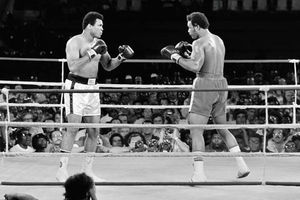
This file photo taken on October 30, 1974 shows the fight between US boxing heavyweight champions, Muhammad Ali (left) and George Foreman in Kinshasa.
Photo credit: File | AFP
The second event was Foreman losing the heavyweight championship to Muhammad Ali in Kinshasa, Zaire ( now the DRC) on October 30, 1974 via an eighth round knockout. The hype surrounding the Rumble in the Jungle was globally palpable. This was a fight Foreman was supposed to win easily. He was young, very strong, and fighting a 32.year old Ali. This fight was shown life to Kenyans through satellite link for a gate fee.The venue was at the KICC.
The third event is the well documented spiritual awakening he experienced in his dressing room after losing to Jimmy Young in 1977. He spoke of being in a hellish, frightening place of nothingness and despair and felt that he was in the midst of death. This experience completely turned Foreman’s life as he went to found a Church and evangelise as an ordained Minister. The fourth event was his endorsement of a Kitchen appliance, The George Foreman Lean Mean Fat- Reducing Grilling Machine. This association netted Foreman more money than he made in his lucrative boxing career.
Adds Ng’ang’a : “Like they honoured Muhammad Ali, with The Ali Center in his birthplace of Louisville, Kentucky, I hope the State of Texas will honour their famous son with such a facility in Marshall where Foreman was born.”