When it comes to football, few debates spark as much heat as refereeing decisions. Goals disallowed, penalties awarded, yellow and red cards—all these can alter the course of a match, leaving players, fans, and even politicians seething.
But nothing stings quite like a goal snatched away by a referee’s whistle.
“The laws of the game state that a referee's decision is final, so there is very little scope for appealing against a referee’s decision, and usually, you never appeal a referee’s decision based on the field of play or on the match itself. You only appeal a referee's decision when it is related to the referee’s sanctions. For instance, you could state that a tackle was given a red card for violent conduct, and in your opinion, it was just a reckless challenge,” says international sport lawyer Raphael Omalla.
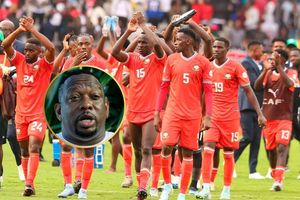
In his complaint, Sonko alleges bias and misconduct by the referees, claiming two legitimate goals for Kenya were wrongly disallowed, ultimately costing Harambee Stars a chance to advance to the semi-final. He now wants CAF to annul the results of the game, order a rematch or award the victory to Kenya.
The goal in question was scored by Ryan Ogam, and it could have doubled Kenya's lead against Madagascar, but it was disallowed for a foul in the build-up.
Harambee Stars' Ryan Ogam celebrates his goal against Morocco during their Chan Group 'A' match at Kasarani on August 10, 2025.
Photo credit: Sila Kiplagat | Nation Media Group
Gor Mahia's Ben Stanley was penalised for pushing a Madagasy defender before heading the ball to Ogam, who found the back of the net.
The other controversial decision happened in Kenya's goal area, where Lewis Bandi was penalised for handling the ball. The former AFC Leopards defender turned his back to block an attempted shot on goal, but the ball inadvertently touched his hands, leading to a penalty. But the penalty decision hasn't drawn much reaction as Ogam's disallowed goal, given that Bandi's hands were not in a natural position.
The game ended in a 1-1 draw in normal and extra time, and had to be settled in a post-match penalty shoot-out that the Barea won 4-3.
Why Mike Sonko's CHAN appeal may not hold water
But as fiery as Sonko’s claims are, he cannot appeal or prosecute any football matter on behalf of the Football Kenya Federation, which is the body mandated by CAF to handle the game in the country.
Chan statutes stipulate that only designated representatives from FKF, such as members of the National Executive Council, can initiate such proceedings.
“Sonko is not a member of CAF. He was not a participant [at Chan] and cannot file a complaint or claim to file a complaint on behalf of FKF. Ideally, it is the FKF that ought to be aggrieved since it involves a team that they fronted for the tournament,” Omalla says.
Additionally, match results from a final tournament, such as the ongoing Chan, cannot be appealed against, let alone being reversed.
Article 44 of Chan statutes states that: "...appeals cannot be against those stipulated as final." There are certainly exceptions to this, but not in the case of Friday’s match between Kenya and Madagascar. Article 9 of the Fifa Disciplinary Code establishes that the decisions taken by the referee may not be reviewed by judicial bodies, unless the issues in contention are among the cases listed in the Code itself.
While reviewing matches already played, CAF relies heavily on the referee’s report. If it is found that the match officials erred in the handling of the game, and the error was so significant as to have influenced the outcome of that match, then the match officials face individual penalties and responsibilities. They may be excluded from future assignments, they could lose their Fifa badge or be suspended indefinitely, as was the case with Zambia’s famed referee Janny Sikazwe in 2018.
But even if Sonko was to be allowed to lodge an appeal, protesting an arbitral decision is a matter that, both at the national and international levels, entails a significant degree of complexity, and unfortunately for clubs, players and supporters, most of the time it is unsuccessful.
“The best Kenya can do is to call for a disciplinary sanction against the referee if indeed it is proved that he was incompetent, but there have been greater instances where people complained and they didn’t go anywhere,” Omalla says.
Harambee Stars players react after losing 4-3 on penalties to Madagascar in the quarter finals of the 2024 African Nations Championship at Moi Internationals Sports Centre, Kasarani in Nairobi on August 22, 2025.
Photo credit: Sila Kiplagat | Nation Media Group
Among the instances where there was an obvious travesty is the famous “Hand of God” incident in the 1986 Fifa World Cup quarter-final match between Argentina and England. World superstar Diego Maradona appeared to head the ball home for Argentina’s first goal. However, television replays showed the great player had indeed used his hand to guide the ball into the net. He went on to score his second, considered the goal of the century, as Argentina won 2-1 to qualify for the semis on their way to winning the World Cup.
Article 9 of the Fifa Code says: ‘‘In cases where a decision by the referee involves an obvious error, the judicial bodies (such as the CAF Disciplinary Board) may only review the disciplinary consequences of that decision.” That is the challenge for teams – to prove the existence of an obvious error that allows the decision made by the referee on the field of play to be left without disciplinary effects.
In short, the chances of achieving a favourable decision when challenging a refereeing decision in the field of international sports competitions are practically a chimera.
As miserable as the loss on Friday was to Kenyans, Ogam’s goal cannot be reinstated, the results cannot be overturned, and the match cannot be replayed.
If Sonko has an issue, he should have compelled FKF to appeal.