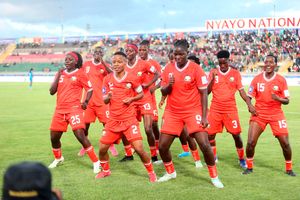
The 2026 Women’s Africa Cup of Nations (Wafcon) tournament will be held in Morocco from Sunday, July 26 2026, and will run till August 16.
The 16-team tournament will take place at four stadiums in Moroccan cities of Rabat and Casablanca. The four stadiums are Moulay El Hassan Stadium (Stade Prince Moulay El Hassan), Olympic Stadium (Stade Moulay Abdellah), Al Madina Stadium in Rabat, and Larbi Zaouli Stadium in Casablanca.
The tournament, which will run from July 26 to August 16, has grown from a four-team event in 1991 to the current 16-team affair.
Kenya will play in Group ‘A’ of the tournament along with Morocco, Algeria, and Senegal. Group ‘B’ has South Africa, Cote d’Ivoire, Burkina Faso, and Tanzania while Group ‘C’ has defending champions Nigeria, Zambia, Egypt and Malawi. Group ‘D’ has Ghana, Cameroon, Mali, and Cape Verde. The teams will fight for a total prize fund of $3,475,000 (Sh449.8 million).
Defending champions Nigeria have won nine titles, the most in the competition, having triumphed in 1991, 1995, 1998, 2000, 2002, 2004, 2006, 2010, 2014, 2016, 2018, and in 2025. Equatorial Guinea has won it twice - in 2008 and in 2012 - and South Africa have won it once - in 2022.
The inaugural 1991 edition had no designated host and was played on a home-and-away knock-out basis to determine Africa’s representative at the inaugural Fifa Women’s World Cup held from November 16 to 30, 1991 in China.
That year, Nigeria, Ghana, Cameroon, Guinea, Congo, Senegal, Zambia and Zimbabwe competed. But Congo, Senegal, Zambia and Zimbabwe withdrew before start of the tournament, leaving Nigeria, Ghana, Cameroon and Guinea to contest for the title. Nigeria beat Cameroon 6-0 on aggregate to become Africa’s first women's champions.
The second edition held in 1995 retained the same knock-out format. Again, Congo, Senegal and Zimbabwe pulled out, and Nigeria kept the title to qualify for another Fifa Women’s World Cup.
It was the final edition to be played as a home-and-away elimination tournament. In 1998, Caf introduced a hosted finals format.
Nigeria hosted eight teams divided into two groups of four. Nigeria qualified automatically as hosts, while the remaining seven places were decided through qualifying and play-off matches. The Super Falcons defeated Ghana 2-0 in the final to win a third straight.
Nigeria retained the trophy in South Africa in 2000, although the final remains one of the most controversial matches in African women's football history.
Nigeria were leading hosts Banyana Banyana 2-0 at Vosloorus Stadium in Boksburg, the Super Falcons were forced to wait as crowd trouble erupted in the 73rd minute. Home supporters threw bottles, stones and other objects onto the pitch, forcing a lengthy stoppage.
Despite appeals from tournament officials, the unrest continued for 20 minutes until riot police intervened. With the security situation deteriorating, the referee abandoned the match with 17 minutes remaining. Caf later upheld the 2-0 score line, handing Nigeria a fourth consecutive continental crown.
Nigeria's dominance continued in 2002 when they defeated Ghana 2-0 in the final on home soil to lift a fifth title, with both finalists qualifying for the Fifa Women's World Cup.
Two years later, South Africa hosted the championship, and Nigeria underlined their supremacy with a commanding 5-0 victory over Cameroon in the final to claim a sixth successive title.
Gabon, who had initially been awarded the 2006 tournament hosting rights, withdrew because of organizational challenges, prompting Caf to hand the hosting rights to Nigeria. The Super Falcons made full use of home advantage, edging Ghana 1-0 in the final to secure a seventh consecutive title.
The competition witnessed its biggest upset in 2008 when hosts Equatorial Guinea defeated South Africa 2-1 in the final to become the first nation other than Nigeria to lift the trophy.
Nigeria reclaimed the title in South Africa in 2010 after beating Equatorial Guinea 4-2 in the final, with both teams qualifying for the 2011 Fifa Women's World Cup.
Equatorial Guinea hosted the tournament again in 2012 and successfully defended home advantage, thrashing South Africa 4-0 in the final to win a second continental crown.
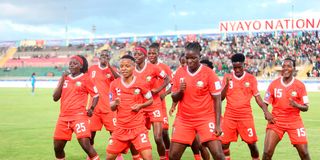
Harambee Starlets players pose for a team photo before their 2026 Women’s Africa Cup of Nations qualifiers first round, first leg match against Tunisia at Ulinzi Sports Complex, Nairobi on February 21, 2025. The return leg will be played on February 26, 2025 in Sousse, Tunisia.
Photo credit: Sila Kiplagat | Nation Media Group
Namibia welcomed the tournament for the first time in 2014. The hosts made their Wafcon debut, while defending champions Equatorial Guinea failed to qualify after falling in the qualifiers. Nigeria restored their dominance by defeating Cameroon 2-0 in the final.
In 2015, Caf rebranded the competition from the African Women’s Championship to Wafcon, aligning it with men’s Afcon. The first edition under the new name was staged in Cameroon in 2016 after being postponed because of weather conditions. Nigeria beat Cameroon 1-0 in the final to win another continental title.
Ghana hosted the 2018 tournament, and Nigeria retained the trophy after beating South Africa 4-3 on post-match penalties after a 0-0 draw in regular time.
The 2020 edition was set to introduce a 12-team format, but the Democratic Republic of Congo withdrew as hosts before the tournament was eventually cancelled due to Covid-19 pandemic. Instead, Caf launched CAF Women's Champions League in 2021, which was held in Egypt, and four-time FKF Women Premier League champions Vihiga Queens took part.
Morocco hosted the expanded 12-team tournament in 2022, ushering in a new era for the competition. South Africa defeated the hosts 2-1 in the final to win their maiden continental title.
Caf retained Morocco as hosts for the next edition, making the North African nation the first country to stage back-to-back Wafcon tournaments. Originally scheduled for 2024, the competition was postponed and was played in 2025.
Nigeria came from two goals down to beat hosts Morocco 3-2 in a dramatic final in Rabat, reclaiming the title after eliminating defending champions South Africa in the semi-finals
Now in its 16th edition, this year’s tournament was originally scheduled for March but was postponed to July and August 16, with Morocco being the first nation to host three successive editions.
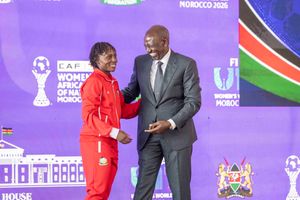
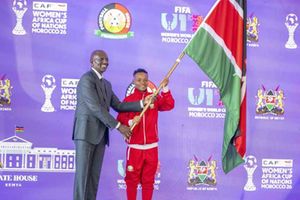
FKF President Hussein Mohammed (left), Junior Starlets coach Mildred Cheche, Harambee Starlets coach Beldine Odemba, President William Ruto, Harambee Starlets captain Mwanahalima Adam, Junior Starlets captain Beverline Awuor, and Cabinet Secretary for Youth Affairs, Creative Economy and Sports Salim Mvurya pose for a group photo at State House, Nairobi, on July 14, 2026, during the flag-off ceremony for the two national women’s teams.
Photo credit: Pool
Caf expanded the tournament from 12 to 16 teams after the qualification process, with Morocco qualifying automatically as hosts. Caf included Cameroon, Côte d'Ivoire, Egypt and Mali to complete the expanded field.
The tournament also serves as Africa’s qualifier tournament for Fifa Women’s World Cup, with four semi-finalists automatically qualifying and two additional teams advancing to Fifa Inter-Confederation Play-Offs.
Wafcon prize money has risen sharply in recent years, reflecting Caf's increased investment in the women's game across Africa.
This year, Caf increased the total prize pool by 45 percent from the 2022 figure to $3,475,000 (Sh449.8 million) as part of Caf’s Women’s Football Action Plan. Previously, the prize purse was either very low, or non-existent.
In 2018, the total prize fund stood at $975,000 (Sh125.8 m), with champions Nigeria earning about $300,000 (Sh38.7 m)
Four years later, Caf doubled the winners' prize money, increasing it by 100 per cent from $500,000 (Sh64.5 m) to $1 million (Sh129m), and the overall tournament prize fund also rose by 45 per cent to $3.475 m (Sh448.3 m).
Caf President Patrice Motsepe said the increased financial rewards underline the body's commitment to developing women’s football across the continent.
"The 100 per cent increase in the prize money for the winners and the 45 per cent rise in the total prize fund should contribute to improving the salaries of women footballers, coaches and other personnel involved in the game," said Motsepe.
He added that the quality of women's football in Africa continues to improve and has reached world-class standards, while expressing confidence that the tournament would attract more fans, television audiences and commercial partners than ever before.
Under the revised prize structure, the champions receive USD 1 million (Sh129 m), while the runners-up earn USD 500,000 (Sh64.5 m). The third-placed team takes home USD 350,000 (Sh45.2 m), and the fourth-placed side receives USD 300,000 (about Sh38.7 m).
Each of the four losing quarter-finalists is guaranteed USD 200,000 (Sh25.8 m), while the team finishing third in its group pockets USD 150,000 (Sh19.4 m). Each of the three teams that finish fourth in their groups receives USD 125,000 (Sh16.1 million).
The total prize fund for the tournament stands at USD 3.475 m (Sh448.3 m), making it the richest edition of Wafcon in the competition's history.