The death of former Harambee Stars and Gor Mahia midfielder Allan Thigo has reopened debate within the Luo community over funeral traditions, particularly with regard to cremation and the huge cost that comes with elaborate burial ceremonies, after it emerged that the football legend wished to be cremated within 72 hours of his death.
Before Mr Odinga’s burial, the country had only witnessed a similarly swift burial during the interment of former Inspector General Francis Ogolla, who was buried two days after he died in a military helicopter crash in 2024.
But while Mr Odinga’s burial revived discussions around quick burials, Thigo’s final wish has pushed the conversation further after his family disclosed that he wished that his remains be cremated, something not widely accepted within Luo culture. The late Thigo’s son, Allan Otieno, on May 11, 2026, said the family was already looking for a venue for the cremation in line with the late footballer’s wishes.
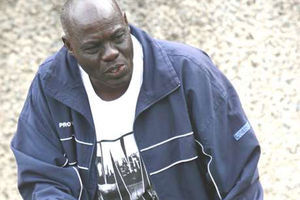
Allan Thigo as Gor Mahia coach in 2008. He led Gor Mahia to victory unbeaten in the 1976 league.
Photo credit: File | Nation Media Group
“My father stated clearly that he wanted to be cremated within 72 hours after his death,” Allan told Nation Sport on Monday. The revelation has stirred reaction among elders in the Luo community, many of whom are supportive of quick burials but remain opposed to cremation.
In an interview with Nation Sport , Luo Council of Elders Chairman Ker Odungi Randa said the community fully supports the idea of burying loved ones within 72 hours of death to ease the burden on grieving families.
“As a community, we support burial within 72 hours because funerals have become too expensive. Nowadays, bereaved families are forced to feed mourners for weeks while also paying huge mortuary bills. It has become a burden,” he said.
He said Mr Odinga’s burial had already demonstrated that the community was ready to rethink lengthy funeral ceremonies.
“Even when Raila Odinga died, we agreed with the 72-hour arrangement because people are suffering economically,” he added.
However, Ker Randa drew the line at cremation, insisting that the practice remains foreign to Luo customs.
“Cremation is not something we embrace in Luo culture. An exception can only be made if somebody has no ancestral home or place to be buried. But Allan had a home in Muhoroni,” he said. The elder recalled his long relationship with Thigo’s family, saying the former midfielder was among the players who elevated Kenyan football.
“We fought the first and second liberation struggles with his father, Ogango Ojwang,” he said. “I watched Allan grow up. I knew him when he was still playing at Onjiko High School. When he stepped onto the pitch, people called him ‘Thigo Wuon Pap.’ He was a disciplined and talented boy who helped raise Kenyan football to another level,” he added.
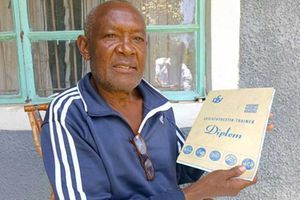
Allan Thigo as Gor Mahia coach in 2008. He led Gor Mahia to victory unbeaten in the 1976 league.
Photo credit: Chris Omollo | Nation Media Group
He said that although a will is legally recognised, the family would still have to decide whether to honour the cremation request.
“A will can be contested. That became a family matter. Even his first wife was buried in Muhoroni. So, the family now has to decide whether he will be buried at home or cremated,” he said.
For generations, funerals in the Luo community have been associated with elaborate ceremonies that can take weeks. Traditionally, however, burials were conducted promptly. When death occurred, family and neighbours gathered immediately to prepare for the burial, often within one or two days. Bodies were buried wrapped in animal skins, often without elaborate ceremonies.
Elders say the practice changed with the arrival of modern funeral homes and the growing social pressure to stage large funerals. Today, many frown upon the tendency to keep bodies in a morgue for long, arguing that the practice has become financially unsustainable.
“This culture of keeping bodies in morgues for weeks is not in our tradition. In the past, mourning was about comforting the bereaved, not entertaining crowds. Today, funerals have become social events,” Pilister Karewe, an elder, said.
“There is no dignity in burdening a grieving family with endless expenses,” she said.
Another elder, Jacob Agola, said quick burials should not be viewed as a sign of disrespect.
“People think burying someone quickly means you did not value them, but that is not true. Actually, it is wisdom because it reduces emotional and financial strain,” he said.
“Many people fear writing wills because they think death will come immediately. But a will helps families understand your wishes and prevents conflict,” he said.
The late Thigo played for Gor Mahia and Harambee Stars between 1970s and 1978. His ancestral home is in Muhoroni, Kisumu County. He established a second home in Bungoma and married a second wife, Doras Simiyu, after his first wife, Rose Auma, died.