“Like other previous host cities, you have the challenge of undertaking a complicated championship. Let’s not forget how complicated they are… It is by a distance the biggest of the world championships.
“You will host more than 2,000 world-class athletes competing in 46 different disciplines over nine days for the 2029 World Athletics Championships in Nairobi, and other than the operational integration, you will have the challenge of having a full stadium in every session, certainly in the evenings, the challenge around transportation, and the need to ensure that the games are safe and secure but in a city that doesn’t feel locked down to its visitors, and to ensure destination-led tourism.”
That was World Athletics President, Lord Sebastian Coe’s succinct message to Kenya minutes after arriving in Nairobi on Wednesday morning for a meeting with President William Ruto.
Seb Coe was flanked by World Athletics Chief Executive Officer John Ridgeon and Director of Communications James Mulligan, perhaps signaling the weight of the occasion.
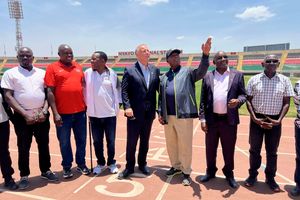
World Athletics President Sebastian Coe addresses the media at Eldoret International Airport in Uasin Gishu County on October 14, 2026. He is flanked by Athletics Kenya President Jack Tuwei second (second right), National Olympics Committee of Kenya Deputy President Barnaba Korir (right), 2029 World Championships Nairobi Bid Chairman Ibrahim Hussein (left) and Sports Kenya Director General Timothy Kilimo (centre, partially hidden).
Photo credit: Jared Nyataya | Nation Media Group
“You know when a gathering is serious… the big guns are in town, but we are in town for a really good and pleasurable reason because first of all, the decision we took (to award Nairobi the hosting rights of 2029 World Athletics Championships) when we were having the World Athletics Ultimate Championships (in Budapest) was a landmark decision. It was one that personally made me happy, but was also the right decision that the sport took,” Coe, who is a retired track and field athlete, set the tone for the meeting.
To him, the clincher for World Athletics Council when making the decision on September 15, 2026 to award Kenya the hosting rights for the 2029 World Athletics Championships ahead of Rome, London and Munich was an all-round and compelling bid backed by government guarantees.
“Any of the four cities would have been very worthy hosts, but Nairobi came through very strongly on a whole series of factors. Clearly, it is a compelling story that Kenya has contributed so much to the sport, that this is the first time that a championship of a senior level is coming to Kenya. This is the first time Africa is hosting a senior outdoor world championship, and we want that to be a bridgehead not just for Kenya, but for African athletics as well.
“Secondly, I think there was recognition that it was a very strong commercial commitment, and strong governmental set of commitments that have to stand behind a successful bid. The recognition that there are legacies here, both hard and soft, the rebuilding of your national athletics stadium (MISC Kasarani Stadium)….and more information was shared about the bid than ever before,” he said.
Nairobi also largely succeeded due to Kenya’s rich athletics heritage, and its experience in hosting major international athletics events, including the 2017 World Under-18 Athletics Championships, the 2020 World Under-20 Athletics Championships held in 2021, and the annual Kip Keino Classic.
Research by World Athletics has shown that Kenya is the most athletics-engaged market globally. Lord Coe expects an improvement on the 2023 Budapest and 2025 Tokyo championships.
“This is our flagship event, and it has to grow from strength to strength. The foundations and the basic commitments that we saw are in place and we just need to ensure that we all develop as one team,” he said.
“I’m here to sit down with the organisers and government because we want to deliver the best championship. That has to be our ambition. Budapest raised the bar, we continued in that vein on Tokyo last year, and next year in Beijing, we could have an outstanding championship.
“Like the athletes, we want to be better every year and, in every edition, and in every championship, so our collective ambition must be to deliver on that because the athletes are the most important asset we have. The better the event is delivered, the better the platform and the better the environment is for the athletes to perform, and the experience sits alongside that for the fans inside the stadium. A billion or so people will be watching the championship in 2029,” he observed.
The success of 2029 championship will be judged not only on its efficacy or otherwise to deliver a championship, but also on the underpinning economics of what it leaves behind.
“The more a city can demonstrate tourism spend, hotel occupancy, the contribution to the Gross Domestic Assets or Gross Domestic Product in a city is really critical. That gives you a better platform to bid for other sporting events,” Coe said. “Government is key to the delivery, because the Local Organising Committee and Athletics Kenya will rely on them for intelligence-led security, procuring of public transport, and seamless operational integration,” Coe emphasized.
Kenya will need to pull off a delicate logistical operation to transfer more than 2,000 elite athletes who are sure to be accompanied by their medical teams, close family members and spouses, coaches, and physiotherapists, from the airport to hotels, competition venues, and training venues on a daily basis.
World Athletics president Sebastian Coe attends a press conference on October 14, 2026 during his visit after Nairobi won the bid to host the 2029 World Athletics Championships.
Photo credit: Reuters
Championship officials, guests of World Athletics, retired athletics stars, spectators from around the world, and recreational runners will also converge on Nairobi to watch the extravaganza, requiring intricate planning to avert a logistical nightmare for the organisers. Kenya will also engage 2,500 volunteers to direct competitors, fans and guests during the championship.
In return, the championship is expected to generate for Kenya high impact economic, media and social value. Economically, the championship will stimulate local spend, drive inbound tourism, utilize sporting infrastructure, and act as a catalyst for legacy programmes. With regard to media, the championship will generate positive global profile for Kenya and boost event hosting reputation.
The social benefits include inspiring Kenya’s youthful population, encouragement of active lifestyles, celebration of local culture, as well as entertaining and engaging fans. It will also promote best standards in environmental sustainability.
World Athletics estimates that both the profile and scale of the World Athletics Championships make it well positioned to deliver a meaningful return on investment “as it brings together the world’s best track and field athletes to compete for their nations on the biggest stage of all.”
“Event organisers, athletes, officials, spectators and recreational runners all bring inbound spending power to stimulate the host city’s economy,” World Athletics says in the Bid Guide for 2029 and 2031 championships.
Based on figures from 2023 World Athletics Championships in Budapest, the total event impact of the 2029 World Athletics Championships on Kenya’s economy will be to the tune of $408.4 million (about Sh53.133 billion).
After meeting President Ruto at State Lodge in Eldoret, Lord Coe left the country on Wednesday with a clear commitment that Kenya will do everything possible to host a successful championship in 2029.
“Kenya has a long history and heritage in athletics; many of its athletes are also legends in the sport. I give my personal commitment and that of the Government of Kenya to deploy all resources possible to ensure that the World Athletics Championships 2029 in Nairobi will be a huge success,” President Ruto said.
The next step for Kenya is to constitute a Local Organising Committee tasked with overseeing the delivery of the championship, and get Moi International Sports Centre Kasarani Stadium and other training venues ready for the championship after co-hosting the 2027 Africa Cup of Nations. Kasarani Stadium which is undergoing renovation for 2027 Afcon will be the centerpiece of the championship, but it will need a new artificial running track.
“The main stadium for the World Athletics Championships should have a minimum capacity of 30,000 spectators and hold a Class 1 Athletics Facility Certificate. Hosts must provide a warm-up track and facilities (including a separate area for long throws) ideally within easy walking distance of the stadium and the warm-up track must be 400m with at least six lanes and the same surface product as the main stadium,” World Athletics Bid Guide says.
It is also expected that athletes from various countries will use 2027 Afcon training pitches during 2029 World Athletics Championships as training venues.
“Adequate training areas and facilities are to be provided at a reasonable distance from the team hotels to ensure training possibilities for all events at appropriate times. Hosts will also be responsible for providing a number of technical and functional areas and rooms at the competition venues. Further information will be provided at a later stage in the Event Guide,” the Bid Guide says.
To avoid crowding and stampede which could lead to loss of life, Kasarani Stadium badly needs a functioning mass transport system to get tens of thousands of fans from Nairobi’s Central Business District to the stadium for the championships and back to avoid crowding and stampede. Crowd handling should also be top-notch to facilitate movement of fans out of the stadium in a matter of minutes after the day’s competitions have ended.
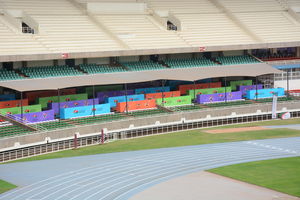
An aerial view of a section of the running track at Moi International Sports Centre, Kasarani in Nairobi.
Photo credit: Pool
Next, the Local Organising Committee will work experts to design world-class marathon course in Nairobi under the guidance of technical experts from World Athletics.
“The road courses must comply with the requirements of Rules 54 (Race Walking) and Rule 55 (Road Races) of the Technical Rules. These must be measured by a World Athletic/AIMS approved Grade “A” International Road Course Measurer to validate the courses used are as measured,” The Bid Guide says of the marathon course.
During his visit , Coe praised Kenya and Africa for making a big contribution to athletics globally.
“I congratulate the people of Kenya, and Athletics Kenya under the leadership of Jackson Tuwei who I know was steadfast in his belief that Kenya, at the right time and in the right environment and the right infrastructure, both hard and soft around it, will be given the opportunity to stage the championship. You made a valiant attempt in 2025, it didn’t work out but you went away and understood more about the challenge and brought back to World Athletics a very compelling bid which our council approved and supported.”
“My competition for many months and years in my career were actually Kenyan athletes, sometimes successful, sometimes not so successful. The contribution that Kenya and Africa have made to the sport was also a compelling part of the (Kenyan) bid, and why the council approved it,” he said.
“Kenya is making progress. One of the first things I did when I became president of World Athletics 11 years ago was to reform the sport. Sitting in the epicenter of those reforms was the creation of Athletics Integrity Unit (AIU). I know because I get frequent reports from (AIU chairman) David Howmann and (CEO) Brett Clothier, and our key practitioners in the field. I’m familiar with this journey because a few years ago, I persuaded the Kenyan government to dedicate higher levels of funding to this challenge. I think we have made good progress in some areas, but we still have work to do in others. Testing from the Athletics Integrity Unit is more intense, extensive, and is much more intelligence-based than it was under the old system… we will never be in a perfect world, but we are significantly further ahead than we were when we started in 2015,” Coe said.
Established by World Athletics on April 3, 2017, AIU works to protect the integrity of athletics through implementation and enforcement of anti-doping and integrity programmes in accordance with World Athletics Anti-Doping Rules and the World Athletics Integrity Code of Conduct.