It is 1987, the year pop culture, sports and politics dominated news.
In Kenya, the level of public awareness for the forthcoming 4th All Africa Games was building up, thanks in part to remarkable sporting achievements: the exploits of Gor Mahia in the preliminary stages of the Nelson Mandela Africa Cup Winners Cup football tournament, John Ngugi’s second victory at the World Cross Country Championships, Patrick Njiru’s finish in the Marlboro Safari Rally – the first by an African in eight years – and the Kenya boxing team’s domination in regional fights.
Businesspeople had tasted the benefits of major events only two years after Nairobi hosted the first United World Conference, with at least 20,000 delegates. Hotels were fully booked and many businesses – big and small – reaped big.
Kenyatta International Conference Centre (now Convention Centre) added to the hype by distinguishing itself as the ultimate meeting destination in Africa. Some families rented out their houses and took early vacations.
The difference between Afcon and Chan.
Photo credit: Nation Media Group
Unlike now, Nairobi only had a handful of five-star hotels and no Airbnb or posh furnished apartments.
Word spread that the All Africa Games, bringing delegations from 42 countries, would be bigger and more rewarding.
Economically, Kenyans had money in their pockets. Even University of Nairobi students could afford a drink at the Serena, New Stanley, 680 and Hilton hotels from their “boom” – students’ loan money.
The African Nations Championship trophy.
Photo credit: Pool
A bottle of beer was Sh9 and the price difference between five-star establishments and pubs elsewhere was in cents.
The dollar was exchanging at Sh16, the British pound at Sh20 and petrol was Sh8 a litre. Bus fare to the peri-urban areas of Thika, Limuru, Kikuyu and Ngong was Sh5 and Eastleigh Sh1.
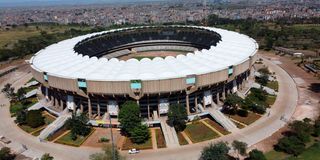
Kitengela and the area between Pangani to Thika was open vast land, apart from stops at Roysambu, Kenyatta University and Ruiru. But then, a modern sporting facility – Moi International Sports Complex, Kasarani – was to open up an entire region once it opened its doors that year on August 1.
In August 1987, Michael Jackson’s “Bad” album rocked the world of pop culture while Madonna was at her peak. In any case, the breakdance craze – which had been spread by the Breakin’ movie a few years earlier – had brought with it a new, bold self-awareness among young Kenyans.
Chains, sleeveless T-shirts, head scarfs and Air Jordan sneakers became the fashion statements of the day. Leg warmers complemented the new-look girl overnight who was now doing things in a modern way. Hair-Glo and other chemical treatment products were the must-have.
In Nairobi, coffee dates in mushrooming cafes or fried chicken, fish and chips were the favourite for those who could while Kenya Cinema, Nairobi Cinema and 20th Century Fox were the meeting points for the young and upwardly mobile.
“Hustlers” patronised Cameo on Kenyatta Avenue and Casino downtown. Asians preferred Globe and Odeon cinema halls.
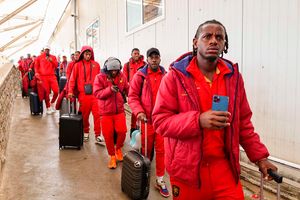
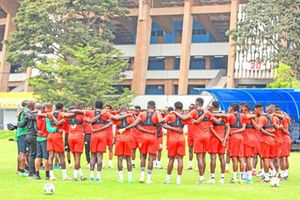
The Democratic Republic of Congo squad arrives in Kenya on July 31, 2025 for the 2024 African Nations Championship (Chan).
Photo credit: Sila Kiplagat| Nation Media Group
The biggest sports stories revolved around Gor Mahia and their superstar Peter Dawo were shining on the continental stage. A python named Omieri in Nyakach, Kisumu District, dominated news too.
In the corridors of justice, a case that started in late 1986 between the Umira Kager clan and Wambui Otieno over the burial site of her husband SM Otieno – a criminal lawyer – brought into focus the clash between the traditional African practices over English Common law.
Otieno’s clan wanted him buried in his ancestral village of Nyalgunga, Siaya District while the widow insisted on the site being their farm in Upper Matasia, Ngong. After a long legal battle, Justice Samuel Bosire ruled in favour of the clan in May 1987.
It was such big news that newspapers produced special editions and there were street celebrations in some parts of Nairobi and Nyanza.
For such a dramatic year, it was no wonder the prospects of hosting the All African Games stirred excitement, but not without scandal. Out of the blue, came a self-proclaimed American sports promoter, a smooth-talking marketing genius who promised heaven but delivered hot air.
He pledged to raise Sh200 million to fund the games, an idea the government welcomed as it was struggling to raise money for the same purpose.
Dick Berg took a whole floor at a five-star hotel, embarked on a media blitz and started receiving donations while making endless promises like bringing global music icons for the opening ceremony. To show his intent, Berg assembled and paraded Michael Jackson’s elder brother, Jermaine, who performed in what was billed as a pre-games mega concert.
His pockets well-lined, Berg disappeared. An investigation ordered to unearth the financial mess of hosting the games fizzled out and nobody was called to account for it.
The games were dogged by problems too. Kenya was to host them in 1982 but lack of facilities and economic hardships forced the Supreme Council for Sports in Africa to push the date forward.
Preparations at Moi International Sports Centre, Kasarani Stadium on August 1, 2025.
Photo credit: Sila Kiplagat| Nation Media Group
The Chinese government stepped in to build Moi International Sports Centre, Kasarani. For Kenyans, the games were all about football mania started by Gor Mahia in their the Nelson Mandela Africa Cup Winners’ Cup camplaign.
The Gor Mahia team of 1987 was like a fairytale. Gor dispatched Marine Club of Somalia 5-0 aggregate (2-0 in Mogadishu and 3-0 at the City Stadium in the first round).
This was followed by one of the largest football matches in Kenya in Kisumu when Nyayo National Stadium was closed for renovation. The match ended in a 0-0 draw against Al-Merrikh Sporting Club but Gor advanced to the third round on an away goal advantage following a 1-1 draw in Khartoum.
Gor reached the quarter-finals by beating Entente II of Togo by 4-1 aggregate (4-1 away and a barren draw at home). By now, the football mania was building up. The team reached the semi-finals after beating Association Sportive Dragons FC of Benin 2-3 in Nairobi after an away barren draw for the final showdown against Esperance of Tunisia at Kasarani Stadium on December 5.
The stadium was packed after President Daniel Moi arrived and ordered the gates open. As many as 80,000 spectators were said to have jam-packed the 55,000 seater stadium to witness Tobias Ocholla lift the trophy, the first and last Confederation of African Football to be won by a team from East Africa.
AFC Leopards were equally engaged in the Africa Club Championship campaign but failed to emulate Gor’s success despite winning the opening rounds match by beating Maji Maji FC of Tanzania 2-0 in the first round before being blasted 7-2 by Al Ahly of Egypt (6-0) in Nairobi and 2-1 at Bukhungu Stadium, Kakamega. Leopards Chairman Alfred Sambu was punished by CAF for attempting to bribe the referee.
AFC Leopards forward Clifton Miheso passes the ball during a past Football Kenya Federation Premier League match.
Photo credit: Chris Omollo | Nation Media Group
AFC Leopards forward Clifton Miheso passes the ball during a past Football Kenya Federation Premier League match.
Photo credit: Chris Omollo | Nation Media Group
On August 1, 1987, John Ngugi carried the games torch into the stadium and lit it after a 2,000-kilometre relay from Nairobi to the Kenyan Coast, the highlands and back to the capital.
Finally, the moment everybody had been waiting for arrived: the football match between Kenya and Tunisia.
It was a pulsating match, with the Kenyans under coach Reinhardt Fabisch giving a display of a free-flowing compact team that matched the North Africans in all departments. Kasarani finally erupted into song and dance when Ambrose “Golden Boy” Ayoyi – his white bandage signature hand stranding out – found the net in the 86th minute.
In just 48 hours, football and Harambee Stars became the talking point, which went a notch higher when the national team held Cameroon to a 3-3 draw at Nyayo National Stadium. The goals came from Ayoyi, Wilberforce “Teigo Maratona” Mulamba and Mickey Weche.
Kenya ended the group matches with a 2-1 victory over Madagascar, with Mulamba and George Nyangi Odembo scoring, and level with Cameroon on the table with five points but an inferior goals aggregate. Probably Kenya has never been a happier country than this day, August 10, 1987. The national team was shooting all the stars in the universe of football as Kenya beat Malawi 4-3 in post-match penalties after a 1-1 draw (Ayoyi and Charles Phiri) in regulation time.
At last, Kenya was in the final against Egypt, a rival who time and again beat Kenya in continental tournaments.
On August 11, the Kenya boxing team – the Hit Squad – won all the medals on offer, the hockey team qualified for the 1988 Seoul Olympics and the women’s volleyball squad had just demonstrated to the world that the future belonged to it by winning the silver medal.
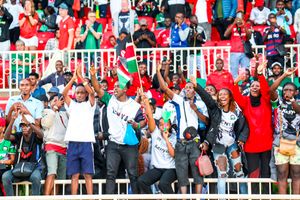
Kasarani was brimming with people by 10am on August 10. More than 50,000 were locked out, expecting President Moi to order the gates open. That was not possible.
Kenya was winning athletics medals with such a frequency that the crowd had become hoarse until Innocent Egbunike stirred them back to life in the 4x400 metres finals.
Kenya was leading when David Kitur took the baton on the final. They watched in disbelief as Egbunike started closing in, his curly kit treated hair sailing with the wind. He levelled on the final bend and started running away. This was the first sigh of despair.
That evening after 101 minutes of football, Kenyans, playing their hearts out, and the Egyptians using all their time tested skills, Mohamed Ramathan finally scored the winning goal in extra time. It broke the hearts of an entire nation. Kenyans walked out of Kasarani too hurt and fatigued to talk about that match.
Kasarani was filled to the brim on December 5 of the same year during the Gor vs Esperance match, in 1997 Kenya versus Nigeria match and the final day of the World Under 18 Athletics Championships in 2017. Will the African Nations Championship, abbreviated as CHAN, revive the spirit of 1987? Perhaps.