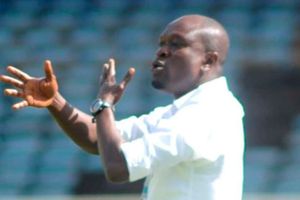
Charles Akonnor was nine years old when he witnessed his father’s death, a moment the Gor Mahia coach describes as “terrible and traumatising”.
His solemn tone carries the sadness of that moment to the present day, transmitting a raw glimpse of his grief and trauma, and his mother struggling to raise him and his four brothers and last-born sister.
“I should not have seen it,” Akonnor says of watching his family’s breadwinner succumbing to a long illness.
“I always had that scene in my mind and it made me act odd. I could not communicate very well but with time I got over it. My mother struggled to raise us but we managed,” he adds.
Charles Akonnor (left) is unveiled as Gor Mahia's new coach by the club chairman Ambrose Rachier after he signed a two-year contract in Nairobi on July 01, 2025.
Photo credit: Courtesy of Gor Mahia
Akonnor, 51, was born in Accra’s Nungua area but spent part of his early life in Tema, a port city in the Greater Accra Region, and Ningo-Prampram, a district in the same region where his father hailed from. However, it was football, discipline, and belief in God that made Akonnor leave Accra, and later Ghana.
He started playing football at school, an experience he described as “enjoyable at first”. Then, as time went by, seriousness invaded the delightful pastime and a rise to prominence followed.
After impressing at youth tournaments and inter-school games in Accra, Okwawu United, a team located 150 kilometres north of Ghana’s capital, considered the 16-year old midfielder classy enough to join their youth team in 1988.
“You know Tony Yeboah played for Okwawu United,” Akonnor says proudly.
Yeboah, a legendary Ghanaian footballer, spent only one season with Okwawu before joining the German club 1. FC Saarbrucken.
Akonnor followed an almost similar path but between him leaving Okwawu United and joining Fortuna Koln, another German club, in 1992, he had a two-year stopover at Obuasi Goldfields, located 230 kilometres north west of Accra. He spent six years at Fortuna Koln before transferring to VfL Wolfsburg and SpVgg Unterhaching.
He ended his playing career at SC Langenhagen, a little-known German club he joined after also playing for AC Horsens in Denmark and Alki Larnaca in Cyprus.
“I have always been serious with my job. I have always worked hard and followed the instructions of my coaches. If you are not serious, you will fall short,” says Akonnor.
He was serious enough to earn the captain’s armband at VfL Wolfsburg, and with Ghana teams at the 1993 Fifa Under-20 World Cup, the 1996 Atlanta Olympic Games, and at the 2000 African Cup of Nations.
He has taken that seriousness to his coaching career, a trait he says has made him unpopular with some people in African football.
“I can be a very challenging person to work with because I always tell the truth. That rubs people the wrong way at times,” he says.
Akonnor would have had little contact with African football had he pursued his interests in fashion design after hanging up his boots.
“I got into coaching by accident. I wanted to become a fashion designer,” he says.
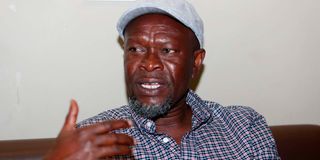
Gor Mahia head coach Charles Akonnor during an interview with the Daily Nation in Nairobi on November 5, 2025.
Photo credit: Chris Omollo | Nation Media Group
The ex-Ghana Black Stars captain started coaching after a friend sought his help to set up a football academy in Ghana.
“We were short on staff so I became the academy’s coach. Later, my friend told me, ‘you are actually a good coach.’ After that, I did my coaching badges,” says Akonnor.
Notably, he has coached fabled Asante Kotoko, Hearts of Oak, and Ghana’s national football team, the Black Stars.
“I have dedicated my coaching career to African football because I feel challenged to give back to society. I am a product of Ghanaian coaches,” Akonnor says.
He does have a German passport and a home in Germany, but believes that African football gives him better opportunities as a coach than European football.
“Had I stayed in Germany, would I have coached their top teams and their national team?” he poses.
Akonnor took a sabbatical from coaching after the Ghana Football Association terminated his contract as national coach in 2021 following a streak of poor results.
“I was hired during Covid (pandemic) and that made it difficult for me to prepare the team well,” Akonnor defends his record as Ghana coach, noting he could not rely on the country’s legion of foreign-based players due to health enforced travel restrictions.
“The Gor Mahia chance came at a time when I was keen to return to management. I looked up the club’s history in Kenyan and African football and it made me want to associate with it,” says Akonnor.
“I am familiar with the demands of the fans. I have met some of them and I am happy to be part of a big family and play my role in making the club great,” he adds.
Akonnor arrived at Gor Mahia with three compatriots as his assistants – assistant coach Bismark Kobi-Mensah, goalkeeper coach Ben Owu, and video analyst Joshua Kofi Boafo. Their entry was followed by that of two Ghanaian players, Ebenezer Adukwaw and George Amonno – acquisitions that prompted rival fans to nickname Gor Mahia “Ghana Embassy FC”.
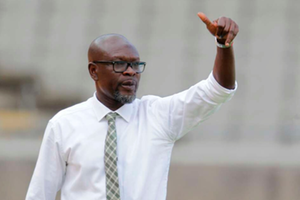
Gor Mahia coach Charles Akonnor gestures from the touchline during a SportPesa League match against Bidco United played at Moi International Sports Centre, Kasarani on September 21, 2025.
Photo credit: Chris Omollo | Nation Media Group
Akonnor laughs and responds: “Look around, even in Europe, everyone works with people they are very familiar with. I have known my technical staff for many years and we have built cohesion and trust that makes working together easy. For instance, I have known Ben Owu for over 30 years. We were teammates in Ghana U-20 when we reached the final of the 1993 Fifa U-20 World Cup.
“As a Ghanaian, I have better knowledge of players in the Ghanaian league than those in other leagues. However, that does not mean I cannot sign a player from Tanzania or Uganda if I find good talent there. Before the season started, I tried to sign a foreign player who impressed during 2024 Chan but unfortunately, his financial terms were too high,” Akonnor adds.
He describes himself as “a continuous learner”. “I like picking people’s brains,” he says before advancing that statement with regret at never having had an opportunity to interact with the late former Gor Mahia patron Raila Odinga, who died aged 80 on October 15.
“I wish I met him before he died,” Akonnor says. “I wanted to pick his brain on his life experiences, particularly how he handled encountering racism in Germany, something that really troubled my young self over there.”
Gor Mahia fans unfurl a giant portrait of club patron Raila Odinga during the SportPesa League match against Kenya Police FC at Nyayo National Stadium on November 9, 2025.
Photo credit: Chris Omollo | Nation Media Group
Akonnor belongs to the Ga-Dangbe community, who are known for their eccentric burials and mourning of their dead. Yet, Odinga’s mourning and burial ushered Akonnor into a new world.
“I have never seen mourning like that. There was an aura around it. Even in death, Odinga moved the whole nation,” he says.
The Ga-Dangbes, particularly those living in Accra’s Bukom area, are also known for their boxing prowess.
“Just like in boxing, you weaken your opponent with body shots to force them to expose their heads,” Akonnor says, while throwing jabs and uppercuts in the air for emphasis.
How is he finding the Kenyan cuisine, life in Nairobi, and learning Kiswahili?
“I am struggling with the food but I like fish and ugali. Nairobi is a fast-forward version of Accra. Everything here is Accra times two, especially the traffic. I like the weather though. It is pleasantly cool,” he says.
“It will take a bit of time to learn Kiswahili but I know the basic words like asante and sawa. My biggest focus has been on building team chemistry,” he says.
Akonnor was born on March 12, 1974.
As he awaits his first Mashemeji derby, Akannor laughs at the realisation of sharing a birthday with AFC Leopards and avoids saying much about them, only stating: “derbies bring life to everything”.
For someone who wanted to have a career in fashion design, it is fitting that Akonnor has carried sartorial elegance to his coaching career.
He describes his newspaper boy hat as a “long-time fashion accessory” and speaks of “always liking to dress well and look good.”
“But if you think I am a good dresser, wait until you see my son, Charles Junior. He is extreme.”
Akonnor has three football playing sons – Charles Junior, who has represented Germany at youth level, Jesaja and Brooklynn.
“Everything that has happened in my life, God had already orchestrated it. Including this interview,” he says.