Today marks 30 years since Harambee Stars defied the odds to eliminate Algeria from the qualifiers of the 1998 Fifa World Cup. Harambee Stars achieved this with a 3-2 aggregate win over the two preliminary qualifying round encounters.
Harambee Stars won 3-1 at Kasarani on June 2, 1996, with headed goals from Musa Otieno and Vincent Kwarula and a Henry Motego penalty. As such, Harambee Stars went into the deciding tie in Algiers with the hosts needing a 2-0 victory to progress on the away goals rule.
Algeria, having been to the Fifa World Cup in 1982 and 1986, and also having won the Africa Cup of Nations on home soil in 1990, was one of Africa’s best teams at the time.
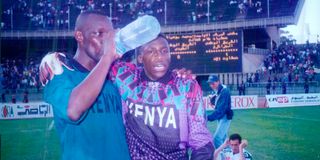
Algeria defender Tarek Lazizi lies crestfallen at the July 5 Stadium in Algiers on June 14, 1996 after Kenya eliminated Algeria 3-2 on aggregate in the 1998 Fifa World Cup qualifiers.
Photo credit: File | Nation Media Group
However, Harambee Stars, coached by the Montenegrin Vojoslav “Vojo” Gardasevic, staged a defiant performance highlighted by a masterclass in defending, and the Algerians could only afford a 1-0 win at the July 5 Stadium on June 14, 1996. The performance is considered the bravest showing by Harambee Stars in their entire history.
“Vojo told us to play behind the ball. All of us. Only Mike Okoth remained up front as the lone striker. People joked that we played a 9-0-1 formation,” Sammy 'Pamzo' Omollo, who captained Harambee Stars over the two ties recalls during a conversation with Nation Sport.
“It was a tough match and typical of the circumstances at the time when playing in North Africa, our hosts did everything to frustrate us. We were given bad food and no training pitch. Fortunately, we had a very good coach who prepared us mentally and physically. Also, most of us were in our prime and we had played together for so long. That really helped our cohesion,” Omollo says.
Matthews Ottamax, who was Harambee Stars’ goalkeeper on that day, left the pitch with a bloodied face after surviving what he referred to as “raid after raid by the Algerians.”
“They never stopped coming at us. They poured a lot of water in our goal area to make the place muddy and slippery but those tricks did not work,” Ottamax says.
Former Harambee Stars goalkeeper Mathews 'Ottamax' Owino gestures during the interview with the Daily Nation in Nairobi on May 23, 2025.
Photo credit: Francis Nderitu | Nation Media Group
The first half of that match ended 0-0, a result which Omollo attributed to “good defending”. The second half, however, had Harambee Stars almost crumbling under pressure, but they held on.
“We went down to 10 men almost immediately the second half started after Francis Oduor was sent off. Our physical fitness really helped us after that because the Algerians started throwing everything at us. They kept getting corner after corner and we were clearing them all. We held on until the 81st minute when they finally scored and at that moment we feared for the worst but we somehow managed to keep our cool even after losing Allan Odhiambo to a second red card late in the match,” Omollo says.
“They even got a penalty but it crashed against the crossbar,” Ottamax says with laughter.
So much was the pressure and tension during the match that Gardasevic lit a cigarette to calm his nerves.
“Smoking while on the technical bench was quite normal then and with how things were tough for us on the pitch, Gardasevic could not contain the tension building up inside him and he lit a cigarette,” Omollo says.
Omollo further recalled the match being “well-officiated” and Algerian fans conceding that they had lost fairly.
“The Algerian fans clapped for us after the finally whistle. Our performance had impressed them. Back then, it was unheard of for an East African to play that well away from home,” Omollo says.
“Other than Mike Okoth, the rest of us were local-based players. Algerians had players in Europe. So, we really our best in that match,” Omollo adds.
After the match, Harambee Stars were escorted to the airport by the Algerian police outriders, a practice which Omollo said was standard at the time.
“Contrary to popular belief, our security was not under any threat after that match. It was normal for teams to receive military or police escort to the airport,” Omollo says.
Omollo and his teammates were received to a heroes’ welcome when they landed at the Jomo Kenyatta International Airport.
“The federation had made good arrangements for our reception. There was a bus that took us round Nairobi before we were hosted to a lunch. Sam Nyamweya was the Kenya Football Federation at the time and he rewarded us handsomely. He gave each one of us Sh50,000. We do not know where he got the money,” Omollo says, ending the last statement with a laugh.
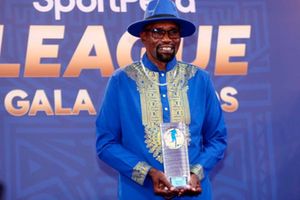
APS Bomet coach Sammy Omollo poses with the SportPesa League Coach of the Month trophy during the SportPesa League awards gala in Nairobi on June 4, 2026.
Photo credit: Chris Omollo | Nation Media Group
Yet, despite that heroic performance, that team was overhauled when Gardasevic was replaced as Harambee Stars coach by the German Reinhardt Fabisch, who was appointed after Peter Kenneth replaced Sam Nyamweya as KFF President.
Under Fabisch, Harambee Stars staged a brave qualifying campaign but finished third in their group with 10 points from three wins, one draw, and two losses.
Nigeria, which topped that group with 13 points, qualified for the 1998 Fifa World Cup. Guinea were second with 12 points. Burkina Faso finished last with 0 points.
However, subsequent Harambee Stars squads failed to build on that foundation. Since then, Algeria has been to three more Fifa World Cups, including this year’s tournament.
“We need to work on structures. We need to take youth football more seriously. The lack of continuity and transition in our national team has hurt us for years. The teams currently doing well in Africa have flourishing youth teams. Senegal are at the World Cup and recently won the Under-17 Afcon. They will not struggle to find a replacement for Sadio Mane because they have a proper youth system,” Omollo says.