The Chinese national football team rarely plays against African teams, yet they have built most of Africa’s stadiums. The Dragon Team, as the Chinese national football team is nicknamed, has played 740 matches in its history. Only 33 of those have been against African opposition.
They have not played an African team since drawing 1-1 with Tunisia on March 31, 2015, and last played on the continent on April 12, 1984, when they lost 1-0 to Kenya in Nairobi.
Overall, they have played 11 matches on the continent with the other matches coming against Botswana, Ethiopia, Guinea, Senegal, Somalia, Tanzania (two), Tunisia (two), and Zambia.
All the 33 matches between African teams and China have been friendly encounters, and there is no country that symbolizes China’s bond with the continent better than Tanzania.
China was one of the first countries to establish diplomatic ties with Tanganyika on December 9, 1961, the latter’s Independence Day. China was also one of the first countries to recognise the independence of Zanzibar, doing so on December 11, 1963, a day after their independence from British Rule.
When Tanganyika and Zanzibar merged to become the United Republic of Tanzania on April 26, 1964, that union was quickly followed by an extension of their diplomatic ties with China.
The nature of Tanzania’s early relations with the Asian nation contrasts with the current state of China’s foreign policy on the continent, as Peace and International Relations scholar Dr Nicodemus Minde explains.
“Before China’s involvement with African countries evolved to its current state, their relations with Tanzania was a friendship that was based on shared ideologies,” Minde, a Tanzanian, says.
China's stadium diplomacy
“Tanzania’s socialist policies under their first President Julius Nyerere aligned with the Chinese political thought at that time under the leadership of Mao Zedong,” he adds.
With Nyerere first seeking China’s assistance to train the Tanzanian army and erode it of British influence in August 1964, an eight-day state visit to Beijing by the Tanzanian leader in February 1965 was soon followed by China providing Tanzania with millions of pounds in loans and grants, and the Chinese investing in various development projects in Tanzania.
However, it was in 1966 that sports started to feature in this friendship between China and Tanzania and that association marked the advent of China’s stadium diplomacy in Africa.
Stadium diplomacy, or infrastructure diplomacy, as Minde defines it, is the advancement of foreign aid by one nation to another nation by way of constructing stadiums and sports facilities.
Before they started mixing the concrete and operating the earthmovers, China’s role in Africa in that regard started on the football pitch with a friendly match against Tanzania.
On June 28, 1966, Tanzania became the first African country to play a match against China in China and despite losing 10-4 to the Asians, they ended up gaining three stadiums constructed with the help of the Chinese in the four years that followed.
“The Chinese built the Mao Zedong Stadium in Pemba and the Amaan Stadium in Zanzibar. They later constructed the Tanzania National Stadium in the Temeke District of Dar es Salaam and are also currently building the Samia Suluhu Hassan Stadium in Arusha,” Minde says.
The Mao Zedong Stadium (opened in 1968), the Amaan Stadium (opened in 1970), and Uhuru Stadium in Dar es Salaam (opened in 1961 but upgraded with China’s assistance in 1969) count as the first stadium projects completed by the Chinese in Africa.
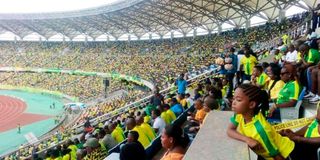
Yanga FC fans attend the team’s pre-season celebrations at the Benjamin Mkapa Stadium in Dar es Salaam in 2024.
Photo credit: File | Nation Media Group
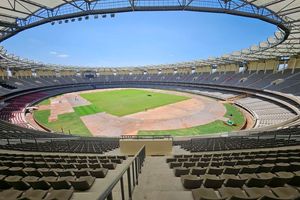
Interestingly, the Uhuru Stadium in Dar es Salaam is adjacent to the Tanzania National Stadium, which is also known as the Benjamin Mkapa Stadium. Benjamin Mkapa Stadium was opened in 2007, while Samia Suluhu Hassan Stadium is due for completion in 2027 ahead of hosting matches during 2027 Afcon. Tanzania will co-host Afcon 2027 with Kenya and Uganda. The three East Africans will also co-host 2024 Chan from August 2 to August 30.
Including Amaan Stadium and Benjamin Mkapa Stadium, two of the three other stadiums that will host matches during 2024 Chan were also constructed by the Chinese. The two other stadiums are Nairobi’s Moi International Sports Centre, Kasarani (opened in 1987), and the Mandela National Stadium in Kampala which was opened in 1997. The exception is Kenya’s Nyayo National Stadium (opened in 1983).
This photo taken in 1987 shows a nearly complete Moi International Sports Center, Kasarani.
Photo credit: File | Nation Media Group
The construction of those first three stadiums in Tanzania by the Chinese was followed by China playing two friendly matches against Tanzania in December 1971. The first match was played on December 9, 1971, when Tanganyika marked 10 years of independence. The match ended in a 1-1 draw but China won the replay played three days later 4-3. The two matches were the China’s first ever on African soil.
Despite Tanzania being very hospitable opponents on the pitch, China never played against them again. Still, that did not hinder China from increasing its presence in Africa in the years that followed. Since then, according to a March 2024 report by the South China Morning Post, China has built or funded the construction of more than 100 stadiums in Africa. The report further added that as of 2021, China had constructed at least two buildings in over 40 African countries within a 20-year period.
“African countries prefer having their infrastructure projects funded by China because Chinese loans do not have strings attached and the Asian nation does not monitor the democracy and human rights record of countries its partners with,” Dr Minde says on why African countries gravitate towards China.
Notably, China also constructed the Alassane Ouattara Stadium in Abidjan which hosted the final of Afcon 2023.
A screen showing Caf President Patrice Motsepe while he delivers a speech ahead of the 2024 Africa Cup of Nations Group ‘A’ match between Cote d’Ivoire and Guinea-Bissau at the Alassane Ouattara Olympic Stadium in Ebimpe, Abidjan, on January 13, 2024.
Photo credit: File | Nation Media Group
The Alassane Ouattara Stadium, the Benjamin Mkapa Stadium, Mandela National Stadium, Moi International Sports Centre, Kasarani, Nyayo National Stadium, and the Samia Suluhu Hassan Stadium exhibit the nexus between sports and politics in African football, where most stadiums, even those not built with Chinese money, are named after presidents or influential political figures.
“Tanzanian leaders always find a way to associate with football to boost their popularity. In Tanzania, football and politics are inseparable and that association precedes the country’s independence when Young Africans (a football team) was heavily involved in mobilizing support for Tanganyika African National Union (Tanu) to agitate for the end of colonial rule,” Minde says.
Minde’s comments were in response to the circumstances under which the Benjamin Mkapa Stadium came to exist. The Benjamin Mkapa Stadium, as one of many named after a nation’s president in Africa, is perhaps the only one that owes its existence to a leader’s amusing awe and shock at his citizen’s love for football.
On June 5, 2003, then Tanzanian President Benjamin Mkapa touched down at the Julius Nyerere International Airport and was shocked to find multitude of people gathered there. Thinking the crowd was there to welcome him, President Mkapa, as Tanzanian author Mwina Kaduguda narrates in Historia Ya Simba SC, asked his aides why such a crowd had gathered to receive him.
This November 14, 1994 photo shows the Nelson Mandela Stadium in Kampala under construction in Kampala.
Photo credit: File | Nation Media Group
“Sir, these people are not here for you. There are here to give Simba Sports Club a heroes’ welcome after they overcame Zamalek of Egypt in Cairo to qualify for the group stages of the CAF Champions League.”
That response shocked Mkapa and his awe was compounded when he was informed that the crowd of people stretched for five kilometres and had caused an eight-hour traffic jam in the area.
Upon hearing that, Mkapa vowed that to construct a world-class stadium for Tanzanians because he had been touched by their love for football.
To achieve that, Mkapa faced East and the Chinese did not disappoint him. The Chinese were approaching 40 years of stadium diplomacy in Africa and constructing the Benjamin Mkapa Stadium was a full circle moment that cost USD56 million (Sh3.92 billion at the time).
That circle of China’s stadium diplomacy will be drawn again when the Benjamin Mkapa Stadium hosts the opening match of Chan 2024 and the Moi International Sports Centre, Kasarani, lights up for the event’s final. It is a circle that will be reminiscent of the first and last match China played on African soil – against Tanzania and Kenya in 1971 and 1984 respectively. If anything, even if China will not play at Chan 2024, they will still show up.