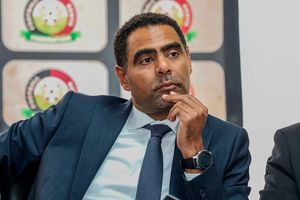
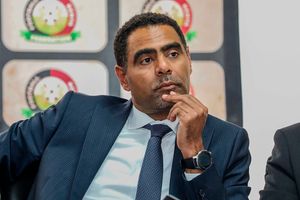
On December 15, 2025, Football Kenya Federation (FKF) National Referees Committee demoted Fifa referee Erick Njogu over poor officiating in the top flight FKF Premier League (FKF-PL).
Njogu was demoted to the second-tier National Super League (NSL), and will serve there for five rounds of matches.
This followed a negative review of his performance in the FKF Premier League matches between Kariobangi Sharks and Shabana, and the match between Nairobi United and Mathare United, which established that he made several key decisions that were “inconsistent with the standards expected at his level.”
Assistant referee Fredrick Kajongo was issued with a warning after it was established that he made an incorrect offside decision in FKF-PL match between Kenya Police and Mathare United.
Centre referee Brookes Onyango gestures during the Mozzart Cup semi-final match between AFC Leopards and Kenya Police at Police Sacco Stadium in Nairobi on May 27, 2024.
Photo credit: Chris Omollo | Nation Media Group
On February 10, 2026, FKF demoted to the NSL referees Susan Nyambura and Emmanuel Ochieng, and assistant referee Jane Cherono for five rounds of matches “after they were found to have made decisions that were deemed to be match influencing and below the expected standards at the top-tier level.”
Those cautioned were referee Kelvin Maina, Evans Kirimi and Lucy Juma.
“While their decisions did not directly affect the outcomes of their respective matches, instances of indecisiveness, lack of authority, and lapses in concentration were noted,” FKF said in warning to the trio.
While these decisions by FKF are meant to correct a recurring problem in Kenyan football, they point to a bigger problem that needs a total overhaul of the system.
Underneath lies the problem of delayed payment to referees, low remuneration, cases of match-fixing, and work conditions that make referees vulnerable to manipulation by teams.
As per FKF’s statutes, a center referee, assistant referees, one fourth official, and one match commissioner must be present before a Football Kenya Federation Premier League match can kick-off.
Whereas Football Kenya Federation pays all match officials who officiate in the FKF Premier League and the second-tier National Super League (NSL), teams playing in FKF Division One (third-tier league) and FKF Division Two (fourth-tier league) contribute match fees to cater for payment of match officials, making such officials vulnerable to manipulation by competing teams.
Before 2023, it was standard practice for both the home team and the away team in the NSL to contribute Sh10,500 towards payment of match officials. FKF took over that responsibility in 2023.
Even as FKF continues to sanction referees entangled in poor officiating in the FKF Premier League, the match officials insist that the solution to the problem lies in improved remuneration, and prompt payment of their dues.
Referees who spoke to Nation Sport also lamented the federation’s decision to publicly name the officials found to have made incorrect calls in matches, saying it further damages their reputation.
Since December 2025, FKF through its National Referees Committee, has demoted from FKF-PL to NSL five referees found to have made wrong decisions that directly affected the outcome of matches.
Six others have been warned after they showed “indecisiveness, lack of authority, and lapses in concentration”.
Centre referee Susan Nyambura (centre) with assistant referees Maxwell Ngei (left) and Fredrick Ochieng during a National Super League match between Kenya Police and Shabana FC at Camp Toyoyo ground in Nairobi on June 12, 2021.
Photo credit: Chris Omollo | Nation Media Group
The officials demoted are center referees Erick Njogu, Susan Nyambura and Emmanuel Ochieng, as well as assistant referees Jackson Opiayo and Jane Cherono. The center referees, issued with warnings are David Serem, Kelvin Maina, Evans Kirimi and Lucy Juma, while the assistant referees cautioned are Fredrick Kajongo and Gladys Kamurem.
The demoted referees will officiate in the NSL for five rounds of matches under the supervision of match commissioners and instructors, and their reinstatement to the top league will depend on the report of their performance in the second-tier league.
Match officials cautioned are also closely monitored by the match commissioners, and instructors for “improved decision making, game control, and application of the laws of the game”, FKF said on February 10, 2026 in a statement while suspending the match officials.
Low remuneration and delayed payments
“These measures form part of our ongoing referee development framework to ensure accountability, consistency and excellence in officiating,” the federation added.
Speaking to Nation Sport on condition of anonymity for fear of victimisation, a number of referees who officiate in the FKF-PL said that low remuneration and persistent delay in processing of their payment are the key contributors to poor standards of officiating in the league.
Since the exit of South-African owned pay TV channel SuperSport in 2017, referees in FKF-PL have had to endure long delays in payment by the federation. As a result, many of them are forced to take loans to take care of match-related expenses such as transport, meals and accommodation, a burden they admit undermines the performance, and consistency in officiating.
“Referees are always in debt because they borrow money to honour matches, and only settle the loans they owe when they are paid. They then borrow money again to honour the next round of league matches, and the cycle of borrowing continues,” one of the referees said, adding that those seriously affected are the referees whose only source of income is officiating.
Centre referee Dickens Mimisa attempts to separate Gor Mahia and AFC Leopards during a Football Kenya Federation Premier League match at Nyayo National Stadium on March 30, 2025.
Photo credit: Sila Kiplagat | Nation Media Group
“When one is not stable financially, it definitely affects their mental state and it will translate to his or her performance on the pitch because they cannot concentrate fully,” another referee noted.
FKF maintains around 64 match referees in its roster for the top league, and they officiate between two and three matches a month. Payment for their services comes many months late.
Currently, the best paid referees in the FKF Premier League are those based in Nairobi, but officiate in matches played in Mombasa. Such referees receive between Sh12,000 and Sh14,000 per match which is inclusive of allowances, but they still have to shoulder expenses such as transport, accommodation, airtime, and meals.
The rates vary depending on the distance they must travel to the match venues. Nairobi-based referees travelling to Kericho to officiate league matches get paid between Sh9,000 and Sh10,000. Nairobi-based referees who officiate matches played within the county get just above Sh7000 per match, while their counterparts who travel to Murang’a for matches are paid Sh8,000 per match.
A typical referee based in Nairobi who officiates two matches within the county earns slightly above Sh14,000, and that is before deducting expenses incurred such as transport and meals.
A full FKF-PL season featuring 18 teams has 34 rounds of matches. As of today, FKF has paid referees their dues until the 24th round of matches played last season (2024/2025 season). FKF is yet to their dues for 10 more rounds. In the current season (2025/2026), the federation has paid match officials their dues up to the 15th round of matches.
Before receiving the latest payment a fortnight ago, the referees had been paid last in mid-December. Due to persistent delays in payment, referees who spoke to Nation Sport said said those sent to officiate in far-flung places such as Mombasa prefer to travel to match venues on the eve of the match, arrive in the morning and officiate the matches before taking the night bus back to their homes to save on cost of putting up in a hotel.
"Because most of the referees travel on the night preceding the match, they don't get enough rest before officiating a match and this affects their performances because they are fatigued," lamented an assistant referee.
"Even taking a proper meal is a problem for the referees because they are saving on costs. With all these challenges, you definitely don't expect the level of officiating to be to the at the required standard," the assistant referee added.
The match officials said they are guaranteed to officiate two or three matches per month. Given the current "low match fees", they noted that the money they make is insufficient to sustain them over a long period of time.
Centre referee Brookes Onyango (right) with his assistants after stopping the Mozzart Cup semi-final match between AFC Leopards and Kenya Police at Police Sacco Stadium in Nairobi on May 27, 2024.
Photo credit: Chris Omollo | Nation Media Group
“A referee sent to officiate in Mombasa is guaranteed about Sh13,000. If you deduct all the expenses which include transport, accommodation and meals, you find that they are left with about Sh7,000. Can that sustain them and their families?" a match referee posed.
“A few referees are involved in match-fixing, but not all of them. It is only a small number. Some mistakes are simply human errors and not match fixing as many people allege,” a match official said.
The referees said that while they welcome the decision by FKF to sanction officials for poor officiating, the names of those punished should not be made public.
“The sanctions are good because they help us learn and keep us on our toes. They push referees to perform better, especially considering that teams invest heavily in preparing for matches and officiating mistakes can cost them dearly. What we feel is not right is the publicity that it is being given to the affected referees. It damages our image and self-esteem,” the match referee said.
Nairobi United and Gor Mahia players charge towards centre referee Brooke Philips during a Football Kenya Federation Premier League match at Dandora Stadium in Nairobi on December 21, 2025.
Photo credit: Chris Omollo | Nation Media Group
Retired Fifa referee, GMT Ottieno, says that referees found to have performed poorly in the FKF-PL should be retained in the NSL for at least one full season. The Kenya Referees Association chairman noted that it would give them sufficient time to correct their mistakes and improve their technique in officiating matches.
“They need to be retained in the lower league for at least one season, not just five matches. They should be given matches every fortnight, and be monitored by different match commissioners and assessors,” said Ottieno.
In any given match, the centre referee presides over action on the pitch, assisted by two assistants. The duties of the fourth official include managing player substitution, monitoring the conduct of team officials, assisting the referee in managing time, checking team lists and player equipment, and acting as backup referee in case the referee or assistant referee cannot continue with their work.
On the other hand, the match commissioner’s responsibilities include ensuring that the match is organized and conducted in line with the competition rules and regulations.