It’s understandable if the first mention of Shushufindi makes you think it’s a place in Kakamega or Vihiga counties. The name sounds Kenyan, but it is actually a place in north-eastern Ecuador. Ángelo Preciado, who is playing for Ecuador in 2026 Fifa World Cup, was born there in February 1998.
However, this year’s tournament features many people and places that have put Kenya on the map at the 23rd edition of football’s greatest showpiece.
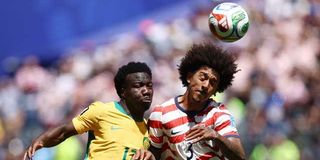
Kenya is one of 69 countries to have produced players for this year’s World Cup. Australia’s 30-year-old forward Awer Mabil, who also played for the Socceroos at the 2022 World Cup in Qatar, was born in the Kakuma refugee camp to South Sudanese parents.
Australia’s 30-year-old forward Awer Mabil.
Photo credit: Reuters
Mabil, who moved to Australia with his family at the age of 10, shares a similar story with his international teammate Nestory Irankunda. Irankunda, aged 20, was born to Burundian parents in a refugee camp in Kigoma, Tanzania, where his family had settled after fleeing a civil war in Burundi. His family moved to Australia when he was three months old, and he became the Socceroos’ youngest ever World Cup goalscorer when he netted the opener in Australia’s 2–0 win over Turkey on Sunday.
Canada's Cyle Larin (right) in action with Qatar's Assim Madibo in their Group B 2026 Fifa World Cup match at BC Place, Vancouver, Canada, on June 18, 2026.
Photo credit: Anne-Marie Sorvin | Reuters
Tete Yengi, the 25-year-old Socceroos teammate of Irankunda and Mabil, also has roots in Eastern Africa. Yengi was born in Adelaide, Australia, to a South Sudanese father and an English mother. He spent part of his childhood in South Sudan through his father Ben Yengi’s work as a refugee advocate.
Qatar has four players with eastern African roots: goalkeeper Meshaal Barsham, forward Almoez Ali and midfielder Assim Madibo, who were all born in Khartoum, Sudan; and forward Yusuf Abdurisag, who was born in Mogadishu, Somalia.
For Kenyans, Austria also evokes a sense of home through their left-back, Philipp Mwene. Born to a Kenyan father and Austrian mother in Vienna in January 1994, Mwene has played a key role in Austria’s journey to the World Cup. After featuring in Austria’s 3-1 win over Jordan on Wednesday morning, Mwene became the third footballer of Kenyan descent to play in the Fifa World Cup, following in the footsteps of Divock Origi and Martin Olsson.
He emulated Divock Origi, the Belgian-born son of former Harambee Stars striker Mike Origi, who played and scored for Belgium at the 2014 Fifa World Cup; and Martin Olsson, who played for Sweden at the 2018 Fifa World Cup after being born in Sweden in 1988 to a Kenyan father and Swedish mother.
These players are evidence of the strong influence that immigration, changes to Fifa regulations on transfer of nationality, colonial links and globalisation have on the selection of Fifa World Cup squads.
According to data compiled by Nation Sport, 295 players at this year’s World Cup were born outside the countries they are representing.
Debutants Curaçao have the most foreign-born players – 25. Only one player in their 26-strong squad, Tahith Chong, was born in Curaçao, which was once a Dutch colony. The rest were born in the Netherlands, whose squad exhibits the opposite. Guus Til, born in Samfya, Zambia, is the only foreign-born player in the Dutch squad.
Other countries with at least ten foreign-born players in their squads are the Democratic Republic of the Congo (20), Morocco (19), Bosnia and Herzegovina and Haiti (17 each), Algeria (16), Tunisia (15), Cape Verde and Qatar (14 each), Senegal (12), Croatia (11) and Turkey (10).
Only seven countries – Austria, Brazil, Colombia, the Czech Republic, Panama, Saudi Arabia, South Africa and Sweden – do not have any foreign-born players in their squads.
Of those seven countries, Panama is the most interesting case. Twenty-two of its players were born in the nation’s capital, Panama City. The remaining four players were born in cities located between 10 and 70 kilometres from Panama City: three in Colón and one in San Miguelito.
However, no city comes close to Paris, the capital of France, in terms of producing players for the 2026 Fifa World Cup. A record 99 of the 1,248 players at this year’s World Cup were born in France or its overseas territories. Of those, 54 were born in Paris. These players are in the World Cup squads of 11 teams, including France, which is a testament to Paris’ diverse culture.
In May last year, Simon Kuper, a British journalist born in Uganda, wrote in the Financial Times that Paris’ status as an international football talent hub was due to “the city’s growing suburbs, known as banlieues, filling with kids who had few entertainments besides football”, and to the French state funding “accredited coaches and artificial pitches in the banlieues”.
Consequently, it is unsurprising that Paris has produced more players for the 2026 Fifa World Cup than major European capitals such as Amsterdam (7), Berlin (2), Brussels (6), London (18), Madrid (3) and Rome (1) combined.
In Africa, Abidjan, the capital of Côte d’Ivoire, is often referred to as “the Paris of Africa” and is considered the continent’s football talent hub. Abidjan has produced ten members of the Elephants’ 2026 World Cup squad, outnumbering Cairo (seven), Dakar (six) and Accra (five).
Abuja, the capital of Africa’s most populous nation, Nigeria, has produced the only Nigerian-born footballer at the World Cup: Canadian forward Tani Oluwaseyi.
Canada forward Jonathan David (10) celebrates with forward Tani Oluwaseyi (12) after scoring a goal against Guatemala in the first half during a quarterfinal match of the 2025 Gold Cup at U.S. Bank Stadium.
Photo credit: Matt Krohn-Imagn | Reuters
Oluwaseyi is one of 16 players of Nigerian descent who will feature in this year’s World Cup, representing countries such as Austria, Canada, England, France, Germany, Norway, South Africa, Switzerland and the United States.
The fact that the other 15 players were all born outside Nigeria shows that, even though African countries rely on their European diaspora to strengthen their national teams, some players still manage to break through.