On the AstroTurf pitch on the rooftop of the Kibera Girls Soccer Academy (KGSA) in Nairobi’s Kibera settlement, young female footballers sit in the scorching Sunday afternoon sun.
Some are cradling their babies, while others are breastfeeding. This was just moments after the final whistle of a match in which they had just taken part.
The mothers had been sprinting across the pitch, competing with the same determination that earned them places in Kenya’s women’s football leagues.
Now, their biggest opponents are not defenders or goalkeepers, but poverty. They are also fighting to balance motherhood and football. The players are also contending with a football system that, they claim, offers little protection to players who become pregnant.
They had just taken part in ‘ Football Mums Tournament’ organised by Path to Russia, an NGO, in partnership with KGSA. The event offers hope for footballing mums from disadvantaged backgrounds, whose careers have been interrupted by pregnancy.
To them, the tournament is more than trophies as it offers them a chance to rebuild their careers, especially for those who were released by their clubs following childbirth and have since struggled to return to competitive football. Some of them play for Kibra-based Young Mothers FC.
Several active footballers became pregnant and later sought a platform where they could regain fitness. That is how Young Mother FC was born.
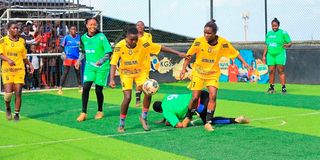
Goalkeeper Nancy Njeri of Young Mothers FC in action during Football Mums Tournament in Kibera, Nairobi on May 23, 2026.
Photo credit: Pool
Goalkeeper Nancy Njeri, 24, plays for AFC Leopardess in the FKF Women’s National Super League and as well as Young Mothers FC.
Njeri says balancing motherhood and football is tough challenge to female players, especially those from disadvantaged families.
“Football is still my passion. Becoming a mother changed many things, but I still believe I can play at the highest level again,” she said after the tournament.
AFC Leopardess, the sister club of Kenyan Premier League side AFC Leopards, finished sixth in the FKF Women National Super League Zone A standings with 29 points — 29 behind the champions, Mathare United Women, who consequently secured promotion to the FKF Women Premier League.
The Leopardesses won nine matches, drew five and lost seven during the campaign, then conceded a walkover to MTG United in their final fixture after failing to travel to the Coast.
“This team was formed after we stopped playing football because of pregnancies. We came together, formed a team and named it Young Mothers FC. Most of the players feature in the National Super League, Division One, Regional League and County League.”
Surviving on football alone
“Playing in this tournament is a great opportunity. Getting pregnant doesn’t mean you give up on football. You can still come back and play,” she added.
Njeri took a year out of football after giving birth. Later, she resumed training, buy relying heavily on her mother to care for her child.
“I am a single mother and I support my child on my own. I used to leave my child with my mother, go to training, and then come back. Life in the slums is challenging, but I kept pushing,” she said.
“Some people think that once you have a child, you should stop playing football. They think you’re too tired. But if you allow yourself to be discouraged, you’ll never grow. I don’t dream of playing for the national team. My dream is to play professional football in Europe.”
Outside of football, Njeri earns a living through casual catering jobs, which she does with her mother.
Twenty-three-year-old Joyce Maina, a defender with Sunderland Women FC in the Division One League, says surviving on football alone is almost impossible.
Players in action during the Football Mums Tournament organised by Path to Russia at Kibra Stadium in Nairobi on May 23, 2026.
Photo credit: Pool
“At my club, we get paid Sh2,000 for a win, Sh1,500 for a draw, and nothing if we lose. There is no salary. We only depend on allowances,” she said.
“The most I have ever earned in a month is Sh4,000. I only play football; I don’t have another job. I live alone. My rent is Sh4,000. Sometimes I save Sh500 when I can. Some times, fans give us small donations after matches.”
When asked how players survive during poor runs of results, Maina laughed and said; “We can’t go a whole month without winning or drawing. But if it happens, we ask the coach to give us an advance.”
Raibella Nyanje is now back in training. She has a three-month-old baby. She says pregnancy interrupted what she believed was a promising career.
“I was at Sunderland for three years, but after I got pregnant, I left the club. I’m now back training but I can’t return to Sunderland yet as I haven’t trained enough. I’m not physically fit,” she said.
She believes the sport still does not provide adequate protection for female players. “Having a child was a setback for me. I am very passionate about football; that’s why I came back early.”
She wants the Football Kenya Federation (FKF) to introduce policies to compel clubs to support pregnant players instead of abandoning them.
“The FKF should introduce a policy to protect female footballers when they become pregnant. They should follow up with clubs and ensure they accept them back, because they have lives outside of football too,” said Nyanje.
“Some get pregnant, the fathers leave, and they have to raise the children alone while trying to continue playing.”
Founded by an IT specialist Eric Baker under the Path to Russia initiative, the programme is designed to ensure young mothers remain part of the footballing community to ensure they are not forgotten after they have children.
Beyond their footballing careers
“This is the fourth edition. The goal is to include young mothers in day-to-day activities. We thought it best to have an initiative that recognises their contribution to society,” said Baker.
Previously held in Embu and Murang’a, the initiative has now found a permanent home at KGSA.
”Kibra is a safe place. It’s not as bad as many people think. We are not only doing this in Kibra; we plan to move across the country.”
After the inaugural tournament, Path to Russia secured a partnership with Sky World, an online educational organisation based in Western Europe.
As part of this partnership, a computer laboratory equipped with state-of-the-art computers was set up at KGSA, where young people are now learning to code and developing their digital skills.
Baker says the objective is to equip players with the skills they need to find employment after leaving school and beyond their footballing careers.
The challenges described by the players contrast with the protections contained in Fifa regulations.
In Kenya, for example, where many women’s clubs operate without player contracts or regular salaries, football mums say these regulations are largely out of their reach, making it hard for them to keep their careers alive.
According to the 2017 FIFPro Global Employment Report, nearly half of female footballers said they had considered retiring early to start families due to a lack of childcare support. This prompted FIFPro to lobby Fifa for global maternity protections.
Since January 1, 2021, Fifa regulations have prohibited clubs from terminating contracts after players get pregnant. The rules guarantee a minimum of 14 weeks’ paid maternity leave, with players entitled to at least two-thirds of their salary during that period.
Players are also expected to retain the right to remain registered with their clubs, and they must be re-registered upon returning from maternity leave, even if the registration window has closed.
However, the new Fifa protections primarily benefit footballers with formal contracts, especially in developed countries.