In Seattle, USA
Money in global sports is often described as the oil that keeps the machine turning.
In Kenyan football, however, it has long acted more like petrol tossed onto an open flame. Had Gianni Infantino, the Fifa president, had his way, the financial tap running from Zurich to Nairobi would open into a torrent.
The Football Kenya Federation (FKF) would have entered the 2027 to 2030 cycle holding $20 million (about Sh2.6 billion), in place of the $8 million (about Sh1 billion) it holds today. The projections ran further still, out past the working life of most people currently in the game. The $22 million for 2031 to 2034, $24 million for 2035 to 2038.
Unfortunately, the structural changes that would have unlocked that money were not approved. And so the figure stayed where it was, a door that closed without anyone in Nairobi hearing the latch. To an outsider, the proposed millions of dollars resembled a tide of capital capable of carving out modern academies, refurbishing neglected pitches and rescuing a generation of raw talent from the margins. A vision of abundance and a future in which Kenyan football is finally nourished by resources.
Yet, abundance in this country has never been a simple blessing. Anyone familiar with the corridors of football governance knows that such promises often evoke a familiar sense of dread. FKF’s history is marked by infighting, government interference and long stretches of suspended funding. The question is not whether Kenya could use Sh2.6 billion. It is whether Kenya could handle it. Even now, simply retaining the baseline $8 million requires the federation to navigate a gauntlet of global compliance rules. Governance, financial transparency and structural reform are not optional.
After years of frozen disbursements, Fifa’s Governance, Audit and Compliance Committee reinstated Kenya’s funding only under probationary terms. Money would flow again, but only if the federation demonstrated discipline, accountability and a willingness to break from its turbulent past.
Yet, even under probation, the domestic game remains paralysed by factional combat. The battle to control the federation has rarely been about tactical philosophies or grassroots development. It has almost always been about who holds the keys to the vault. Zurich’s generosity has consistently served as the prize in an endless political war of attrition.
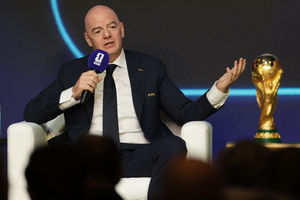
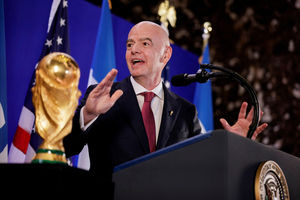
Fifa President Gianni Infantino is welcomed by Football Kenya Federation boss Hussein Mohammed upon his arrival in Nairobi on August 29, 2025 for the 2024 African Nations Championships final.
Photo credit: Pool
FKF has been a battleground for competing interests, each convinced it holds the rightful claim to the pipeline. Elections have been contested with the intensity of national politics. Administrations have collapsed under the weight of scandal. Cabinet ministers have intervened, sometimes out of frustration, sometimes out of ambition. The result is a federation that often appears more consumed by internal rivalry than by the development of the game itself.
Which brings us to the uncomfortable question now looming over local football. If a pot of Sh1 billion is enough to incite constant mutiny, what happens when that pot triples? What happens when the stakes rise to $20 million? In a country where football is both a passion and a political tool, such a windfall could either transform the sport or tear the institution apart, and the two outcomes are not as far apart as they sound.
A larger pot invites larger battles. The perennial infighting that has defined FKF could intensify. The temptation to treat football money as political capital could grow heavier. The pressure on administrators, already immense, could become unbearable. And the risk of mismanagement, always lurking at the edge of the accounts, could return with a fresh appetite.
Increasing the flow of money without fixing the vessel does not cure a drought if the vessel is cracked. It simply washes away the foundation. Pouring tens of millions of dollars into an unstable administrative apparatus risks supercharging the very greed that crippled Kenyan football in the first place.
High financial stakes invariably raise the intensity of political combat. Instead of inspiring long‑term planning, a larger treasury may only attract more opportunistic suitors, turning the federation’s headquarters into a fortress of competing ambitions while the pitches across the country remain dusty and neglected.
Fifa’s ambition to equalise global football through massive capital expenditure is noble on paper. But capital without institutional integrity is merely temptation masquerading as progress. If Kenyan football is ever to realise its potential, the focus cannot rest solely on the size of the cheque arriving from Switzerland.
True reform requires building an environment capable of holding the weight of those billions. Until the custodians of the game in Nairobi prove they can nurture the seed rather than fight over the harvest, more money will not build a golden era. It will only deepen the shadow hanging over the pitch.
Fifa president Gianni Infantino (right) President William Ruto, Caf president Patrice Motsepe during the African Nation Championship final at Moi International Sports Centre, Kasarani on August 30, 2025.
Photo credit: Chris Omollo | Nation Media Group
The task in Nairobi is to build the sort of federation for which a larger cheque would be safe. A house with a roof, and walls, and a floor that will not buckle. Build the house. The rain is coming either way. What Kenya has lacked is evidence that money sent across continents can land on solid ground rather than vanish into the fog.
And so the story turns from the blueprint of a federation to the physical things that arrived when Zurich opened its wallet. There are two objects that explain 15 years of football development money in Kenya. One is a carpet of synthetic green fibre, laid at City Stadium in Nairobi and Moi Stadium in Kisumu in 2010, still underfoot, still hosting matches.
The other is an outside broadcast van, allegedly bought for Sh180 million, which became less a piece of equipment than a question. Both were financed by Zurich. Only one of them can be photographed doing its job. The turf arrived under an older regime of giving. Sam Nyamweya, president of FKF from 2011 to 2016, presided over the closing years of Fifa’s Financial Assistance Programme and its Goal Programme, the instruments that preceded Fifa Forward.
“Kenya has benefitted from major projects during Blatter’s tenure,” Nyamweya said at the time, naming the Goal Project and the artificial turf in Nairobi and Kisumu, and promising to push the work outward, to Mombasa, to Nakuru, to counties with no facilities at all. His administration drew steady criticism over governance and financial management. In 2016, he did not stand again.
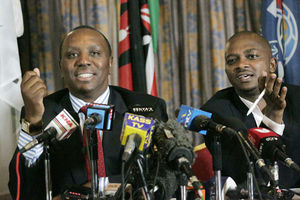
Former Football Kenya Federation President Nick Mwendwa.
Photo credit: Sila Kiplagat | Nation Media Group
Nick Mwendwa succeeded him on a platform of reform, transparency and commercial growth, and became the first Kenyan administrator to draw fully on Fifa Forward, the programme assembled in 2016 out of the wreckage of the 2015 corruption scandal. Under him, Kenya funded youth football, women’s football and administrative capacity. Under him, too, came the van.
The vehicle was meant to let the federation televise its own competitions and keep the revenue. Instead, its procurement, delivery and working status became a matter of public argument. No court has established criminal liability in the matter. Mwendwa’s account is specific.
“Before the payment, Fifa came to Nairobi, inspected the van, Okayed the project and made the payment,” he said, adding that the federation “did everything overboard with total transparency” and is now a creditor, with the seller, WTS Group, having gone into administration.
The two projects are not opposites so much as a lesson in what is easy to verify and what is not. A pitch either exists or it does not, and anybody may walk onto it. A procurement is a chain of documents, and a chain can be tested only by people willing to read it.
Fifa takes no public money. Its income comes from the commercial machinery around its tournaments: broadcasting rights, sponsorship, hospitality, ticketing, licensing, and above all, the World Cup, which generates billions every four years before being redistributed among 211 member associations. Recently approved projections put revenues at roughly $14 billion for the 2027 to 2030 cycle, the largest in the organisation’s history.
Africa is the biggest bloc inside that deal, 54 associations strong.
Since 2016, Fifa expects to approach $1.28 billion by the end of 2026. African federations have qualified for well over $600 million across the first three cycles, before anything routed separately through the Confederation of African Football. Forward 3.0 alone it has invested more than $1 billion on the continent through Forward, a figure it distributed about $2.25 billion worldwide between 2023 and 2026.
“It is our responsibility to give hope and dreams to the children of Africa through football,” Infantino said, naming the continent’s two assets as the talent of its players and the passion of its people.
In Mauritania, the money rebuilt Cheikha Boidya Stadium and added three artificial pitches, a youth academy, a medical centre and a federation headquarters in Nouakchott. In Liberia, it built a headquarters and refurbished Antoinette Tubman Stadium.
Fifa President Gianni Infantino (seated, second left) with Sports Cabinet Secretary Salim Mvurya and FKF president Hussein Mohammed during a tour of the Talanta Stadium in Nairobi August 30, 2025.
Photo credit: Chris Omollo | Nation Media Group
Forward is the detail most often lost beneath the totals. It replaced the older programmes because the older programmes were loose. Associations must hold recognised membership, produce audited accounts, submit projects with budgets and procurement plans, report periodically, and account for what they have already spent before the next tranche moves.
For Kenya, 16 years on, the turf in Nairobi and Kisumu remain the most legible thing the Fifa millions have made. Ahead lies something more ambitious. A technical development centre at Machakos, on 20 acres provided by the county government, has been projected to cost about $4.5 million (Sh600 million).
The plans list two artificial pitches and one of grass, accommodation, classrooms, offices, medical facilities and training rooms for coaches and referees. If built, it becomes the permanent home of the youth national teams.
The distinction that matters is between a facility a boy can walk onto and a file only an auditor will ever open. Kenya has produced both. The next figure, whatever its size, will be judged by which of the two it leaves behind.