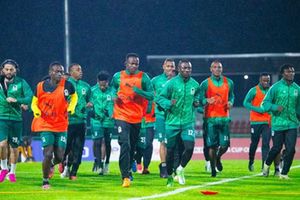
After 28 matches at the 2025 Africa Cup of Nations, former Harambee Stars coach Francis Kimanzi observes that the identity of African play is thriving in Morocco.
Kimanzi, the Football Kenya Federation Technical Development Officer, told Nation Sports on Wednesday that physicality and vibrant wing play are among the key aspects of play that have stood out for him thus far.
“Even with the use of VAR, hard tackles are going unpunished. I have seen challenges which would be punished with a yellow card or a red card in top European leagues but since physicality is an identity of African football, there seems to be an unconscious effort by referees to overlook tough tackles,” Kimanzi said.
Still, he expects changes in that regard during the knock-out stages, when the stakes will be higher.
“I think the referees will be keen to punish hard tackles in the knock-out stages,” said Kimanzi.
“Africa is known for producing a lot of good wingers. The most dangerous players at this tournament have been wingers, either those playing in attack or as overlapping defenders. Afcon 2025 has maintained the consistent quality of vibrant wing play by African teams. This has forced teams to defend wide,” the former Mathare United, Sofapaka, Tusker, and Wazito coach opined.
“The tactical level has improved. Teams, particularly Mali and Morocco, are playing with very high intensity. The improvement in tactical awareness has also been shown in teams playing better after going a man down due to a red card. South Africa struggled to break down Egypt and eventually lost 1-0 despite their numerical advantage,” Kimanzi noted.
Afcon 2025 has witnessed four send-offs – suffered by Egypt, Equatorial Guinea, Mali, and Sudan.
Regarding set-pieces, Kimanzi said teams have built team cohesion in a very short time.
“I am seeing set-piece routines which you can only witness in club football, where players have enough time to practice such drills. South Africa has particularly impressed me on that,” Kimanzi said.
Teams competing at Afcon 2025 had seven days to prepare for the tournament but Kimanzi reckons the scheduling of the competition in December and January, instead of the traditional January and February, meant they arrived “fresher” because “players have not played many games for their clubs.”
“Teams from the Cecafa region – Sudan, Tanzania, and Uganda – have struggled. Kimanzi attributes this to the region having fewer players based in Europe and less competitive domestic leagues.
“So far, it is only Sudan who have won a match. We are struggling to cope with the intensity. We need to ensure that our leagues are more competitive and establish scouting networks which can get more eastern African players to Europe while they are still young,” said Kimanzi.
The FKF Development Officer, meanwhile, welcomed the decision of CAF to have Afcon held every four years from 2028.
“Under the current format, national teams are under pressure to develop players every two years. Playing Afcon after every four years now gives us enough time to develop players and reduce reliance on veterans,” he added.
“At least the Nations League fills the gap in those four years, and teams will still have competitive matches to look forward to,” he said.
Kimanzi argued that the Nations League will be beneficial to low-profile African teams, who struggle to find opponents for friendly matches.
“Nations League matches will replace friendly matches, meaning lowly ranked African teams will have an opportunity to play more competitive matches and that will help them develop.”