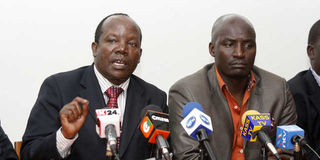
The Football Kenya Federation Special General Meeting held on Saturday in Meru made a far-reaching decision to expel its vice president, McDonald Mariga, together with six National Executive Committee (NEC) members allied to him.
The six members are Kerubo Momanyi (Women Representative), Gabriel Mghendi (Coast), Dan Shikanda (Nairobi), Collins Opiyo Kalee (Nyanza), Robert Macharia (Central) and Bernard Lagat (Upper Rift Valley), who were involved in a power struggle with federation president Hussein Mohammed and six NEC members on his side.
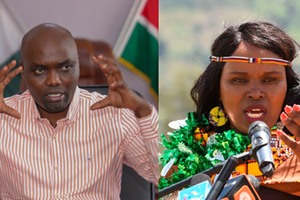
Football Kenya Federation deputy president McDonald Mariga.
Photo credit: File | Nation Media Group
The accusations included: purporting to unlawfully remove Hussein, Acting FKF General Secretary Dennis Gicheru and nominated NEC member Abdullahi Yusuf from their positions, purporting to remove Hussein from office without affording him an appearance, failing to attend NEC meetings, purporting to communicate on behalf of the federation and taking football-related disputes to ordinary courts.
Power fights within the top hierarchy of the federation and ejection of members is not new to Kenyan football
Nation Sport looks back at previous fights, expulsions and suspensions of FKF’s top leadership by delegates.
In August 2005, Alfred Sambu was removed as the chairman of Kenya Football Federation (now FKF) at a General Assembly and replaced by his senior deputy Mohammed Hatimy.
Alfred Sambu. He was removed as the chairman of Kenya Football Federation.
The orchestrated leadership change took place at a SGM which had been convened by Hatimy at Stem Hotel in Nakuru.
Overwhelmingly elected in December 2004, Sambu was accused of financial impropriety and league mismanagement, allegations which he denied.
However, Fifa didn’t recognise the meeting, thus creating confusion in the leadership of Kenya’s football as both men claimed to be the legitimate chairman of the organisation.
With Fifa giving Kenya three months to resolve the leadership wrangles or be banned, sports stakeholders, including the then Sports Minister Maina Kamanda, held a meeting in December 2005 where they resolved that Sambu should be reinstated into office.
In January 2006, at an SGM held in Nairobi, 80 delegates against 37 voted that Sambu should be the KFF chairman.
However, the infighting within the federation persisted, and in October 2006, a section of delegates passed a vote of no-confidence against Sambu and Secretary Dan Omino.
In November of the same year, Sports Minister Maina Kamanda dissolved the FKF and appointed a caretaker committee to oversee its affairs. However, the High Court suspended those decisions and ordered the reinstatement of Sambu’s team. The High Court also stopped the Registrar of Societies from listing the caretaker committee.
Hatimy returned to the helm of KFF in an acting capacity before assuming the role officially in 2007.
He held the position until 2011, when KFF was rebranded to FKF and Sam Nyamweya was elected the new president.
However, it was not long before divisions emerged within the new administration.
The following year, the federation suspended Nyanza NEC member Tom Alila and his Coast counterpart Hussein Swaleh Hussein (often referred to as ‘Terry’).
Alila was accused of corruption, allegations that he denied, while Swaleh was accused of bringing the game of football into disrepute.
At an FKF Annual General Meeting held at Kabarak University Guest House in 2014 at Kabarak University Guest House, the delegates imposed a six-year ban on both Shollei and Shikanda from all football activities following their earlier suspension.
Football administrator Sammy Sholei. PHOTO | FILE |
In 2015, the Sports Disputes Tribunal lifted the ban on Shollei and reinstated him to the vice president position. He, however, chose not to resume office since the elections were just three months away.