There are honours that crown a career, and honours that try to bury a mistake. There are gestures in football that illuminate greatness, and gestures that merely illuminate guilt.
Uefa’s President’s Award to Thierry Henry is one of the latter, just a clumsy apology arriving late and limp, hoping nostalgia will disguise cowardice.
He played at a speed the rest of the division did not have access to. Defenders did not so much mark him as watch him leave. Highbury on a Saturday was less a football ground than a theatre where one man decided, week after week, what was possible. The professionals he played against voted him the best player in England that year. So did the writers who watched him every week. Both groups had the advantage of standing close enough to see.
PHOTO | AFP | GRAHAM STUART
Arsenal's French striker Thierry Henry celebrates scoring the winning goal of the English Premier League football match between Sunderland and Arsenal at the Stadium of Light in Sunderland, north-east England on February 11, 2012.
Then the committees voted.
Everyone with functioning eyes remembers how Henry redefined football that season. He played with such authority that defenders looked like they were auditioning for roles in his humiliation reel. Goalkeepers seemed to be running through fog. It was the year Henry bent the Premier League to his will, the year he turned Highbury into a cathedral and himself into its high priest.
A season so outrageous that even rival fans spoke of him with the kind of awe usually reserved for natural disasters and divine intervention. And yet the Ballon d’Or went to Nedved. Uefa and Fifa, twin temples of self‑importance and their voting cartels, looked past the brilliance unfolding in North London and handed the golden orb to a midfielder whose greatest achievement that year was a Champions League run Henry never had the institutional privilege to match.
French former star player Thierry Henry waves as he arrives to give the 2014 FIFA Ballon d'Or award for player of the year during the FIFA Ballon d'Or award ceremony at the Kongresshaus in Zurich on January 12, 2015. PHOTO | FABRICE COFFRINI |
It was a decision that aged like milk. They have been living with the sourness ever since. This President’s Award is their attempt to sweeten the air. Nedved was a fine player, a tireless runner, a man who could kick a ball very hard in a straight line.
But in 2003, he was not Henry. He was not the player who made the Premiership feel like it was being played at two different speeds; Henry’s and everyone else’s. The football know‑it‑alls in the voting committees know this. They have known it for 23 years.
And now, in 2026, they have decided to send Henry a consolation prize, a polite little plaque that says, in effect, “We botched it. We botched it spectacularly. Please accept this decorative apology.”
They are not honouring Henry. They are begging history to forgive them. And Arsenal fans, the people who watched Henry turn physics into suggestion and defenders into props, are expected to clap politely and pretend this gesture carries weight. They are expected to nod along as Uefa praises Henry’s character, his humanitarian work, his punditry, his statesmanship.
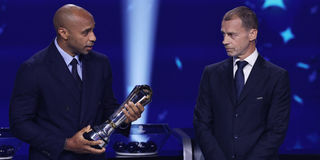
Former footballer Thierry Henry receives the UEFA president's award from UEFA president Aleksander Ceferin ahead of the league phase draw as presenters Pedro Pinto and Reshmin Chowdhury look on in Monaco on August 27, 2026.
Photo credit: Manon Cruz | Reuters
But Arsenal fans are not fools. They know what this is. They know when an institution is trying to rewrite its own shame. Because what does this award actually accomplish? It does not return the Ballon d’Or. It does not rewrite the injustice. It does not correct the record. It simply acknowledges, in the most timid and bureaucratic way possible, that Henry’s greatness was too immense to ignore forever, even for organisations that once failed to see it.
This award is a bandage placed on a wound that healed into a scar years ago. A gesture made safe by time, delivered when no one can be harmed by admitting the truth. The kind of honour that costs nothing because the moment that mattered has already passed.
Arsenal fans accept it with laughter because Arsenal fans recall the glide, the shrug, the finish, the celebration. They recall the way Henry made football feel like art and inevitability at the same time. And they watched, with disbelief, as the Ballon d’Or slipped through his fingers.
They recall the season when he was the best player alive, and the world should have crowned him as such.