In Kenyan football, the whistle doesn’t always signal the start or end of a match — sometimes, it signals a sudden shift from playing to enforcing the law.
For some players in the Football Kenya Federation Premier League (FKF-PL), the distinction between the touchline and the frontline is blurred.
One moment they are organising a defensive wall against strikers; the next, they are swapping their football kits for riot gear to respond to an urgent call of duty.
The stakes are high for these officers as they lead a double life, balancing professional football with the unyielding demands of the National Police Service (NPS).
For Victor Matete, while most FKF-PL players are asleep at 3am, he is already awake, preparing for another day split between football and policing.
The 3K FC left-back is a police constable attached to GSU headquarters in Nairobi. He is expected at the club’s training ground in Embu by 6:30am.
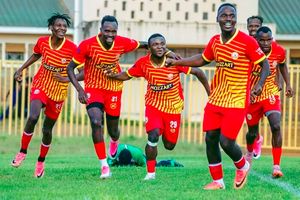
3K FC players celebrate after scoring a goal in a recent match.
Photo credit: Pool
The 125-kilometre journey takes up to three hours. After training, on selected days, Matete returns to Nairobi for police duties – a demanding routine that he has embraced.
Unlike his colleagues at Kenya Police FC and APS Bomet FC, Matete plays for 3K, a community club.
“I talked to my bosses and they agreed to let me play football,” says Matete.
However, this arrangement comes with one condition: whenever duty calls, particularly during emergencies, policing takes precedence over football.
Kenya Police FC captain Clinton Kinanga, and former Gor Mahia and Kenya Police FC defender, Harun Shakava, recall occasions when they had to prioritise their police duties over football, including during anti-government protests.
Having played for Kakamega Homeboyz, Shabana FC and Fortune Sacco FC, Matete sees 3K as another stepping stone.
He has registered two assists and two pre-assists so far this season. He hopes to play for bigger clubs.
Kinanga has built his football career within the police structure. The club’s longest-serving player, Kinanga has witnessed its rise from the National Super League (NSL) to becoming FKF-PL champions in the 2024/25 season.
Clinton Kinanga of Kenya Police FC celebrates his goal against Bidco United during an FKF Premier League match at Police Sacco Stadium, Nairobi on September 30, 2023.
Photo credit: Chris Omollo | Nation Media Group
He is currently attending a leadership course at Kiganjo Police College. His contribution to their title-winning campaign earned him a promotion to corporal last year.
Like Matete, Kinanga has sometimes had to prioritise his police duties over football. He believes football has given officers an opportunity to understand the communities they serve.
“The sport has helped us to understand the problems facing society,” says Kinanga.
This belief was put to the test in May at the Gusii Stadium during the quarter-final of the Mozzart Bet Cup between Shabana and the Kenya Police.
Following a disputed decision that saw Police win 1-0, some Shabana supporters rioted.
As anti-riot officers prepared to intervene, Kinanga approached the Shabana stand and spoke to the supporters.
He warned them that violence could result in sanctions being imposed on their club. The match then resumed.
“As police officers, we understand the emotions of players and fans because we have been there. We also understand police procedures. You don’t need to fire tear gas into a packed stand to restore order,” he said, adding that the same approach should be taken as the country prepares to co-host the 2027 Africa Cup of Nations (AFCON) with Uganda and Tanzania.
Kenya Police FC captain Clinton Kinanga in police uniform.
During the Kenya-Morocco CHAN championship match at Kasarani on August 10 last year, the police used tear gas to disperse supporters who had breached the barriers after the stadium had reached capacity.
CAF later condemned the use of tear gas and stun grenades, fining FKF and restricting the venue’s capacity to 60 per cent, or 27,000 spectators.
A Gor Mahia–Nairobi United league match at Dandora Stadium in December last year was abandoned in the 58th minute after supporters clashed. Police used tear gas to disperse the crowd. Some fans were injured.
While Kinanga has built his football career within the police force, Shakava’s experience illustrates the other side of the balancing act: what happens when the demands of the service outweigh a player’s ambitions?
Shakava, a police constable, joined Kenya Police FC in 2022 after a spell at Gor Mahia, before eventually transitioning fully into police service. He is now stationed in Kabras in western Kenya and has retired from professional football.
Harun Shakava (left) of Gor Mahia vies for the ball with Micheal Owino of Wazito FC in an FKF Premier League at Utalii Sports Club, Nairobi on May 31, 2021.
Photo credit: Chris Omollo | Nation Media Group
“It’s not easy to balance football and police work. I was personally forced to retire from professional football because police duties often required a lot of my time, making it difficult to balance the two,” Shakava told Nation Sport.
He also recalled being recalled for police duties during anti-government protests and other security assignments.
“Our bosses should consider people like us, who have played at a high level, and assign us to police teams because we believe we have a lot to offer and can help these teams,” he said.
Former Gor Mahia and Kenya Police FC captain Harun Shakava (centre) poses for a photo with Gor Mahia officials among them club patron Eliud Owallo (second left) and Chairman Ambrose Rachier (second right) at Mumias Sports Complex on May 4, 2026.
Photo credit: Nation Media Group
The contrast was clear when he was deployed to provide security at the Mumias Sports Complex for a league match between Kakamega Homeboyz and Gor Mahia in May.
He had once led Gor onto the pitch as captain. This time, he was in uniform, securing a match involving his former club.
“It was a nice experience. It brought back memories of my active days. I felt as if I should have been on the field playing,” said Shakava.