In Dallas, Texas
The boardroom coup that resulted in the reversal of the 2025 Africa Cup of Nations (Afcon) final has since drifted from the back pages into the austere halls of international law, morphing from a sporting row into a huge confrontation that could redraw the lines of authority in global football.
What happened on the pitch is now almost secondary to what happened after. A 15 minute walk-off, a referee’s discretion, a trophy lifted and then, weeks later, reassigned. The Senegalese Football Federation’s appeal to the Court of Arbitration for Sport rests on a deceptively narrow distinction, the kind of technicality that in football often becomes a fault line.
George Weah, the former Ballon d’Or winner and former Liberian president, insists that the fulcrum of the entire dispute is the difference between a stoppage and a forfeiture.
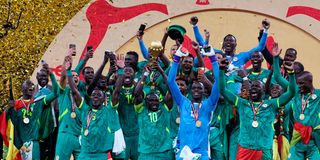
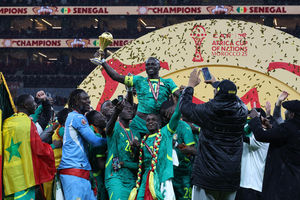
Senegal's Sadio Mane holds the trophy as they celebrate after winning the Africa Cup of Nations at Prince Moulay Abdellah Stadium, Rabat, Morocco on January 18, 2026.
Photo credit: Amr Abdallah Dalsh | Reuters
The Confederation of African Football’s (Caf) Appeals Board awarded the title to Morocco by invoking Article 84 of its disciplinary code, a rule that treats a team’s refusal to play as an automatic 3–0 forfeiture. But Weah, in a sharply worded statement, argued that the rule was misapplied, and perhaps unlawfully so, given the reality of what the match officials recorded that night in Rabat.
“The referee on the pitch is the final authority,” Weah said, citing Law 5 of the Fifa Laws of the Game.
And so the decisive document for the tribunal in Lausanne will be the referee’s report, not a video replay or a VAR freeze-frame. An unglamorous, bureaucratic artifact that now carries the weight of a continent’s footballing credibility. It is understood that the official classified Senegal’s walk-off as a temporary stoppage rather than a refusal to continue.
Under standard protocol, a forfeiture is declared only when a referee formally abandons a match. By allowing play to resume and overseeing 30 minutes of extra time, the referee, Jean Jacques Ndala, appeared to exercise his discretion to keep the contest alive.
Legal analysts suggest that if the court determines the referee never abandoned the match, the confederation’s retroactive imposition of a forfeiture could be deemed an overreach.
Weah warned that permitting committees to re-decide matches after the final whistle risks creating a dangerous precedent, one in which administrative bodies supersede the officials on the field. The tribunal’s ruling may hinge on whether a governing body can manufacture a forfeiture out of a stoppage that the referee had already resolved through play.
Football’s greatest vulnerability is now uncertainty. A sport built on final whistles cannot survive if finality itself becomes negotiable. The controversy has fractured the ranks of African football’s most celebrated figures.
Samuel Eto’o, the Cameroonian icon whose relationship with the confederation’s leadership has long been strained, denounced the ruling as an unprecedented rupture. He condemned what he described as the administrative overturning of a result earned “through sweat and blood on the grass.”
Even typically diplomatic voices have found the moment untenable. Augustine Jay Jay Okocha, the Nigerian maestro, expressed disbelief at the retrospective punishment.
“The beauty of football is that if you want to be champions, you have to win against the best on the pitch,” Okocha said.
He warned that the ruling has plunged the competition’s reputation into chaos, emboldening critics who argue that the tournament still lacks the institutional stature of the Euros or the Copa América.
The two federations at the center of the dispute have dug into opposing legal positions. The Senegalese Football Federation condemned the ruling as “unjust and unacceptable.”
Senegal’s government called Caf’s decision “grossly unlawful and profoundly unjust” in a statement issued Wednesday.
“This unprecedented decision, of exceptional gravity, directly contravenes the cardinal principles underpinning sporting ethics, foremost among which are fairness, loyalty and respect for the truth of the pitch,” the statement read. “It stems from a manifestly erroneous interpretation of the regulations, leading to a grossly unlawful and profoundly unjust decision.
Senegal's Sadio Mane lifts the trophy as they celebrate after winning the Africa Cup of Nations at Prince Moulay Abdellah Stadium, Rabat, Morocco on January 18, 2026.
Photo credit: Amr Abdallah Dalsh | Reuters
“By calling into question a result achieved at the end of a match that was duly played to its conclusion and won in accordance with the rules of the game, Caf is seriously undermining its own credibility as well as the legitimate trust that the African people place in the continent’s sporting institutions.”
Senegal said it rejected the ruling, adding in the statement: “It calls for the opening of an independent international inquiry into allegations of corruption within the governing bodies of Caf.”
Captain Kalidou Koulibaly delivered a defiant message to supporters: “It wasn’t handed to us; we won it. The trophy is here. It’s not going anywhere.”
The Royal Moroccan Football Federation has cast its stance as a defense of regulatory integrity. Its statement argued that the appeal was a necessary insistence on the application of rules, and not an attack on Senegal’s performance.
Morocco’s football federation, conversely, accepted the verdict when it was announced on Tuesday.
“The federation wishes to recall that its approach has never been intended to challenge the sporting performance of the teams participating in this competition, but solely to request the application of the competition’s regulations,” the federation’s statement read.
“The federation reaffirms its commitment to respecting the rules, ensuring clarity in the competitive framework, and maintaining stability within African competitions.”
To Moroccan officials, the walk-off constituted a breach of the competitive framework that could not be ignored, regardless of what transpired afterward. Caught between these warring interpretations is Patrice Motsepe, the president of the confederation.
In a recent interview, Motsepe attempted a delicate balancing act, defending the independence of the confederation’s judicial bodies while acknowledging the legacy of mistrust that shadows African football.
Confederation of Africa Football (Caf) President Patrice Motsepe speaks to the media in Nairobi on September 16, 2024.
Photo credit: Chris Omollo | Nation Media Group
“The Caf Appeals Board took a totally different position,” Motsepe said, presenting the reversal as evidence of a healthy, non-monolithic legal process. Yet he conceded that the turmoil undermines the progress the organisation has sought to project. Notably, he did not obstruct Senegal’s appeal to the court in Switzerland, signaling that the final word may come from outside the continent.
The timing is fraught. With the 2026 World Cup in North America approaching, African football finds itself under an intense global spotlight. Fifa has criticised the walk-off while treading carefully around the administrative fallout. The fear is that the atmosphere between two of Africa’s footballing heavyweights could tarnish the continent’s sporting image.
And so the 2025 trophy, polished, photographed, and paraded, has become something else entirely. It’s now a contested symbol, a legal artifact, and a mirror reflecting the anxieties of a sport that has long struggled to balance passion with governance. For Senegal, it represents a stolen triumph.
For Morocco, a legally mandated victory. For the sport’s historians and lawyers, it is a warning flare. If the ruling stands, football may find itself confronting a future in which the final whistle no longer guarantees finality, and where the boardroom, rather than the pitch, becomes the ultimate arbiter of victory.
The confederation’s executive committee meets on March 29, a date that some hope will bring clarity, though many fear it may only deepen the wounds in the beautiful game. In the meantime, the trophy sits in limbo, waiting for a judgment that could shape the soul of African football for years to come.