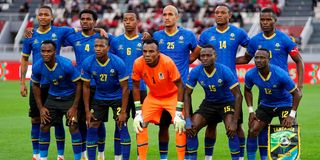
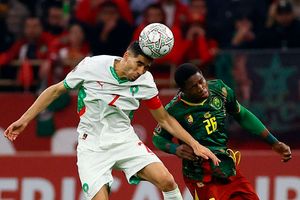
The 2025 African Cup of Nations (Afcon) – hosted by Morocco – has seen East Africa diagnosed as the sick men of African football yet again.
The region’s three representatives – Sudan, Tanzania, and Uganda – won only one match between them despite featuring in 10 matches.
Such were their struggles to convincingly register a win that Sudan’s 1-0 over Equatorial Guinea was as a result of an own goal by their opponents, while the match between Tanzania and Uganda ended in a 1-1 draw.
Even though Sudan and Tanzania qualified for the knockout stages as one of the four best-ranked third-placed teams, their stay in the tournament ended in the Round of 16 following 3-1 and 1-0 losses to Senegal and Morocco, respectively. Matching the continent’s best is still beyond the region’s best efforts.
Tunisia's Sebastian Tounekti in action with Tanzania's Haji Mnoga during their 2025 Africa Cup of Nation Group C match at Prince Moulay Abdellah Stadium, Rabat, Morocco.
Photo credit: Reuters
Still, Sudan’s and Tanzania’s performances could be rationalised by war and political instability. Sudan qualified for and competed at Afcon 2025 on the back of civil war in their country, while Tanzania was still reeling from the country’s controversial October 29 elections, which were marred by violence and the killing of protesters.
Their gallant displays on the backdrop of such strife led to East African teams appearing in the knockout stages at Afcon for the first time since Sudan’s quarterfinal appearance at Afcon 2012. Before that, Uganda, when they reached the final at Afcon 1978, was the last East African team to feature in the knockout stages at Afcon.
The history of the performance of East African teams at Afcon has consistently sparked wonder at the region’s lack of football prowess despite being one of the first adopters of the sport in Africa.
Peter Alegi’s African Soccerscapes: How a Continent Changed the World's Game chronicles football activity in Zanzibar in the 1880s, in Uganda in 1891, and in Kenya in 1909.
In 1926, Kenya and Uganda competed in the first edition of the Gossage Cup, the oldest football tournament in Africa. Their two encounters on May 1 (1-1 draw) and May 3 (2-1 win for Kenya) at the Landi Mawe Grounds in the Railways area of Nairobi marked the first international football encounters between two African teams.
Tanganyika (now Tanzania) and Zanzibar were supposed to compete at that tournament but they pulled out and later made their debuts in 1945 and 1947, respectively.
Such was the frequency of meetings between Kenya and Uganda that by the time another pair of African countries had played against each other – Southern Rhodesia (now Zimbabwe) vs Northern Rhodesia (now Zambia) in 1946 – the two East African neighbours had met
The 1926 Gossage Cup preceded the first edition of Afcon by 41 years. Still, the formation of the Confederation of African Football (CAF) and the playing of the first Afcon in 1957 were heavily influenced by East Africa. CAF’s four founding members include Ethiopia and Sudan. The other two countries were Egypt and South Africa.
Ethiopia went on to win Afcon 1962 when it was a four-nation tournament, while Sudan became the winners in 1970 when the competition had expanded to eight teams.
Those two instances still account for the only occasions of a team from the Cecafa region winning Afcon. That reality always forms the basis for asking how the East African region went from being the game’s pioneers in Africa to its sick men. The truth is that until East African football met the rest of Africa, the former was just a big fish in a small pond.
In terms of exposure to European football, North and West African nations were already far ahead of other regions of Africa.
The proximity of North and West African nations to Europe meant that African players from those countries were playing for European clubs as early as 1886, when the Ghanaian Arthur Wharton, playing for Preston North End, became the first African to play for an English club.
The colonial policy of assimilation adapted by the French (and Portugal in its colonies in Africa) in North and West Africa contributed to a migration of African footballers to France from as early as 1920. In the 1930s through to the 1960s, the French national football team featured players of African origin.
“By including blacks in Les Bleus, France sought to demonstrate the success of its “civilizing mission” and the allegedly positive aspects of colonial rule,” Alegi writes in African Soccerscapes: How a Continent Changed the World’s Game .
This phenomenon saw North and West Africa creating a football network with Europe that would later come to serve their dominance of the sport in Africa. This went beyond players from those countries migrating to Europe but also setting up football academies in the 1990s.
Looking at the East Africa region, which was majorly under British colonial rule, such contacts and networks with European football could not be established in those years due to British colonial policies promoting segregation of races.
Ghana and Nigeria, the West African countries that were under British colonial rule, somehow navigated that challenge by tapping into the network of their Francophone neighbours. Most importantly, their founding Presidents, Kwame Nkrumah of Ghana and Nigeria’s Nnamdi Azikiwe were passionate football fans who aggressively promoted the sport’s growth in their countries.
Nkrumah, in particular, used Ghana’s national football team for diplomacy. The team played friendly matches with numerous African countries – including Kenya – in the 1960s as a way of spreading his ideology of pan-Africanism.
East Africa lacked such leaders. Kenya’s first President, Jomo Kenyatta, was so detached from the sport that it birthed urban legends like he once stopped watching a match Kenya was losing badly after learning legendary athlete Kipchoge Keino could not be brought on as a substitute to run with the ball and pump some goals.
It is East Africa’s isolation from thriving football networks that explains why the region always seeks the help of foreign football coaches.
In the 1970s, Kenya engaged the services of the German Bernard Zgoll to improve the country’s football. He set up youth centres all over the country, which produced a generation of footballers who impressed for Harambee Stars in the 1980s and early 1990s.
However, the country later ditched that model but at the peak of the success of Zgoll’s blueprint in 1987, the Mathare Youth Sports Association was founded and filled the gap, producing most of the players who helped Kenya qualify for Afcon 2004.
Soccernomics , a book by Simon Kuper and Stefan Szymanski, further emphasises the importance of football networks.
In the book, Kuper and Szymanski share fascinating insights to explain why some nations are better at football than others. They attribute the dominance of successful football nations to a combination of two of the following three factors: a high population, a high national income, and a robust football network.
Having a high population, Kuper and Szymanski argue, means a large pool to draw football talent from. A high national income translates to increased ability to fund football development and a robust football network means having access to information and knowledge about current and transformative best practice and trends in the sport.
Five of the 10 most populous African countries are in East Africa – Ethiopia, Tanzania, Kenya, Sudan, and Uganda. That list also includes Nigeria, Egypt, DR Congo, South Africa, and Algeria – all who have reached at least two Afcon finals, won the competition at least once, and have played at the FIFA World Cup.
The five East African countries listed above also rank in the top 20 in Africa in terms of Gross Domestic Product (GDP).
South Africa is perhaps the best example of a country whose football thrives despite being surrounded by neighbours who have no football history and network to write home about.
Cameroon's Christian Kofane (centre) tussles for the ball with Nkosinathi Sibisi and Siyabonga Ngezana of South Africa during their Round of 16 Africa Cup of Nations match at Al Medina Stadium in Rabat on January 4, 2026.
Hence, South Africa is a perfect case study on how East African countries can use the modest strength of their economies to improve their sports infrastructure and invest in knowledge and expertise that can grow their football.
In a way, that would mean the East African countries making strategic investments in foreign connections and networks that would build the capacity of their local coaches and technical bench officials, as well as improve their sports infrastructure.
That will create more local experts who will continuously create new knowledge to develop the sport. The creation of new knowledge will attract focus on East Africa and as a result, the establishment of more connections and networks with strong footballing nations.
The profiles of most Afcon-winning and World Cup-winning nations show that a country is as good at football as its neighbours. All countries that have won Afcon – excluding Senegal and South Africa – have a neighbour who has won the competition.
Excluding England, European countries that have won the Fifa World Cup share a border with a fellow world champion. The same applies for the South American World Cup-winning trio of Argentina, Brazil, and Uruguay.
East African countries can create such profiles if they work together to create connections and networks that will boost the growth of the region’s football. This process will definitely require funds but, by African standards, they have modest economies which can support that process.
Otherwise, their high populations and modest economies will continue to make East Africa the headquarters of African football’s sick men.