Last Sunday, Argentina’s 56-year-old Ricardo Gonzalez finished tied for seventh place at the Chubb Classic in Florida (USA) with, among others, fellow countryman and agemate Angel Cabrera on an eight-under-par score, five points behind American winner David Toms.
The $1,800,000 (Sh243 million) Chubb Classic is part of the PGA Tour Champions series with Toms earning a winner’s top prize of $270,000 (Sh35.1 million) as Gonzalez and Cabrera banked $53,000 (Sh7.1 million), each, for the four-way seventh place alongside Australia’s Rod Pampling and American Bo Van Pelt.
The PGA Tour Champions series, formerly known as the Senior PGA Tour or Champions Tour, is a series for golfers aged over 50 years and features 28 tournaments mainly in the USA, but also including the Trophy Hassan II in Rabat, Morocco (May 21-23) alongside two other tournaments in Scotland and Portugal.
At 56, Gonzalez has sustained a stellar pro golf career since winning a place on the European Tour in 1992 but was unable to keep his Tour card after failing to garner a required purse, dropping to the second-tier Challenge Tour in 1993.
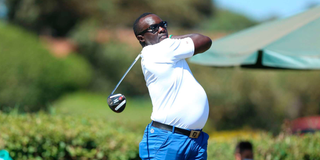
Golf Park golfer Jacob Okello follows the flight of his tee shot during a past session at Ngong Racecourse.
Photo credit: Sila Kiplagat | Nation Media Group
But the Argentine earned his card back by winning the Kenya Open in 1998 in a dramatic, three-hole play-off with Kenya’s Jacob Okello, holding his nerve in the third sudden death hole where Okello missed the green and faltered in his chip.
Okello, currently coaching at the Golf Park in Nairobi, earned Sh703,465 for his second-place finish which, holding into consideration cumulative inflation over the years, has an adjusted value of between four to five million shillings today. That remains the best ever performance by a Kenyan golfer to date at the Open.
Okello has kept contact with Gonzalez since and remembers that play-off loss like yesterday, but doesn’t lose sleep over what might have been had he driven his tee shot firmly onto the green at the par-three 13th with over 3,000 fiercely partisan fans in tow.
“Throughout the tournament, I was just playing my game. My game was on point and I was just playing one hole at a time,” Okello recalls the 1998 drama in an exclusive interview ahead of this week’s Kenya Open at Karen Country Club. “After you finish your first 18 holes, that’s when you look at your score and know where you are at.”
He attributes Kenya’s high golfing standards in the 1990s to discipline and commitment, factors he argues are lacking in today’s Kenyan players who struggle to make the cut at the Magical Kenya Open.
“We worked very hard, played a lot of golf and practiced hard. We were helped and could also seek for help from people who were more experienced. I got help from the top guys, like the late John Mucheru, Peter Githua, Abdallah Bekah, Naushad Merali, Charles Farar… all of them were part of building me to make me what I was.
“They used to tell me that ‘for you to get to the top, know that this (golf) is your office, it’s work, and you must know that you have to report to somebody.’ And that was the most important thing. They would follow up and check what was wrong if we didn’t practice,” reflects Okello who launched his golfing career under the wings of his father, Ben Okello, who was based at Nairobi’s Railway Golf Club before relocating the Nyali Golf Club in Mombasa.
Okello Senior was also a member of Uganda’s Masaka Golf Club and is remembered for winning the Uganda Open in 1972.
Before following in his father’s footsteps, Okello played football to a high level while at Kakamega High School, Kenya’s football powerhouse, and had stints at Gor Mahia FC while still in school where his teammates included the legendary George Nyangi Odembo.
But incessant injuries forced football’s wonder kid to quit the game and settle for the smaller ball, thanks to his father’s guidance.
“I always thank God for my father. I realized golf is an individual game and it’s about you. It’s not about anyone else and the more work you put in, the better you are, and the less work you put in, it shows in the results. I always thank my father for his guidance.”
Calibre of Kenyan golfers
Okello settled seamlessly into golf and was one of the first African players to win the Junior Strokeplay at Muthaiga at 16 years, and then took up the sport seriously when his father was transferred to Nyali, representing Kenya from junior levels in 1990 as the country’s number one junior player.
He was invited to play in the national team where he played alongside the likes of John Mucheru, Peter Githua, Jimmy King’ori, Charan Thethy, Hardeep Tethy, John Kiondo and David Wandua.
“They were good players and I played with them a lot when I was a junior and before I got to professional level,” he recalls.
Okello turned pro in 1996 and played in the 1997 Kenya Open, launching a sensational professional debut by making the cut before finishing second the following year, losing to Gonzalez in the play-off.
Injuries troubled his subsequent Open attempts and when the nine-hole, pay-and-play Golf Park came up at the Ngong Racecourse, Okello ventured into coaching.
Golf Park golfer Jacob Okello tips Gideon Waweru of BrookHurst School during the launch of Golf Sport on June 12, 2023.
Photo credit: Chris Omollo | Nation Media Group
In the no-holds-barred interview, the 57-year-old Okello, who was born on Christmas Day in Kampala, viewed most of the current Kenyan pro golfers as lacking the discipline needed to excel in the game.
“Golf is about you and your discipline…The calibre of players that we have are not hard working. Most of them were caddies who moved to being good amateurs and then professionals, and according to me, they needed to get it right from the beginning.
“I can have the competition course at my disposal all year round but if I don’t have the discipline, and if I’m only thinking of immediate financial gain instead of working hard to get such financial gain going consistently, I don’t stand a chance.”
He also argues that most golf coaches are half baked and despite the enormous pool of player talent available in Kenya, the country lacks requisite skilled personnel to convert such talent into performance.
“I feel very sad that our juniors are being coached by individuals who have done a Level One coaching course in three days… What can you learn in three days to teach? Our short cuts aren’t giving results. Once you go through the right process, everything automatically works.
“We have over 5,000 juniors now, and out of these, we should be able – in a perfect world – to get 10 percent of them playing. For them to get to that level of playing, what do you need to do? You need to have a Professional Tour that is divided into various categories – Senior Professionals, Main Professionals, Ladies and Juniors. This Tour should be run by Kenyans, and owned by Kenya, like the Japanese do with their Tour.”
“The Japanese had their Tour built from scratch. They were like ‘why should we go to America? We have the land, the weather, everything. How do we get 5,000 players into the golf market?
“In Kenya, a country with almost 60 million people, we just need 10 percent of these to play golf, and, mathematically, we shall be viable to have our own Tour. Once you have the 10 percent playing, then the cost of everything will go down.”
Okello seeks to see more public golf courses in Kenya, proposing that each of the 47 counties hives off areas for the development of sports centres that include golf among other sports.
And as a supporter of President William Ruto’s affordable housing project, he appeals for Ruto’s administration to push for such sports centres in tandem with the affordable homes to help inspire talent from the young ages.
“The kid in Buru Buru will be involved, the kid in Mathare slums will be involved if the government can build public golf ranges, like the Japanese ones. Why can’t such amenities be part of the affordable housing project?”
And while he heaps blame on golf administrators for Kenya’s failure to perform at the Open, Okello also points at individual player flaws as triggering such low standards.
“It’s not about the Union. It’s about the individual. The challenge is us, players. Do we have the interest of the game? Why do we go the short cut way – organizing quick qualifiers, organizing quick programmes for coaches?” he poses.
“It’s high time that the Kenya Open Golf Limited, Kenya Golf Union, Kenya Ladies Golf Union - all of them - be held accountable. It pains me when I hear these officials talking and ask myself, ‘what’s their vision?’ To them it seems (holding office) is a stepping stone to politics! For the sport to grow, there have to be drastic changes!”
But the veteran golfer is excited at the prospects that the current Equator Tour brings, noting that the entry of corporates is a huge relief to the contracted players and offers them an opportunity to play golf throughout the season.
NCBA Bank, Kenya Airways, Diageo, Visa Kenya, Britam and Safaricom are giving Sh3 million each to support players on the Equator Tour, covering their day-to-day running costs and supporting their participation in the Tour’s eight tournaments.
Golf Park golfer Jacob Okello.
Photo credit: Chris Omollo | Nation Media Group
The Equator Tour, now entering its second season, is designed for players affiliated to the Professional Golfers of Kenya (PGK) and drives towards boosting their competitiveness.
Okello believes the Tour’s impact will be felt at this week’s Kenya Open where he projects that seven Kenyan pros will make the cut, if organisers hand the hosts 15 slots envisaged.
But as at yesterday, controversially, only 12 had been entered namely Samuel Chege, Mutahi Kibugu, Greg Snow, David Wakhu, Njoroge Kibugu, Dismas Indiza, Daviel Nduva, Edwin Mudanyi, C.J. Wangai, Jastas Madoya, Mohit Mediratta and Mike Kisa.
“The scores on the (2025/26) Equator Tour were good and unless something very drastic happens between now and the Open, and if they enter the agreed 15 players, then I predict that seven will make the cut, that’s if we go according to their performances on the Tour.”
Okello, whose typical day starts at 4.30am with an hour’s gym session and ends with nine holes of golf from 4pm, will be 58 next year and is planning a Kenya Open comeback after four years out “to teach the young players some lessons.”
“Some of them (young players) are saying I’m old and I’m telling them, yes, I’m old and you are young and you still keep doing the same mistakes…"
“Benhard Langer (Germany’s two-time Masters Champion) is 68 years old and is still winning the Senior events, and he keeps making the cut in the Masters. There are people who are 25 years old and he still beats them! That’s a typical German machine… he goes to the gym and knows what to eat and what to do… That’s the discipline we want in Kenyan golf.”