On November 12, 2023, Kisumu-based Lakers Hockey Club embarked on a road journey to Blantyre, Malawi, covering approximately 2,306 kilometres to compete in the 2025 African Cup for Club Champions (ACCC).
First held in 1996, the African Cup for Club Champions is Africa’s premier field hockey tournament for clubs. That year’s competition was held from November 16 to 26. Unable to afford air travel, the Kisumu-based team opted for the long road south, determined to compete with the continent’s best despite financial challenges.
By the time they arrived in Blantyre, the Lakers had already overcome one obstacle. On the field, they would overcome several more. They defeated Nigeria’s Delta Queens 2–0 in the semi-final to reach the final against Ghana Revenue Authority (GRA) Royal Ladies. The title was within reach. But hours before the final, everything changed. Officials from the Africa Hockey Federation informed the team that they would not be allowed to play, citing the alleged use of ineligible players.
The decision was delivered at the team hotel during breakfast. Instead of contesting the final, Lakers watched from the sidelines as GRA played Kenya’s Blazers. The sanctions that followed were severe. The club was fined Sh344,341 before being cleared to compete again. Four officials: team manager John Paul Otieno, head coach Austin Tuju, assistant coach Elizabeth Awuor Obong’o and assistant team manager Robert Oketch were banned for five years and fined individually. Eight players were also suspended. For many clubs, such penalties would have triggered collapse; however, for Lakers, it marked the beginning of a difficult but defining reconstruction.
The immediate impact of the ban was operational paralysis. The officials who had built the club’s structure and culture were now barred from active involvement, while the playing squad was depleted.
Yet, according to former team manager John Paul Otieno, withdrawal was never considered. The banned officials chose to maintain strategic continuity from a distance, ensuring that administrative coordination, player welfare and logistical planning did not collapse.
Lakers Hockey Club players Stacy Chentry Achieng (left) and Elizabeth Odhiambo Awuor pose with the Women’s Africa Cup of Club Championships trophy they won after they beat Ghana Revenue Authority in the final in Harare, Zimbabwe.
Photo credit: Pool
According to him, their priority was to keep the institution alive, even if individuals had to step back. With eight players suspended, nearly a full match-day squad, the club turned to its long-standing development philosophy rather than the transfer market. New players were recruited from grassroots programmes and secondary schools, reflecting the club’s emphasis on youth development and long-term sustainability. At the time, the team was left with only six league matches in the 2024 season.
Despite limited experience, the new recruits stabilised the team. Lakers finished seventh, narrowly avoiding relegation.
“We didn't get relegated, which was a plus and it was a good show. It showed that we could find people who came in and fit in the shoes of the suspended players, even if they didn’t perfectly replace them. They held the club,” Otieno told Nation Sport on Saturday in Kisumu.
At the same time, the club mobilised resources to settle the federation’s penalties and secure clearance for future participation. By the start of the 2025 season, suspended players had completed their sanctions and returned to competition.
“We managed to pay (penalties) for the club because we had to ensure that the club was there. Even if we are not there, the club needs to go on,” he said. With its core team restored, Lakers climbed to the top of Kenya Hockey Union Women’s Premier League standings with only a handful of matches remaining.
“So as we started the year 2025, we promised that we were going for African Cup for Club Champions. We needed to lift the trophy and also to lift the KHU league trophy,” he added.
The team’s former head coach, Austin Tuju, now serving as a technical advisor during his suspension, describes the period after the team’s suspension as the most critical moment in the club’s history. Within hours of receiving the disqualification notice, the management agreed on two guiding principles: internal unity and communication restraint.
The team would address the matter through official channels and avoid public confrontation, particularly on social media. Players faced online criticism and speculation, but the club encouraged silence, arguing that public debate risked misinterpretation and further reputational damage.
Coach Austin Tuju (left) and John Paul display the African Cup for Club Champions trophy and medal during an interview with Nation Sport at the Nation Media Group offices in Kisumu on February 6, 2027.
Photo credit: Alex Odhiambo | Nation Media Group
“We came with a decision to avoid social media to date; we are not active on the platforms. Because if you express your agitation through social media, nobody will really understand what you are trying to say. We also advised our players to refrain from social media,” Tuju says.
That decision, Tuju says, prevented internal divisions and allowed the group to focus on recovery rather than controversy. Equally significant was the emotional impact of the ban on players.
For a women’s team, management recognised that career disruption had wider personal implications. Six long-serving players started their families. Rather than resist these transitions, the club adopted a broader welfare approach, incorporating life-skills support and flexible engagement. The experience, Tuju notes, reinforced the need to view athletes as individuals with long-term life trajectories, not just competitive assets.
One of the most consequential decisions during the recovery period was structural expansion. Lakers increased its player base by establishing a second squad; Lakers ‘B’ team, to sustain the main team. The move effectively doubled the club’s development capacity and created an internal progression pathway. The broader structure, referred to internally as the Lakers Hockey Family, now integrates senior teams, development players and support networks. The approach proves critical when several senior players became unavailable due to injury, personal commitments or maternity leave.
By the time the team travelled for the next continental assignment, a significant portion of the squad had progressed through the second team.
“Only one of our key players left the club, Aurelia Opondo. She has an outstanding record in women’s hockey. She has been the league’s MVP more than once, and twice finished as top scorer in the league,” he said.
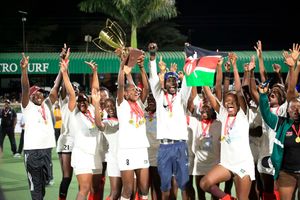
Lakers Hockey Club captain Alice Owiti lifts the trophy aloft in celebrations with teammates after winning the Women’s Africa Cup for Club Championships in Harare Zimbabwe.
Photo credit: Pool
For Tuju personally, the ban required a fundamental shift in leadership approach. He describes the period as a lesson in emotional discipline, remaining present without overstepping regulatory boundaries. Even informal engagement carried risks of extended sanctions, forcing him to operate strictly as an observer and mentor outside formal team structures. The suspension, which runs until December 2028, has reinforced his view that institutional continuity must take precedence over individual roles.
In January 2025, Lakers prepared for another continental campaign, this time in Harare, Zimbabwe. Unlike during their trip to Malawi, there was no major sponsor. The team relied on fundraising, personal contributions and logistical improvisation. The journey would cover more than 2,882 kilometres. The squad departed Nairobi on January 17, travelling through Dar es Salaam before continuing south toward Zambia and Zimbabwe.
“We were meant to leave Kisumu on January 13 but by that day, we barely had Sh5,000 in our M-changa account,” Tuju said.
As they approached Mbeya in Tanzania, their bus suffered a mechanical failure, leaving the team stranded for nearly 16 hours. With limited cash and no access to formal catering, players relied on basic food sourced locally. Anxiety grew as tournament deadlines approached.
“At that time also, we had no exchange currency. So the players had to endure 14 to 16 hours of hunger. The only thing we could get were fruits within the village. We could walk short distances and maybe pluck a mango. So the villagers, and women within the market, made us black tea which we took with mandazi,” Tuju said.
A second breakdown later in the journey intensified concerns about missing the opening match. Eventually, emergency transport organised by the club’s patron ensured the team reached Harare less than a day before the competition. Players had only eight to nine hours of rest.
The opening 2–0 defeat to defending champions GRA was considered acceptable, given the physical fatigue and travel stress. More importantly, the team avoided heavy losses that could have damaged confidence.
“Even though we went down 2-0, we knew it was better. We could have been thumped even six or eight times, because we were tired, we had not rested. And GRA is not an easy team,” Tuju added.
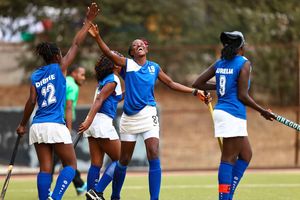
The team recovered to beat the home teams Hippo (4-1) and Bulawayo (3-0) before their final match against GRA. GRA took the lead through Elizabeth Opoku, who scored from a penalty corner, but Faith Amondi equalised to force a thrilling penalty shoot-out. Lakers’ goalkeeper Maureen ‘Archie’ Achieng stopped four shots. She was later named player of the final. Achieng and Debra Otieno scored for Lakers, and captain Alice Owiti was named player of the tournament.
Owiti reckons that the combined challenges, which included long road trip and vehicle breakdowns, strengthened their unity, mental toughness and resolve to win. The team travelled 355km from Kisumu to Nairobi, then 823km to Dar es Salaam, and finally 2,436km to Harare.
After lifting the continental title in Harare, the celebrations quickly gave way to another reality, the long road home.
According to technical advisor Austin Tuju, the most emotional moment of the entire trip came not during the tournament, but just before the team boarded the bus back to Kenya.
“The first hour before departure was very emotional. Some of the players broke down because the journey ahead reminded them of what they had just gone through, the breakdowns, the sleepless nights and the uncertainty we experienced on our way to Zimbabwe,” he recalls.
Despite returning as African champions, the prospect of repeating the same difficult journey unsettled the squad.
For some players, the memories of being stranded on the road, fatigued and anxious, were still fresh.
“A few of them were in tears,” he says. “They were asking, ‘coach, why do we have to go through all this even after winning the title? What exactly comes with this victory?’ At that moment, you could see the emotional weight they were carrying.”
Tuju admits the questions reflected a deeper frustration about the sacrifices required in elite sport without corresponding support.
“I told them honestly, I have been in this game for many years, and sometimes the level of commitment we put in does not match the rewards. It may look like misplaced passion, but that is the reality of our sport. What keeps us going is belief and love for the game.”
Players comforted one another, sharing hugs and reassurance before eventually agreeing to board the bus.
“The team had to encourage each other. After some conversations and reassurance, they agreed to travel,” Tuju says.
Despite their continental triumph, Tuju says the team returned home to a disappointing silence, with little recognition or institutional support at either county or national level.
According to him, the reception contrasted sharply with the magnitude of the achievement.
“Even after winning the most prestigious club title in Africa, there has been no formal recognition or support from either Kisumu County or the national authorities,” Tuju says.
“From Harare, the team travelled back and arrived quietly in Nairobi. We made our way from River Road to the Nation Centre; in many ways, the media is what helped people know that we had actually won the title,” he said.
For Tuju, the lack of official acknowledgement has been difficult for the players, who had endured significant hardship to bring the trophy home.
“To date, there has been no formal appreciation or recognition in any form. Yet this is one of the biggest achievements for Kenyan club hockey in recent years,” he adds.