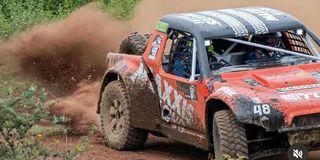
It is April 12 this year, and the duo of Mark Glen and Dougie Rumbgren is competing in a Rally Raid event in Soysambu in Gilgil near Naivasha. Their rugged desert raid car - a CRT body shell propelled by a Toyota IUZ 4.2 litre V8 engine - has succumbed to the violence of the terrain.
What happened next should have been a retirement. But Glen, the reigning champion of the National Rally Raid, dug deep into the Kenyan spirit of improvisation. He affixed an Allan Key to a Universal Joint spanner and used the makeshift tool to wrestle the damaged steering mechanism and nurse the car home.
The resulting clip, capturing raw ingenuity and sheer grit against the backdrop of the wet floor of the Soysambu Conservancy in Gilgil became an internet sensation, the sort of stunts captured on extreme sport TV channels. Glen became a subject of profound social media following. They arrived back to service looking like aliens, their bodies caked in mud.
The CRT is an over-engineered machine based on the Lexus 400 car, with a forged steel crankshaft, six-bolt main caps, and a non-interference valve design that makes it highly durable and capable of exceeding 500,000 km with basic maintenance.
The models with Variable Valve Timing-intelligence (VVT-i), a gadget that continuously adjusts the timing of the engine’s intake valves to optimise performance, improve fuel efficiency, and reduce emissions, produces around 290 horsepower, similar to a Group N medium rally car, according to Toyota user manual. And in that viral fix, the National Rally Raid Championship, a niche, dedicated corner of Kenyan motorsport, found its unexpected spotlight in local motorsport suffering from personality clashes.
Kenyan motorsport has been a source of national pride but will conclude 2025 without a national rally championship for the first time in 44 years. Activities have been paralysed by court battles between the traditional governing body, the Kenya Motor Sport Federation (KMSF), and a recently formed rival, Motorsports Kenya.
Yet, insulated from this politics, Glen and a dedicated cadre of drivers have continued the competition in Rally Raid, a Kenyan-style Dakar Rally held in the open wilderness where endurance, navigation, and absolute speed are paramount.
Mark Glen and Dougie Rumbgren drive their in CRT Toyota IUZ 4.2 litre 8 Cyclinder car in Soysambu Conservancy, Nakuru, during Rally Raid in June 14, 2025. They survived a damaged steering mechanism in the rough terrain to make it to the service point.
Photo credit: Pool
This weekend’s competition, the fourth and final in the series, is a 260km race spread over two days. Day one (Saturday) will cover 90km, and Day two (Sunday) will be run over 120km. Routes are not fixed but the latitude in which to drive through is liberal compared to the GPSR-mapped tight space in the WRC Safari Rally, notes Geoff Mayes, the route liaison officer of the organising committee. Mayes works closely with veteran rally driver Harry Sagoo.
Oserengoni is 20km in Moi South Road, Naivasha and forms larger ecosystem that includes Lake Naivasha and the Makasarani - Oserian - Oserengoni conservancy network ecosystem,
The commitment of this small community - the “faithful 25” drivers -is not just about sport but also preservation. Many competitors boasting strong roots in the Kenya National Rally Championship have joined Rally Raid to escape pervasive politics.
“Rally Raid has grown to between 22 to 25 teams. The number has increased, and the variety of machinery gives us healthy events. The secret to its success is clear, we don’t let politics into it,” Mayes observes.
It has attracted local legends. Ian Duncan leads the current championship standings, and Ross Field has cemented his status as a big threat to him, having won the championship repeatedly both on a bike and on a car. Alistair Keith who has previously competed in the KNRC circuit, now tackles the cross-country challenge in a Land Rover car. Meanwhile, Carl Tundo’s regular co-driver, Tim Jessop, is building a reputation in the unforgiving bike category.
But as the calendar concludes this weekend at Oserengoni Wildlife Sanctuary in Naivasha, the champion who embodied the spirit of the sport will be missing.
Glen, whose viral moment put the series on the map, will not be competing. The same V8 engine that powered his CRT, manufactured in South Africa, failed in the last event, seizing up and cannot be repaired on time.
“It’s sad. I wanted to be there to secure the third position I have been occupying,” Glen said yesterday. His absence means the path is open for Duncan to secure the 2025 crown.
The Rally Raid is not designed for easy spectating. Unlike circuit racing, it’s a cross-country discipline requiring stages averaging more than 80km, necessitating remote locations far from crowded areas. This remoteness, Mayes argues, contributes to its perceived obscurity, but it is also the key to its survival.
“Our loyal spectators follow us around the country. We are usually less than three hours from Nairobi,” Mayes explains. He reckons that this brand of endurance racing could be the next big thing in Kenyan motorsports.
The machinery itself is testament to dedication and resourcefulness. While the Dakar Rally-type desert cars are often expensive imports and are primarily sourced from South Africa, the local situation encourages innovation, something that was common in Kenyan motorsport in its golden years. Back in the 1970s and 1980s, most drivers hand-craft and strengthen their own vehicles in local workshops.
The passion shared by the organisers, among them Mayes whose father Pete Mayes was a celebrated organizer of the Zimbabwe Challenge Rally, ensures that the focus remains solely on racing.
As the final round commences this weekend at Oseregoni, the Rally Raid will 2025 champions across cars, bikes, and quads. While the warring protagonists in the national governing bodies continue to flex their legal muscle, bringing traditional rallying to its knees, the small, passionate group behind the Rally Raid has proven that the spirit of open-country motorsport cannot be grounded.