Safari Rally organisers are working feverishly around the clock to wriggle the iconic Kenyan event out of the woods amid rising speculation that the world-famous rally could, once again, find itself outside the FIA World Rally Championship calendar from next year.
The 14-round 2026 WRC circuit’s latest stop was Portugal from May 7-10 after the opening rounds in Monte Carlo (January 22-25), Sweden (February 12-15), Safari Rally (March 12-15), Croatia (April 9-12) and Islas Canarias, Spain (April 23-26). Japan will host the next round from May 28-31.
The Safari Rally was jettisoned off the global calendar in 2002 for, inter alia, lack of government funding and safety concerns, but was reinstated in 2021 after government guarantees by the President at the time, Uhuru Kenyatta. However, President William Ruto’s recent announcement that State funding beyond this year’s event would be withdrawn has sent organisers back into panic mode.
Hosting the Safari on the WRC calendar is a costly affair, with Sh400 million required in annual affiliation and related fees to the International Automobile Federation (FIA) to maintain a spot on the global roster, with total organisational costs ranging between Sh2.1 billion in 2023 to just below Sh1 billion this year, the government meeting almost all of these costs.
Confirmation that fresh events are aggressively knocking on the World Rally Championship (WRC) door has also fanned the flames of speculation about the Safari’s demise, though both event organisers and top government officials maintain they are pulling out all the stops to ensure the rally maintains its elite status.
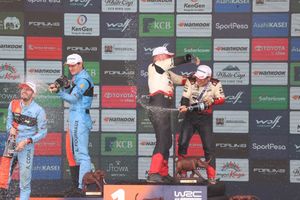
President William Ruto congratulates the podium finishers at Hell’s Gate after the Safari Rally Kenya on March 15, 2026. Third-placed Sami Pajari and co-driver Marko Salminen (right), second overall Adrien Fourmaux and co-driver Alexandre Coria, and the winning crew of Takamoto Katsuta with co-driver Aaron Johnston of Toyota lift their trophies during the celebrations.
Photo credit: Sila Kiplagat | Nation Media Group
On January 23, 2022, Kenya’s Sports Cabinet Secretary at the time, Amina Mohammed, signed a four-year contract extension with WRC Promoter Managing Director Jona Siebel to keep the Safari Rally on the WRC calendar, at least until this year. The signing ceremony, held at Monte Carlo’s affluent Automobile Club of Monaco, was one of the longest-ever contracts signed by the WRC Promoter, global rallying’s commercial and marketing arm.
By early this year, negotiations were already underway to further extend the contract and guard the rally’s solid position on the calendar, banking on the uniqueness and rich history of Africa’s only round that returned to the WRC circuit in 2021 after a 19-year hiatus. The late release of government funding, delayed payment of hosting fees and other guarantees to the WRC Promoter, coupled with a last-minute rush to secure rally routes, characterised a less-than-ideal build-up to this year’s competition, the mad rush punctuated by the replacement of Charles Gacheru as CEO by legendary driver Carl “Flash” Tundo just days before the flag-off.
President William Ruto poses for a photo with podium-finishing teams during the WRC Safari Rally Kenya on March 15, 2026, at Hell's Gate National Park. From left: Team Hyundai’s Adrien Fourmaux and co-driver Alexandre Coria (first runners-up); Team Toyota’s Takamoto Katsuta with co-driver Aaron Johnston (winners); and Sami Pajari with co-driver Marko Salminen (second runners-up).
The boardroom changes came as this year’s edition introduced a major route realignment with a break from tradition as the Kasarani Super Special Stage and ceremonial start at the Kenyatta International Convention Centre were replaced by an entirely Naivasha programme.
A new Nawisa “shakedown” stage was introduced with the traditional Soysambu, Elementaita and Kedong stages run in reverse order in the rally that featured 20 stages run over a 350.52-kilometre competitive distance.
“I think with the time we were given, I am happy with the outcome. Of course, it was not ideal to have such a short window to put everything together, but the team of men and women pulled it off,” Tundo flashed back exclusively to Nation Sport.
Most significant was the announcement by President Ruto that the government would no longer sponsor the Kenyan round of the World Series, which would now be entirely sponsored by the private sector “to allow the government to channel resources to more urgent needs such as education.”
Belgian driver Thierry Neuville (right) and Belgian co-driver Martijn Wydaeghe celebrate on the podium after winning with their Hyundai I20 N Rally1 Hybrid for Hyundai Shell Mobis World Rally Team after the 92nd WRC Monte-Carlo Rally, at Place du Casino in Monaco, southern France, on January 28, 2024.
Photo credit: Valery Hache | AFP
“This is the Last Safari Rally where we will be expending public money to promote. From next year, this event will be fully funded, fully supported by the Private Sector...that is what Public-Private Partnership looks like,” the President said during this year’s edition in Naivasha.
Ruto said sponsorship of the event by corporates would make it sustainable in the long run and, although the government will still be involved, it will not do the actual organisation, a decision Tundo embraces as “the most logical way forward.”
“I think it should have been done a long time ago,” Tundo reacted. “It takes away the government's burden of having to fund the event and makes it more efficient under the private sector.”
Corporates chipped in with about Sh400 million in backing this year’s Safari Rally, with KCB Bank Kenya the biggest spender with Sh227 million, as Kenya Breweries Limited, through the White Cap brand, gave Sh45 million and CFAO Mobility Kenya, home of Toyota, committed Sh48.5 million for logistics and development.
The government’s decision to withdraw financial backing for the Safari Rally, meanwhile, attracted new suitors to the table with gaming firm SportPesa coming on board in the 11th hour with an undisclosed sponsorship package that saw the 2026 edition successfully across the line. SportPesa announced a Sh120 million, multi-sport sponsorship portfolio that included a Sh40 million package for local driver Leonardo Varese, but sponsorship figures for the Safari Rally were not disclosed.
The gaming company’s entry was a huge relief to Kenya as the WRC Promoter continues to lure fresh organisers onto the global circuit with Aberdeen-based Rally Scotland expected on the 2027 WRC calendar alongside an Italian round in Rome. Rally USA is also expected to feature on the 2027 roster with a Candidate Rally being organised from June 11-17 this year around Tennessee and Kentucky as a precursor to a US WRC round next year.
The US last hosted a WRC rally in 1988 (Olympus Rally), and FIA President Mohammen Ben Sulayem sees the move to return to the States as an important step in growing the sport.
“The United States represents one of the most important growth opportunities for the FIA World Rally Championship. It is a nation where motor sport is part of the cultural DNA, home to world-class domestic championships and a rapidly growing appetite for global competition,” Ben Sulayem said earlier this year.
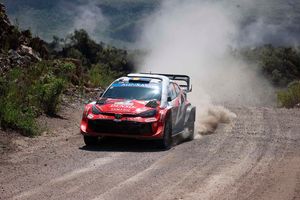
Esappeka Lappi navigated by Enni Malkonen in a Hyundai i20 drive through Elementaita Stage during World Rally Championship Safari Rally Championship on March 14,2026.
Photo credit: Sila Kiplagat | Nation Media Group
“Expanding the WRC into North America would not only elevate the championship’s global reach, but unite rallying with a knowledgeable, passionate and expanding fanbase in a market where participation and fan engagement continue to accelerate.”
Responding to questions from Nation Sport, the WRC Promoter confirmed they are working with Tundo’s team to streamline the Safari’s private funding model and maintained no decision had been made so far as to whether or not Kenya would remain on the global scheme of things from 2027.
“Negotiations are ongoing. We have several obstacles to overcome, but let’s see in the next couple of weeks,” Tundo said, remarks corroborated by the WRC Promoter’s Head of Communication, Jared Grellet.
“We are continuing to work towards a privatisation model in Kenya with the key support of Carl Tundo,” Grellet confirmed, adding: “For now, however, we do not have any updates to give, but I can contact you when we have something more concrete to share and report.”
Sports Principal Secretary Elijah Mwangi defends the decision to run the entire rally this year around Naivasha, clarifying that it was due to regulations stipulated by FIA, the custodians of global motorsport.
“Traditionally, the WRC Safari Rally had its shakedown phase in Nairobi before heading to Nakuru, but due to FIA rules on reduction of the number of days, it was not possible to have the Nairobi shakedown, and as a result, every stage was in Naivasha,” he explained, also supporting the private sector involvement in the rally’s organisation.
“The private sector took charge, pumped in the required budgetary support and coordinated the complex logistics that made it a resounding success. The government, having handled the previous WRC events, offered backup support and worked closely with the private sector to ensure everything went on smoothly. And it did.”
The PS is confident the Safari Rally will remain on the global programme next year, noting that competing drivers had also expressed their support for the Kenyan round.
“As a government, we are confident that WRC will remain in Kenya for several years to come. First, Kenya is a natural home for testing the dependability of cars as well as the skills of drivers in the motorsport universe...
“The scenic and the terrain are very challenging, offering the ultimate test of navigational skills and endurance for both man and machine, as witnessed in the Nakuru event. The rally drivers expressed their optimism of coming back to Kenya to try to conquer this magical terrain. We are currently engaging FIA to have our license renewed to continue hosting the Safari Rally. We are confident of having WRC Safari Rally's back in Kenya in the next cycle.”
Like Tundo, the PS maintains government weaning the Safari off State funding is the best way forward as the private sector driven model guarantees sustainability through timely budgetary support: “When we talk about Public Private Partnership (PPP) in sports, the WRC Safari Rally model exemplifies the best of this practice While the government applies for license to host the WRC Safari Rally event, the logistical coordination and execution is with the private sector.”
With the Safari Rally fighting to keep up with the Joneses, bizarrely, the local Kenya National Rally Championship circuit has provided an ugly anticlimax with virtually no competition the whole of last season, save for the WRC Safari that also runs a parallel round of the KNRC.
Local drivers have resigned their racing machines to garage parking lots, with only a handful attempting competition beyond the borders in the African Rally Championship, with eight Kenyan drivers shortlisted for last week’s Pearl of Africa Rally in Uganda, won by Kenyan Karan Patel with compatriot Samman Vohra second.
Wrangles within the Kenya Motorsport Federation (KMSF) haven’t made the Safari Rally’s future any brighter, with court battles threatening the development of Kenyan motorsport.
At the height of the crisis, two factions of the KMSF arose, one led by Maina Muturi and the other by rally veteran Jim Kahumbua, with a third entity - Motorsports Kenya (MK) - jumping into the lacuna. MK appears to have the support of quite a number of drivers, including veterans Baldev Chager and Asad Anwar.
“With the recent developments and emergence of Motorsports Kenya, there’s renewed optimism that motorsport in Kenya can move towards a more professional, commercially driven and inclusive future with stronger private sector involvement. That is what the Safari Rally ultimately needs to survive long-term – stability, credible leadership, investment and a united vision for the sport,” multiple national rally champion Chager maintains.
“The KNRC also needs rebuilding and strengthening because a healthy national championship is the foundation of a successful WRC event. If stakeholders work together properly, I believe Kenya cannot only retain the Safari Rally, but grow it further,” he adds.
Owing to the current impasse, clubs and individuals have opted to run their own events across the sport’s portfolio, including autocross and karting, with development programmes for young drivers nipped in the bud.
“They (clubs and individual organisers) are more than happy to come back to a federation where there’s sanity and accountability. My take is to overhaul the whole thing and inject new fresh blood of approach,” Muturi reacts, noting that the wrangles in the sport “have stopped any meaningful youth motorsports development and the running of National Championship events” as young drivers remain idle with lost opportunities.
“As you might know, the FIA Stars Project just died, and by the time we took over, the two Ford rally cars were in a scrap junkyard workshop. No one can guide as to why and what happened, and there have been legal battles of ownership or monies owed.”
The youth development programme was also supported by CFAO Motors (Toyota), who came on board with two locally homologated Toyota Starlets for the academy and for driver ages below 25 years.
“Definitely, we cannot afford to lose the WRC Safari Rally… This is the most watched rally in the WRC calendar and probably the toughest. But, obviously, the Government project cannot sustain itself and I, 100 per cent, support the commercial approach of the WRC Safari Rally to be run through a corporate approach where investors will be looking for their return on investment, while the country may be looking at the major gains of Sports Tourism benefits,” Muturi observes.
In 1994, Ian Duncan made history as the first, and so far the only Kenyan winner of the Safari Rally as a round of the World Rally Championship, winning the overall title in a Toyota Celica Turbo 4WD, famously known as the “Flying Sausage”, navigated by Dave Williamson.
He feels the government should continue with some financial support for the Safari Rally to keep it on the global WRC roster next year.