In Dallas, Texas
In the land of the brave and the home of the deep-fried everything, a unique kind of worship is reaching its fever pitch tonight. The first Sunday of every February is the sacred slice of time when America stops its restless hustle to pray at the altar of the Super Bowl. To the uninitiated Kenyan eye, American Football looks like a high-speed traffic accident involving men dressed as intergalactic gladiators.
It’s a game of inches, stopped every 30 seconds for a committee meeting, played with a ball that isn’t even a ball. Yet, for Americans, this single game is more important than the Fifa World Cup. Across 50 states, the air thickens with the smell of barbecued ribs, potato chips rustle like Luhya chicken drumsticks, and somewhere in Kansas, an octogenarian paints his chest blue to cheer for a team he’s supported through heartbreak since the Tom Mboya airlifts.
For sports fans in Kenya, who scroll through X and witness this glorious chaos of pads, helmets, and beer commercials, they can’t help but scratch their heads and ask: What’s all the fuss about a sport where players barely use their feet?
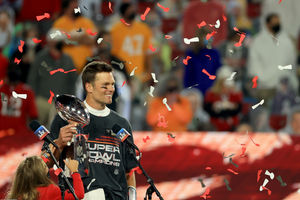
Tom Brady #12 of the Tampa Bay Buccaneers hoists the Vince Lombardi Trophy after winning Super Bowl LV at Raymond James Stadium on February 07, 2021 in Tampa, Florida. The Buccaneers defeated the Chiefs 31-9.
Photo credit: Mike Ehrmann | AFP
To be fair, the NFL’s crown jewel is a cultural spectacle that’s part gladiatorial showdown, part Broadway production, part national therapy session. It’s where strategy meets spectacle, where brute strength tangoes with Michael Jackson’s choreography.
Yet, even at its loudest, the Super Bowl remains a distinctly American religion. The Super Bowl draws around 100 million viewers every year, give or take. An impressive figure, until you realise that the Fifa World Cup Final attracts an audience north of 1.5 billion, a population so large it could fill all of Africa 1.2 times over.
When Lionel Messi scored his penalty in the final of 2022 Fifa World Cup in Qatar, whole neighbourhoods in Africa erupted in jubilation. Strangers in striped black-and-blue jerseys hugged like long-lost cousins. The World Cup is a lively global wedding where everyone is invited, from the samba-dancing Brazilians to the chanting Germans.
Argentina captain Lionel Messi lifts the Fifa World Cup trophy following their victory over France in the final of the 2022 Fifa World Cup at Lusail Stadium in Doha on December 18, 2022.
Photo credit: File | AFP
Meanwhile, when Patrick Mahomes threw a touchdown in Super Bowl LVII, only a handful of Kenyans followed it live, mostly insomniac sports analysts, American expats, and the die-hard enthusiasts in darkened bars who can explain what a “4th and inches” actually means. For America, in its soul, it’s a fortress. They don’t want to be part of a global conversation; they want to be the conversation.
The Super Bowl might own Sunday night in America, but the World Cup owns the sun itself. Now, let’s be kind to our gridiron brothers. American Football is chess dressed as war, with every play drawn up with mathematical calculators.
But it’s also a game where you can spend four hours watching what amounts to 11 minutes of actual action. Soccer, by contrast, doesn’t need commercials to sell drama. The suspense is organic, brewed in 90 minutes of thrillers. It’s the long sigh before a counterattack, the heartbreak of a mistimed offside, the tearful glory of a late winner. The ball keeps rolling, and so does our pulse.
In our world, the ‘advert’ is a nuisance. It’s the three minutes you use to run to the kitchen to check on the boiling ugali water. In the Super Bowl, the commercials are the scripture. Companies spend $7 million (about Sh900 million) for a 30-second spot. Americans don’t watch the Super Bowl despite the ads; they watch it for them.
Imagine if, during the World Cup final, you were more excited about the new Safaricom campaign than Messi’s free kick. That is the madness of the Super Bowl. It is a celebration of capitalism where the scoreboard is often secondary to the stock price. The NFL earns roughly three times the annual revenue of the English Premier League. It is a machine designed to conquer. As Pelé once remarked, “The more difficult the victory, the greater the happiness in winning.”
Three-hour bloody contest
“The cost involved in entering the stadium for a three-hour bloody contest disguised as sport is not just obnoxious but unimaginable. It is profligacy in its worst form, spending over Sh2 million for a contest that will take at most three hours. There are also other expenses outside the stadium like alcohol, food, gas and a plethora of other costs,” offers Omulo Okoth, a former Sports Editor in Kenya and a fan of the Seattle Seahawks in Lynnwood, Washington.
He adds: “On the other hand, it is a veritable manifestation of the power of sport and America’s ability to showcase and export their pop culture to the rest of the world of sports, music, flick and fashion. I agree with sports science don, Prof Vincent Onywera, the Deputy VC at KCA, about his characterisation of the Super Bowl as showing ‘the power of sport’.”
In American Football, there’s strategy in stillness, beauty in the collision, and poetry in the pause. In soccer, there’s poetry in motion. Both sports make their disciples weep, only the rhythm of the tears differs. To Kenya’s credit, we do love a spectacle. And no one stages one quite like the NFL.
The Super Bowl halftime show is the spear of entertainment. High, majestic, and perilously expensive. We’ve seen legends rise in glitter and fall into internet memes, from Janet Jackson’s wardrobe controversy to Rihanna’s midair maternity cameo. It’s less a concert than a declaration of imperial confidence, America saying, “The game is great, but so are we.”
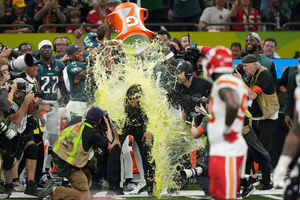
Philadelphia Eagles head coach Nick Sirianni is dunked with gatorade during the second half of Super Bowl LIX at Caesars Superdome on February 9, 2025.
Photo credit: Kirby Lee | Reuters
The closest we get to that magnitude of halftime pizzazz is probably at the Safari 7s rugby tournament. There, DJs spin, fans dance under the Nairobi sun, and everyone pretends they still know the rules of rugby after the third beer.
The World Cup, though, doesn’t need to stage its emotion; it embodies it. When the national anthem plays before kickoff, entire nations hum in communion. Nobody lip-syncs. No fireworks are needed. The stadium itself burns with the collective heat of 80,000 dreams.
Omondi Tunya, a sports fan in Dallas, Texas, observes: “Culturally, it is the closest to the American mindset of bravery, heroism and war. All games are high-stakes because there’s very few of them (17 per season so each one matters. The Super Bowl is the ultimate process that could grant someone immortality. It’s been highly commercialised and endless efforts are spent to improve the product from TV screening to merchandise sales. Add the practice of tailgating on game days and you have the perfect combo for passing time on a Sunday.”
The Super Bowl may have ads that cost more than Nairobi’s annual water budget, but soccer offers something money can’t buy, which is universality. You don’t need a helmet, a billion-dollar stadium, or six referees with PhDs in rule interpretation. All you need is a ball (or something vaguely round) and enough space between two rocks to serve as goalposts. That’s why in Africa, kids play soccer barefoot at dusk, the ball often a bundle of newspapers and nylons reborn as destiny.
Bad Bunny (center) poses with Ebro Darden (left) and Zane Lowe during the Super Bowl LX halftime show press conference at Moscone Center on February 5, 2026.
Photo credit: Kirby Lee
You rarely see kids in pads tackling each other for touchdowns. Our mothers wouldn’t even let us try. In America, football is a franchise. In Kenya, Africa and most of the planet, football is identity. Still, the Super Bowl deserves our respect. Its choreography, storytelling, and sheer scale mirror what Americans do best, which is turning competition into culture.
And in a globalised age, maybe that’s exactly what the NFL is chasing. Converts. As the great Andrea Pirlo said, “Football is played with your head. Your feet are just the tools.” In American Football, the head is a computer, and the body is a battering ram. When a quarterback throws a ‘Hail Mary’ pass, it is the same desperate prayer we feel when the Harambee Stars need a goal in the 90th minute. It is the same spirit Cristiano Ronaldo spoke of: “I’m not a perfectionist, but I like to feel that things are done well.”
Already, you’ll find Kenyan fans of the New England Patriots and Seattle Seahawks forming WhatsApp groups, trading memes, and arguing about whether Tom Brady can truly be called the GOAT when he no longer plays. The spark is there; perhaps one day, the flame will burn brighter. Until then, we can enjoy the Super Bowl as curious pilgrims at a foreign temple, admiring its rituals, savoring its intensity, but still whispering to our round soccer ball, “You’re still the one.”
After all, in sport, there’s room for both the pigskin and the planet. The Super Bowl may belong to a nation, but the World Cup belongs to us all.