Hello

Your subscription is almost coming to an end. Don’t miss out on the great content on Nation.Africa

Ready to continue your informative journey with us?

Hello

Your premium access has ended, but the best of Nation.Africa is still within reach. Renew now to unlock exclusive stories and in-depth features.

Reclaim your full access. Click below to renew.

Impala RFC
Caption for the landscape image:

How Impala Floodlit rugby tournament was started

Scroll down to read the article

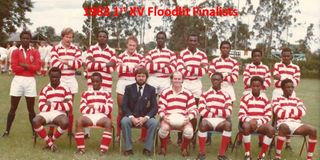
The 1983 Impala Floodlit losing finalists, Impala RFC.

Photo credit: Pool

The 42nd edition of the annual season opening Impala Floodlit kicks off next weekend. The draw will be conducted on Friday.

The tournament, hosted by Impala RFC and the Impala Club, was first played in March 1983.

Impala RFC

The 1983 Impala Floodlit losing finalists, Impala RFC.

Photo credit: Pool

It is safe to say that none of the players who will feature in this year’s tournament were born when the oval ball was kicked at the Ngong Road-based club 42 years ago.

So how did this tournament come into being?

“The concept of the Floodlight tournament was introduced alongside the lines of split rugby, which was used in the Kenya Cup between 1974 and 1979. This involved Kenya Cup sides fielding two teams of approximately equal strength,” says Peter Giraudo, a Kenyan journalist who practiced his trade in the 1970s and 1980s and was also the chairman of Impala RFC in 1983 and 1984.

Split rugby was abandoned at the Kenya Cup in 1980 because some teams were unable to raise two sides. Impala Club also introduced floodlights in 1982 to allow adequate training time for players, up to 8.30pm.

“When we introduced the Floodlit tournament in 1983, we decided to revive the split side concept,” said Giraudo. “The concept was borrowed from Zambia where the East Africa Tuskers toured in 1975 and again in 1979. The Tuskers had played some of their matches under floodlights.”

Impala floodlights

Kenya Rugby Union President Sasha Mutai and Safaricom's Fawzia Ali hand over the Impala Floodlit trophy to Menengai Oilers on November 2, 2024 at Impala Club, Nairobi.

Photo credit: File | Nation

Impala Club erected floodlights in 1982. The playing unit then complained of the extended training sessions, but it soon became a normal routine.

“I suggested it be a tournament in late February or early March and the Kenya Rugby Football Union (KRFU) agreed to give it a go. This might generate revenue for the club, which we badly needed. I proposed it would give Impala something really different and was a gamble worth taking,” Giraudo explained.

“Dave Rondell, our second XV prop, was working at Masinga Dam and was able to sell us very cheaply three huge lighting towers. The then chairman of Impala main club, Dan Mwendwa, was an engineer and helped supervise the towers and pylons, whilst second XV player Ron de Haay had some influence with the Dutch Embassy and Phillips, a Dutch company. Lo and behold, we were able to get a set of powerful floodlights duty free,” Giraudo recalls.

The inaugural tournament was a roaring success. Matches were held on Wednesday and Saturday to overflowing crowds that almost overwhelmed Impala resources. Giraudo talks about a huge gate revenue and bar sales that went off the chart.

“The Floodlit became the place to be seen socially for young and upwardly mobile young Nairobians, and branched quickly into post-match social events, side shows, concerts and merchandising, bringing a new side to rugby of a festival atmosphere to 15-a-side games, and a very big new audience of young Kenyans. The event became hugely popular for many years and whose success the committee and I hoped for.”

Impala floodlights

KCB Rugby players celebrate as they lift the Impala Floodlit Rugby tournament trophy on November 12, 2022 at Impala Club.

Photo credit: File | Nation

The inaugural tournament involved 10 teams: Nondescripts Lions and Nondescripts Tigers, Impala Gazelles and Impala Boks, Kenya Harlequins Ruffians and Kenya Harlequins Vandals, Mwamba Vumbi and Mwamba Umeme, Barclays Bank, and Lenana School.

“Mwamba Vumbi powered their way into the semi-finals after beating Impala Boks 20-3. Chris Lee of Boks was red carded by centre referee Emman Akatsa. Nondescripts Lions dispatched Kenya Harlequins Vandals 26-6 to also qualify for the semi-final. Andy Pryce, David Evans and Bruce Evans scored four tries with David kicking a drop goal as Skipper Pryce kicked a conversion,” the Daily Nation reported on March 12, 1983

Four days later, on a Wednesday, Gazelles beat Harlequins Ruffians 24-8 while Lions eliminated Vumbi 30-9 in the semi-finals.

Reported the Daily Nation on March 16, 1983:

“Geoff Radier of Gazelles intercepted a Quins pass and ran through unchallenged to score. Radier scored a second try late on. Ken Mulli intercepted another Quins’ pass to score a try. Mike ‘Tank’ Otieno kicked three penalties for the hosts. Beth Alunga Omolo and Cliff Mukulu scored a try each for Quins but Frank Ngaruiya missed the conversions for the result. In the second game, Mwamba Vumbi ran into the peerless kicking of David Evans who scored 22 points. The Nondies pack wrecked the Vumbi pack, giving scrum half Bruce Evans a field day.”

The final was played on March 19, 1983, on a Saturday. Nondescripts Lions showed their hand by fielding seven East Africa Tuskers players including David Evans, Bruce Evans, Rod Evans, Andy Pryce and Allan Ramsey.

Impala were led by captain George Kelly, Kenya 15s internationals Joe Masiga, “Tank” Otieno, Ken Sagala and Nesbitt Wesonga as well as Geoff Radier of Watembezi Pacesetters. The powerful Nondescripts side won 12-0.

Impala floodlights

Members of Resolution Impala Saracens team winners of the Impala Floodlit tournament on October 15, 2016 at Impala Rugby club grounds.

Photo credit: File | Nation

David Evans kicked two drop goals and two penalties. Masiga made powerful runs but each time he was neutralised by the white shirts defence. “Tank” Otieno inexplicably missed three penalties. Kenya’s then Attorney-General Mathew Guy Muli presented the trophy to the team and the Most Valuable Player award to David Evans.

Impala Club collected Sh10,000 from the gate, according to Giraudo.

But hosts Impala had to wait until 1999 for their first Floodlit title. In 2011, the tournament was held twice in one season as the Union moved to align with the international calendar.