The ODM party is in a profound state of flux, its every deliberation a live wire sparked with uncertainty—and not even the poignant tributes to Raila Odinga's would-be 81st birthday last Wednesday helped to seal the cracks.
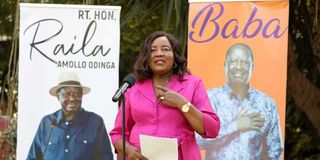
As the drama unfolds, Ida Odinga, the matriarch whose influence has long been the quiet and effective engine behind Raila's throne, has stepped in.
Now, in the wake of Raila’s absence, she is emerging not just as a mourner, but as the moral and strategic anchor for a movement adrift under the stewardship of her brother-in-law, Dr Oburu Oginga.
Her handlers say she has been forced out of the shadows in an attempt to save the Orange party from potential schism.
“My husband left you a thriving party. You must keep it vibrant and strong, if not for anything else, at least do so in honour of his memory,” she told a gathering of party stalwarts at her home last week, according to an account corroborated by two of the guests.
During Wednesday's gathering at the Odingas’ Karen residence, where mourners donned customised Arsenal jerseys in homage to Raila's football passions, Ida's voice cut through the haze with resolute clarity; “Baba had another love, and that is the love for ODM."
Ida reflected on the man and the politician, underscoring his dual devotion to family and the party he built. In appeals laced with both grief and command, she is urging unity in the Orange party and lending her authority to steady the ship now tossed about by the winds of grief and loss of its leader.
She said: “It is my wish that we can preserve ODM party in Raila's honour as a matter of service to our country.”
Supporters are increasingly vocal, some using their social media handles to suggest that she should take up ODM leadership, recognising her as the power behind Raila’s political throne and the custodian who shaped his strategies for decades.
Behind closed doors, Ida is navigating intimate family tensions—clashing subtly with her daughter Winnie Odinga over the party's direction—while publicly steering toward reconciliation.
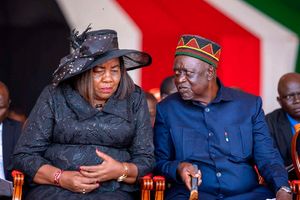
Mama Ida Odinga and Siaya Senator Oburu Oginga during Raila Odinga’s funeral in Bondo, Siaya County.
Photo credit: File | Nation Media Group
Her role is charged with future promise: Could this matriarch, drawing on Raila's playbook, reinvigorate the Orange dream and guide its disciples into a post-enigma era? Would she want to?
Winnie belongs to the category of the young and restless in ODM, who are largely opposed to the broad-based government arrangement with President William Ruto.
Amid the swirling undercurrents of grief and renewal in ODM, a torrent of "young blood" is surging forward, infusing the party with raw vitality that could either fortify its core or ignite its break-up.
Controversial Embakasi East MP Babu Owino epitomises this fierce ambition, posting on social media on Friday: "We want ODM to call a National Delegates Convention (NDC), it’s time to take over the party leadership. ‘Baada ya Baba ni Babu. Babu Kwa Sababu. Bila Babu Tabu’ ."(After Baba is Babu. Babu for a Reason. Without Babu, it’s Trouble"). His slogan appears to demand a generational shift, positioning him as the heir to Raila's youth-mobilising legacy.
At the same time, activist Kasmuel McOure, catapulted into fame during the June 2024 anti-tax protests yet untested at the polls, is aggressively vying for influence. He claims to be the acting ODM secretary-general and declared that Edwin Sifuna's days in the office are numbered. Recruited to energise Gen Zs and expand membership, supporters of Kasmuel's push believe it could revitalise ODM's ageing framework, drawing in disillusioned young voters through digital activism and fresh ideological fire.
Yet, this explosive youthful energy wields a razor-sharp edge, threatening to shred ODM's fragile unity amid its grieving haze. Babu's brazen call for a delegates’ convention risks sparking brutal infighting, alienating elders and mirroring the fractures that doomed Raila’s father Jaramogi Oginga Odinga's Forum for the Restoration of Democracy (Ford), as premature power grabs clash with the party's mourning ethos.
Kasmuel's unproven bravado — marked by sidelining accusations and ouster threats against Sifuna — could breed opportunism, turning internal elections or 2027 nominations into savage battlegrounds that scatter Raila's 6.9 million voters into disillusioned shards.
If unchecked, this zeal might accelerate atrophy, but harnessed by experience and wisdom from the party elders, it could forge a fiercer ODM, blending legacy with innovation to charge boldly into the future.
Nearly three months after Raila's passing on October 15, 2025 —following the high-level dashed hopes of his African Union Commission bid—the party he moulded into Kenya's opposition powerhouse is navigating a metaphorical fog of grief.
Psychologists often describe how humans traverse the stages of grief, as outlined by Elisabeth Kübler-Ross: denial, where loss is rejected; anger, erupting in blame and frustration; bargaining, seeking deals to reverse the irreversible; depression, a heavy cloak of despair; and acceptance, where a new reality takes root.
ODM, as a collective organism of ambitions, loyalties, and ideologies, appears to be walking a similar path — denial manifesting in hurried leadership handovers that pretend continuity, anger flaring in factional accusations, bargaining unfolding in tentative alliances, depression shadowing whispers of irrelevance, and acceptance glimmering as a potential rebirth.
This is not a mere metaphor; it's the party's pulsating reality, a philosophical reckoning that charges the air with both melancholy and electric possibility.
As Kenya hurtles toward the 2027 General Election, ODM is teetering on a precipice: Will it coalesce around Raila's enduring philosophy, or splinter like the political winds that scattered Jaramogi Oginga's legacy?
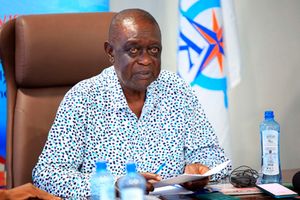
ODM party Secretary-General Edwin Sifuna
Photo credit: Dennis Onsongo | Nation Media Group
Raila Amolo Odinga, the engineer who became Kenya's ultimate political puzzle, had ascended to a stature that blurred the lines between opposition leader and de facto head of state. From his detention-defying days to engineering the 2010 Constitution and forging multi-ethnic coalitions, Raila's philosophy—a potent mix of social justice, devolution, and pragmatic alliances—mobilised millions.
In the 2022 elections, he commanded 6,942,930 votes (48.85 per cent), a mere whisper behind William Ruto's 7,176,141 (50.49 per cent), proving his machine's enduring pull.
“Raila taught us that leadership isn't about the seat; it's about service," Ida said in her tribute, painting him as a family man and fighter whose enigma still haunts Kenyan politics.
Yet, without him, ODM is murmuring over its inheritance: What becomes of those 6.9 million-plus votes? The disciples of Raila's philosophy — grassroots organisers, youth mobilisers, and ideological purists — are watching intently, their fate intertwined with the party's trajectory.
Ford splintered in the early 1990s into Ford-Kenya (led by Jaramogi), Ford-Asili (Kenneth Matiba), and later Ford-People (Simeon Nyachae).
That fragmentation diluted the opposition's punch against Daniel arap Moi's regime, a cautionary tale now echoing in ODM's halls. Will Raila suffer a similar posthumous fate? The answer is unfolding in real time, charged with the energy of possibility and peril. Key players are personifying this tension.
Edwin Sifuna, ODM’s silver-tongued secretary-general, is extending gestures of peace amid the storm after Ida’s intervention: "We may never stop mourning," he vowed this week after days of throwing and receiving political brickbats "I won’t wreck ODM; I'm ready to talk."
His recent parley with interim leader Dr Oburu Oginga, Raila's elder brother, centred on "unity and growth," yet unresolved accusations against Junet Mohamed for fumbling the 2022 campaign funds hang like storm clouds. The Suna East MP has fired back while facing labels such as “traitor” or “mole.
The broad-based government — Raila's "handshake 2.0" that embedded ODM ministers like John Mbadi (Treasury) and Opiyo Wandayi (Energy) in Dr Ruto's Cabinet — is the fulcrum of division, a bargaining stage incarnate. Purists decry it as a betrayal of opposition fire, while pragmatists hail it as Raila's "dying wish" for stability.
Some Western heavyweights like CS Wycliffe Oparanya are mulling exits, Kisii and Coastal alliances fraying, potentially reducing ODM to a Luo Nyanza enclave.
"I think as Raila was exiting, he wanted stability in the country, and he had accepted President Ruto to be a leader. Baba left ODM in the broad-based government," the Central Organisation of Trade Unions Secretary-General Francis Atwoli said recently during a Citizen TV interview, suggesting Raila's tacit blessing.
“After Raila Odinga, there is no opposition in Kenya,” Atwoli said.
Embakasi East MP Babu Owino speaks during the World Teachers Day Celebrations at Kenya Science Campus in Nairobi on October 5, 2025.
Photo credit: Lucy Wanjiru | Nation Media Group
Imagine the scenarios unfolding: In rebirth, Ida’s guidance fuses with Sifuna’s eloquence and Babu’s fire, channelling the 6.9 million votes into a unified bloc. Yet, if anger and depression prevail, collapse beckons. Factions break away, votes scattering into pieces, some to Ruto’s fold, others to nascent parties, just like Ford’s fate.
This weekend, as Kenya pauses, ODM’s haze invites reflection: Raila’s enigma endures, charging the future with questions. Will the disciples unite, or disperse? The 2027 horizon beckons—highly charged, profoundly uncertain, but ripe for reinvention. The Orange path, still murmuring, awaits its decisive stride.