In the rolling epochs, from one to another, nations are faced with the task of making impactful choices. These are decisions that define directions for a community, city-state, or an interest group that would guarantee survival, stability, and prowess over a visionary timeframe. That is the position in which the Luo, as a people, are today. It is certainly not the first time.
Right from the Pharaonic times in the Nile Valley and into the Rumbek area of Sudan, hard decisions had to be made by the Luo. The hard choices, either due to shrinking land space, strife, or conflicts, had to be made. Narratives abound that inform us that the migratory dispersal of the Luo was at times the result of Abrahamic and heart-rending choices.
The migrations spread the Luo into lands as far as Chad, the Congo, Ethiopia, Uganda, Tanzania, and Kenya, among others. The splitting of the Luo people into the mentioned countries was as a result of boundaries forced by colonisers in the 19th century.
As Kenya walked into independence in the early 1960s, the question of how and who was to lead in the governance of the country emerged. Like with other African nations, it would soon dawn on the Kenyans that the colonial masters had meticulously engineered divisive sentiments that would pit socio-cultural entities against each other.
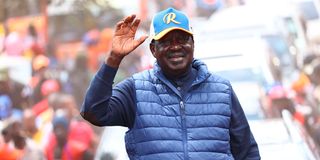
Former Prime Minister the late Raila Odinga.
Photo credit: File | Nation Media Group
At independence, the Luo of Kenya were already a tightly molded and formidable polity, claiming space in all spheres as rightful citizens. Fierce competition emerged for power, resources, and other interests. Kenyans proudly celebrated independence and then started the struggle on how to steer a nation of well over fifty ethnicities. It was yet another period of grave concern to communities, including the Luo. Hard decisions had to be made.
At the formation of government, the Luo were in the independence party, the Kenya African National Union (Kanu). Jaramogi Oginga Odinga became the vice president, with a number of Cabinet ministers and other senior positions occupied by the community’s sons and daughters. That did not last long. Ideological differences caused a clash between the President and his vice president. Jaramogi’s formation of an opposition party, Kenya People’s Union (KPU), in 1966 initiated rivalry that also split the communities of the two titans. Jaramogi was detained, KPU banned in 1969, and Kenya became a one-party state by law.
The feeling of victimisation was entrenched. This went on to the end of Jomo Kenyatta’s rule in August 1978. Then came Daniel arap Moi’s rule that lasted 24 years. Since Moi had decisively opted to follow Mzee Kenyatta’s footsteps (Nyayo), not much changed in terms of the placement of the Luo.
Fourteen years into Moi’s rule, Jaramogi led the tumultuous struggle for multiparty politics in Kenya. The church’s voice was very strong and even became international: Desmond Tutu of South Africa and Angolan Dr Jose Chipenda would at times appear in Nairobi to give a push to the protestations for multiparty democracy.
In the early 1990s, Moi relented, and Kenya held the elections of 1992 under a multiparty system. Jaramogi passed on in 1994 and left a fairly conspicuous opposition political party, Ford-Kenya.
With the death of Jaramogi, there was no doubt that there would be need for a kingpin for this politically conscious and expressive community. A decision had to be taken.
After upheavals in Ford-Kenya, Raila exited and used the National Development Party (NDP) as landing gear. With NDP, Raila got 21 MPs in the 1997 elections. By 2000, Raila started cooperation with Moi’s Kanu, dissolved NDP, and some of Raila-leaning MPs got appointed to the Cabinet.
There was hope that Moi would hoist Raila as his successor. Moi preferred Uhuru Kenyatta instead. Decisions had to be made. Raila took the Liberal Democratic Party (LDP) and grafted it to the National Rainbow Coalition (Narc), from where his rendition of Kibaki Tosha rang out. NARC went on to decisively win the 2002 elections with Mwai Kibaki as President.
Shockingly, the signal that Canaan was still far off for the Luo came the very afternoon that Kibaki was sworn in. Operatives denied Raila free entry into Kibaki’s residence at Muthaiga and restricted visits to State House. Subsequently, the Narc government was one of the very shifty relations. It is in this situation that the 2007 elections came.
These were the darkest elections in Kenya’s history. They are still the darkest in that since then, no presidential election has ever been decided at the ballot. The situation has been that the election is won and not won. The 2007 presidential election was a complete debacle: Kibaki won but did not win, Raila won but did not win. The presidential election morphed into all-out violence and stopped being a solely Kenyan affair. At the internationally convened negotiations, William Ruto was playing hardball on Raila’s side, while Martha Karua stood rather hard on Kibaki’s wing. Under Kofi Annan, the Grand Coalition government was patched. Kibaki was President while Raila became Prime Minister. Settled?
Former President Mwai Kibaki and former Prime Minister Raila Odinga.
Photo credit: File | Nation Media Group
Not just yet. Some aspects of the happenings had to be processed at the International Criminal Court (ICC) at The Hague. Paradoxically, that is where the twinning of Uhuru and Ruto was brewed.
As it turned out, in the 2013 General Elections Uhuru Kenyatta vied for the presidency with Ruto as his running mate. Raila’s Orange Democratic Movement (ODM) joined the Coalition for Reforms and Democracy (Cord). Uhuru won but did not win. The results were contested at the Supreme Court.
In 2017, Raila again went into the elections against Uhuru. Raila was flying the flag of the National Super Alliance (Nasa). The incumbent was with Ruto as his running mate under Jubilee Alliance with the Tuko Pamoja rallying call. Again, Uhuru won but did not win. The contestations reached the Supreme Court, which, in an unprecedented judgment, agreed with Raila that the presidential elections were conducted unconstitutionally and ordered a repeat. Chief Justice David Maraga received accolades from the world over. The Luo, for once, felt that their god was just.
Raila rejected the repeat polls and continued street action. Miraculously, and politicians being who they are, in March 2018 the animosity between Uhuru and Raila thawed and the reworking of relations bore the famous Handshake. In the strangest cause-and-effect realm of politics, the easing of relations between Raila and Uhuru revealed the bleeping signs that things were no longer at ease in the Uhuru–Ruto alliance.
The famous handshake between President Uhuru Kenyatta and former Prime Minister Raila Odinga at Harambee House in 2018. JEFF ANGOTE | NATION
In the elections of 2022 that pitted Ruto against Raila, Uhuru was tightly on Raila’s side. Martha Karua, who presumably would have hurled anything at Raila in the fiasco of 2007/8, was his running mate. Ruto won and did not win, and the decision on those elections reached the Supreme Court. Then in 2024, it got settled in what was christened the Broad-Based Government.
On October 15, 2025, the sun rose with the news hitting like a thunderbolt that Raila had died. The gap Raila left in Kenyan, and particularly Luo, politics is mindboggling.
It would seem that in all the cycles of elections, party formation and angling for formation of government and seeking state power, the Luo had come to trust Raila to have a decision and a choice. Indeed, as it turned out, he, Raila, was the choice. So now, with general elections at hand and an imminent formation of government, what is to be done? Options have to be dexterously sifted.
The first option that comes to mind is to find a kingpin for the community. On this, the majority agree that a kingpin of the stature of Jaramogi and Raila shall emerge. It is never an elective position, never by appointment, nor through selection. The people watch how one handles public affairs, one’s thoughts, words, judgment, and sagacity. Can one unflinchingly stand between danger and the community? It is through these that one’s mettle is discerned, and through these one emerges.
Secondly, Raila passed on in the circumstance of an election just months away. Can the Luo go it alone? The Kenyan ethno-fabric is such that seeking state power requires coalition – a huge coalition at that. The question is, coalesce with whom? ODM, the party that Raila led, is an opposition party. Should ODM coalesce with the opposition? Arguably, political logic does not run in such a linear trajectory. Or does ODM present a presidential candidate?
Thirdly, the community and ODM, the party to which a big number belong, are in a political relationship with President Ruto’s government in what is called the Broad-Based Government. Should the Luo coalesce with UDA in Kenya Kwanza? Is there viability in that political maneuver? Again, political decision-making requires complex, novel consensus-building, and there is never a one-answer-satisfies-all solution.
The processing of a choice shall require careful and calm but timely conclusion in view of the approaching elections, the need for communal survival and stability,and in the dream of pursuit of sustainable prowess in the centuries to come. Just like in the solemn Luo Doho (assemblies) that deliberated on motions in which decisions were made right from the generations in the Nile Valley, religio-political discussions would have to settle on a choice in this era. It should be a choice that pleases the constellation of ancestors in the heavens.