Billions in debts, millions lost in unbilled water and high employee costs continue to dog Coast region water companies with most staring at shutting down, a new report has revealed.
The damning report by the Coast Water Works Development Agency (CWWDA) has laid bare the rot in five water firms in the region which have been choking in debts, grappling with governance issues and are unable to optimally meet water demands by residents, resulting in water rationing.
According to the report, the utility firms owe a staggering Sh30.9 billion to development partners through CWWDA, where some Sh19.84 billion is due for repayment.
The ballooning debt, which continues to accrue interest, are loans taken by the agency from development partners such as World Bank to finance projects across the Coast region, including development and rehabilitation of water sources, bulk water transmission infrastructure, water distribution networks and sewerage infrastructure, among others.
The non-performing loans date as far back as 2008 and have already accrued interests of more than Sh2.8 billion.
In an analysis of the outstanding debts due for repayment reveal that Sh6.54 billion has been outstanding for less than 12 months, while those over two years account for Sh12.7 billion, all owed to the World Bank.
“Despite provision for loan repayment, the Agency continues to experience non-remittance of amounts due from the respective water service providers, resulting in the accumulation of outstanding loan obligations,” said CWWDA chief executive officer Hamoud Mguza.
The report indicated that the utility firms are struggling with high levels of non-revenue water which reduces revenue available to meet operational and financial obligations as well as aging infrastructure.
Water Vendors queue to have the commodity at a Water Point in Bomu area within Changamwe, Mombasa in this photo taken on 28th August 2026. Mombasa is among the Coastal Counties Cut off from the Bulk Water Suppliies after failing to settle Outstanding Bills.
Photo credit: Kevin Odit | Nation Media Group
The Water Services Regulatory Board (Wasreb) was also damning in its assessment of the water companies, saying the service providers from the Coast are performing the worst compared to the rest of the country.
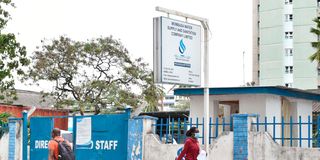
Wasreb revealed that Mombasa Water Supply and Sanitation Company was at one point put under special regulatory regime – a last ditch effort before putting a company under receivership or shutting it down because it is unable to operate optimally.
Mombasa Water is grappling with historical debts amounting to Sh1.47 billion and high non-revenue water of 49 per cent, above the allowable threshold of 25 per cent.
The company is also faced with significant cash flow constraints as well as high operational and maintenance costs. The triple threats have impacted the firm’s ability to generate revenue to meet operations and debt obligations.
“Most of the firms are technically insolvent and will need restructuring. Their overheads are higher than revenue they generate and hence cannot meet their obligations,” said Senate County Public Investments and Special Funds Committee chairperson Johnes Mwaruma.
“For instance, Tavevo generates Sh31 million but needs more than Sh45 million annually to operate optimally. There is a need for an urgent roundtable between the stakeholders to find a solution,” added the Taita Taveta senator.
Dilapidated infrastructure
In the financial year ending June 30, 2026, according to the report, Mombasa Water generated 10 million cubic meters of water against a demand of 85.9 million cubic meters, meeting only 11.6 per cent water demand by residents.
During the period under review, Kilifi Mariakani Water and Sewerage Company supplied nine million cubic meters against a demand of 32.3 million cubic meters, meeting just 27.8 per cent of the demand.
For Malindi Water and Sewerage Company, the firm supplied eight million cubic meters of water against a demand of 15.69 million cubic meters translating to 50 per cent of the demand.
Malindi Water is dealing with a loan of Sh539 million with no view of what the money did and historical liabilities dating back to pre-devolution. The firm is unable to provide reliable and affordable water to residents.
On the other hand, Kwale Water and Sewerage Company supplied five million cubic meters of water against a demand of 27.63 million cubic meters, a paltry 18 per cent of the demand.
The utility firm is grappling with a wage bill of Sh6.5 million as well as dilapidated infrastructure leading to high levels of operations and maintenance costs. During rationing, residents only get water for 14 days in a month.
Lastly, Tavevo Water and Sewerage Company supplied 4.5 million cubic meters of water against a demand of 15.4 million cubic meters, translating to 29.2 per cent of the demand.
The company is struggling with debt obligations of more than Sh949 million having risen from a paltry Sh1.27 million at the advent of devolution.
On matters labour practice, Mombasa Water managing director Habiba Ali has also been acting for 18 months with Mombasa County Water CEC Kibibi Abdallah, saying her confirmation has been pending due to her confirmation letter having “some typos that they are rectifying”.
On the other hand, Kilifi Water Company where managing director Catherine Baya has been acting for one and half years whereas also the technical manager has been acting for a year.
The firm said they have been operating without a Board with a new one being set up just three months ago in July.
“This is unfair labour practice to have individuals act for more than six months without being confirmed,” he said.