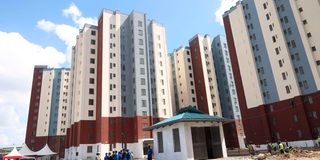
It was a spectacular sight as residents of Mukuru Phase II, Embakasi South, Nairobi, received keys to their brand-new homes in fourteen-storey apartment blocks under the government’s “Boma Yetu” initiative.
When President William Ruto arrived to open the gate and officially hand over the houses, the community erupted in song, dance, and ululations, celebrating dreams finally realised.
For the first time since independence in 1963, Mukuru residents will spend the festive season in proper homes, complete with running water and electricity.
Mukuru, along with Kibera and Mathare, is among Nairobi’s most notorious informal settlements, housing the city’s semi-skilled and casual wage workers. The slums are plagued by illegal electricity connections, frequent electrocutions, open defecation spreading disease, high crime, and poor access to jobs and infrastructure.
These informal dwellings highlight the consequences of unplanned urbanization outpacing housing and infrastructure. Each year, about 277,000 Kenyans aged 20–24 move to cities, driving urban growth of 4.3 percent. With the private sector supplying only 50,000 new homes annually, a gap of over 200,000 remains. By 2050, more than half the population is expected to live in urban areas, underscoring the urgent need for housing to prevent slum expansion.
An affordable housing project. Two Kenyans have challenged President William Ruto's plans to allocate teachers and the police 20 percent each of the affordable housing units.
Photo credit: File | Nation Media Group
Migration is driven by economic opportunities, better services, and environmental pressures like climate change that reduce agricultural yields. Cities such as Nairobi, Kiambu, and Kajiado experience high population gains, straining infrastructure and services, fuelling informal settlements, and leaving labour shortages in rural areas. Informal dwellings proliferate, often with poor conditions.
From 1958 to 1986, the National Housing Corporation (NHC) developed housing estates nationwide. Loans from the World Bank and other sources were channelled through the National Treasury to local authorities for urban housing development, sale, and management. This system delivered thousands of municipal homes and slowed slum growth.
The 1986 Structural Adjustment Programmes (SAPs) by the World Bank and IMF discouraged government housing investment, arguing that government should enable private enterprise rather than compete with it. Following this, the government largely withdrew, leaving housing to the private sector.
The private sector could not meet demand, creating a massive housing shortfall and triggering rapid slum expansion in major cities. Kenya soon became one of Africa’s top five countries facing severe urban slum challenges. Other countries with notable urban settlements include South Africa (Khayelitsha in Pretoria/Johannesburg), Nigeria (Ajegunle and Makoko in Lagos), Angola (Cazenga in Luanda), and Ghana (Agbogbloshie in Accra). Across Africa, rural-to-urban migration is closely linked to the uneven distribution of development resources, particularly in rural areas. Invariably, there is an inverse relationship between resource allocation and the desire to migrate. In Kenya, for example, regions that have historically been underfunded tend to have disproportionately high representation in urban slums, making these settlements central to regional and ethnic politics.
The government’s recently launched affordable housing programmes are therefore instrumental in mitigating the challenges associated with rapidly expanding urban slums. By constructing decent housing in rural areas, young and educated people are encouraged to remain, easing pressure on already overstretched urban infrastructure. These housing projects also create substantial opportunities for economic growth and improved resident well-being. The benefits are numerous.
The construction phase generates thousands of direct and indirect jobs for skilled and unskilled Kenyans, including engineers, architects, quantity surveyors, project managers, welders, masons, and general labourers. Housing projects also stimulate local businesses and industries: demand for construction materials and services boosts manufacturing and supply chains, channels billions into the local economy, and supports small, micro, and medium enterprises (SMEs).
Simultaneously, local workers gain valuable hands-on experience and technical skills, preparing them for future employment beyond project completion. Increased economic activity gives residents higher disposable incomes to spend on local goods and services, strengthening rural economies and expanding the tax base. Moreover, these projects attract investments from private developers and financial institutions, as government support and a large pool of demand create a viable market.
Mukuru Housing Estate Phase 1, Nairobi, in this photo taken on May 27, 2025.
Photo credit: Wilfred Nyangaresi | Nation
Furthermore, decent housing provides access to dignified living. The primary goal is to offer safe, secure, and quality housing with essential amenities—clean water, sanitation, and electricity—uplifting the living standards of low- and middle-income households and moving families out of informal settlements. Good accommodation and living conditions contribute to better education and health outcomes.
Providing affordable housing to urban dwellers also promotes social integration and cohesion. Developing mixed-income housing units encourages a diverse mix of tenants, fostering inclusive urban growth and reducing the concentration of poverty in specific areas.
Home ownership enables families to build asset wealth, which can serve as a foundation for future investment and economic stability. Housing projects transform underutilized areas into valuable resources, supporting better urban planning and regeneration, while increasing land value across the country. Well-planned urban housing also helps manage population growth, curb urban sprawl, and incorporate sustainable building materials and renewable energy sources in line with climate goals. Additionally, housing projects often include supporting infrastructure such as roads, community centres, and health facilities, improving accessibility and making neighbourhoods more habitable.
In a nutshell, Kenya’s ambition of achieving developed-country status by 2030 will remain unattainable unless its citizens are guaranteed dignified living. With commitment and sustainable funding, the dream of affordable housing for all urban dwellers is achievable. However, a few loose ends need to be addressed. First, stakeholders must reach consensus on funding, costs, and the type and location of housing units to align supply with demand. Second, they need to agree on when projects will become self-financing on a sustainable basis. Third, houses should be allocated to the most deserving citizens. Finally, the government should explore opportunities for attracting private equity to finance housing projects through the Public-Private Partnership framework, which could help resolve the perennial problem of inadequate government funding.
In conclusion, while civil society and politicians must remain vigilant to ensure value for citizens’ money in all government projects, endless politicking harms the economy as potential investors seek alternative destinations.
Professor Ongore is a Public Finance and Corporate Governance Scholar based at the Technical University of Kenya. [email protected]