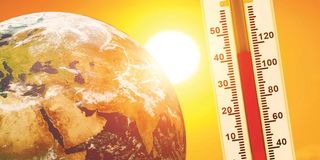
The United Nations Environment Programme has warned that long-term global warming was likely to exceed 1.5°C above pre-industrial levels within the next few years.

A new scientific report published this past week has given one of the clearest diagnoses yet of a planet moving rapidly into instability.
The 2026 State of the Climate Report, published in refereed journal, BioScience, tracked 16 indicators touching on the atmosphere, oceans, ice and land. Seven of these measures are at record extremes, while the others are either accelerating or changing abruptly.
According to the study, concentrations of major gases associated with climate change such as carbon dioxide, methane and nitrous oxide reached new records in 2026. Atmospheric carbon dioxide exceeded 428 parts per million in May, about 50 per cent above pre-industrial levels, ocean heat and sea level are at record highs, and glacier thickness and Greenland ice mass are at record lows.
Yet the report also captures a troubling paradox. Whereas low-carbon sources supplied roughly 43 per cent of global electricity in 2025, and renewable electricity overtook coal globally for the first time in more than a century, fossil fuel consumption also rose by 0.9 per cent, pushing energy-related carbon dioxide emissions above 41 billion tonnes.
In other words, the transition to renewable energy is expanding, but the transition is not yet displacing fossil fuels fast enough. The world is therefore adding clean energy while continuing to enlarge the system that created the crisis in the first place.
For Africa, this diagnosis is one more illustration of the argument the continent has made repeatedly that climate consequences do not respect historical responsibility. Communities that contributed least to accumulated emissions are already facing the most grave consequences of climate change and yet have the weakest infrastructure and least fiscal room to recover from the devastation. And for many countries such as Kenya, Uganda and the wider sub-Saharan region, a climate hazard can simultaneously pressure food, water, health, public budgets and household incomes.
Long-term global warming
Just last month, the United Nations Environment Programme (Unep) warned that long-term global warming was likely to exceed 1.5°C above pre-industrial levels within the next few years. According to the organisation’s latest edition of the Limiting Overshoot Report, studies found that even the best climate scenarios would still see global temperatures hit 1.8°C, or higher. In essence, the world must prepare for the possibility of exceeding 1.5 degrees Celsius before trying to return below it.
This is of course, a troubling state of affairs, but for now, it is apparently, the best remaining option after decades of inadequate action. Yet, returning below 1.5 degrees eventually, would not undo the damage accumulated during overshoot.
Sea levels could continue to rise for centuries, ecosystems may not recover and communities may already have moved and lost livelihoods and social connections.
For Africa, this means building the capacity to adapt to a climate problem that will keep changing. Yet desperately needed adaptation finance, remains structured around short projects. The roughly US$64 billion available in 2024, for instance, only met about a fifth of what developing countries will need each year by 2035.
There is no obvious or less problematic way of closing the gap. Plugging the hole through loans would deepen fiscal vulnerability, while routing more money through central governments and large infrastructure projects would still bypass frontline communities that need the money the most.
Going forward, therefore, the continent needs finance that is larger, more predictable and grant-based, with money, climate information and accountability flowing directly to the local institutions expected to do the adapting.
Fossil infrastructure
Some of this architecture, though imperfect, already exists. Kenya’s Financing Locally-Led Climate Action programme channels resources to county governments and to community committees that help set priorities. It shows that devolved climate finance can work when the people living with the hazard have a say in how money is spent. Models of this kind should be scaled up, not treated as pilots that are wound down when a donor cycle ends.
But Africa cannot rest the whole argument on the obligations of others alone. The same report that exposes the world’s failure to displace fossil fuels should be food for thought for governments on the continent that are eager to expand oil, gas and coal on the grounds that richer nations did so first. The claim to developmental fairness is legitimate, and difficult to argue with.
Yet critics argue that locking in fossil infrastructure for decades may expose African economies to stranded assets and to the very instability they are trying to escape.
From a sustainable development standpoint, therefore, the continent’s stronger case may well rest on its immense renewable endowment, its young population and its land, which, if managed regeneratively, can store carbon, restore soils and secure food at the same time.
The diplomatic test in the face of these sobering reports will be coming soon enough. When negotiators gather for COP31 in Antalya, Türkiye next month, the pledge made in Belém to triple adaptation finance by 2035 will need a credible delivery pathway.
Africa must not accept another round of headline figures that dissolve into loans and delayed disbursements.
The US$300 billion annual goal agreed in Baku already falls well short of what the continent and the rest of the developing world truly needs.
Letting it drift further would tell the world’s most vulnerable nations that overshoot is a risk they must absorb alone.
Dr Ageyo is the Editor in Chief of Nation Media Group - Uganda. He holds a PhD in media studies with research interests in science, environment and climate change communication