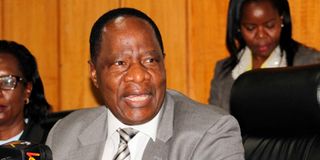
On Thursday, the nation laid to rest Dalmas Otieno Anyango. Dalmas was not just a politician, he was a force of history. Whether you agreed with him or not, you could never pretend he was not there.
Dalmas first entered Parliament in 1988, when elections were like school exams. You did not always choose whether you passed or failed. Even then, he cut a figure of seriousness. President Daniel Arap Moi spotted him early, and in Cabinet, he always asked Dalmas to speak last because colleagues knew he would bring a considered, intellectual view, not the sycophancy of the Kanu era. That was his gift: to be inside the system without being swallowed by it.
This is why, in 1997, when multiparty politics was still fragile, Dalmas was picked to chair the Inter-Parties Parliamentary Group (IPPG). The reforms he helped to hammer out on elections and media freedom opened the road to the democracy we enjoy today.
Later, in Kibaki and Raila’s Grand Coalition, he steadied the Public Service in a delicate environment that few could handle. He was the leader who read government circulars at midnight, not the one chasing cameras.
Yet he was also a man who understood the kitchen table. In the single-party days, he campaigned with salt and lesos, the cheapest gifts one could find but the most useful in rural homes. He could speak to the brain in Nairobi and to the heart in Rongo, sitting women on the grass to reason with them. That ability to switch gears, to be the intellectual in policy rooms and the barefoot mobiliser in the village, is why his name still echoes.
He knew both triumph and tragedy. He lost two sons in his lifetime. When a journalist once asked how he endured such pain, he gave the kind of answer only he could give: “We shift our attention to those who are alive.”
Dalmas believed in doing things in a big way. On encouragement from the failed Luo Thrift project, he founded Thabiti Finance. It later folded under the weight of politics, but it was a bold dream that the community should work to fulfil. Together with his neighbour Hezekiah Oyugi, he lifted Rongo with cottage industries and diaspora-fed livelihoods. It is no accident that Rongo is often said to have the highest per capita wealth in the region.
The casket bearing the body of former Rongo MP Dalmas Otieno during the funeral service at Kangeso Secondary School in Migori County on October 2, 2024.
Photo credit: George Odiwour | Nation Media Group
Dalmas carried himself with authority, always sharply dressed, always commanding the room. I first admired him as a boy in Rapogi High School, where he is an old boy.
Later, in 2012, after I quit my corporate job to run for the gubernatorial seat in Migori County, I met him at a funeral in Sigiria, where he was the master of ceremonies, and he gave me the microphone to speak. After I spoke, he told me: “Young man, I see you have a good brain.”
His politics could be hot-blooded. I still remember as a young man watching his contests with Linus Aluoch Polo (his cousin) and Ochillo Ayacko. Years later, when I sought the governorship, we locked horns. At the tallying centre in Rongo, my lead was overturned when the nominations were marred by violence elsewhere. The ticket was handed directly to another candidate. That is politics. Yet with Dalmas, rivalry did not preclude respect.
Over time we grew into a father-son relationship. At the Salaries and Remuneration Commission (SRC), his last post in public service, we shared long conversations. Even a week before his death he called me to share a few thoughts.
He never shied from strong opinions, even when they cut against the grain. Once, after a meeting with President William Ruto as part of the ODM Seven (immediately after the 2022 elections), he called me aside. “You are not wrong,” he told me. “Just make sure you follow through on the President’s promises. Government is a big machine. Things move slowly. There will be many words, but little action.”
Three years on, I see how right he was. We are in the broad-based government.
What should the younger generation take from him? Knowing the system from the inside gives you the tools to change it. That ideas can outlive failure. Kalausi his whirlwind political rebellion did not conquer, but the questions it raised about party democracy remain alive.