On May 23, 1960, Ghana’s founding president, Kwame Nkrumah, made an offer to British Prime Minister Harold Macmillan that could have altered the course of Kenya’s history.
According to archival records, during a private meeting at Number 10 Downing Street in London, Nkrumah suggested to Macmillan that he was ready to offer Jomo Kenyatta asylum in Ghana, where he would stay as his guest.
The request came amid the growing calls for the release of Kenyatta, who was still in detention in Lodwar on allegations of involvement in the Mau Mau rebellion.
Two weeks earlier, Kenya’s colonial Governor Patrick Renison had issued a long televised speech vowing never to release Kenyatta despite the growing pressure, accusing him of being a divisive figure.
The governor argued that Kenya needed unity among all its communities as it headed towards self-governance.
“At present, I have no evidence whatsoever that Jomo Kenyatta will help Kenya in these aims. I have much evidence to the contrary. I have very carefully studied his life and modes of thought and speech and action, particularly in the period between his return to Kenya in 1946 and the declaration of the state of emergency in 1952. As I have said, he planned for Kikuyu domination; he was an implacable opponent of any cooperation with other people, tribes or races who live in Kenya,” Renison said.
“I have been here long enough to know that without such cooperation, Kenya will not become a modern and developing nation but will split up into opposing tribes again and either stagnate with a threatened return to savagery or be subjected to the fears and intimidation of a dictatorship.”
“The decision is mine. By this statement, I wish to make it clear that he will remain under restriction,” the governor concluded.
As soon as Governor Renison finished his speech, Tom Mboya, James Gichuru and Jaramogi Oginga Odinga were on their way to Government House to put pressure on him to free Kenyatta or at least allow a delegation to visit him in restriction.
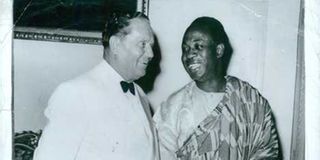
Former President of Ghana Kwame Nkrumah at the White House in March 8, 1961.
Photo credit: AFP
In London, Nkrumah, who was attending the 1960 Commonwealth Prime Ministers Conference, took advantage of his private meeting with McMillan to seek an explanation about the future of Kenyatta.
Kenyatta’s friendship with Nkrumah dated back to the period just before World War II, when Britain was the locus for anti-colonial activists from colonies and their pan-African activities.
Their close association was highlighted by Peter Abrahams, a prominent writer and activist who was also deeply involved in pan-African activities in England at that time.
Abrahams recalled how he, Nkrumah – who was then known as Francis Nkrumah – and Kenyatta (then going by the name Johnstone Kenyatta) met in a small flat to discuss their activities.
During the meeting, Nkrumah proposed that they form a society called “The Circle”, and that each of them should spill a few drops of blood in a bowl while taking an oath of secrecy as a sign of their dedication to the emancipation of Africa.
“In the end, Francis Nkrumah drifted from us and started his own little West African group in London. We were too tame and slow for him. He was an angry young man in a hurry,” Abrahams said.
Kenyatta and Nkrumah would later play a great role in organising the Fifth Manchester Pan-African Congress in 1945, which is widely regarded as the spark that lit the fire of Black nationalism that raged across the continent in the post-war period.
One of the main resolutions passed by the delegates at the conference was that freedom for Africa could only be achieved by agitating within the continent itself, and that if they were really genuine, they should return to Africa and fight from there.
In 1946, Jomo Kenyatta boarded the Alcantara at Portsmouth Harbour and made his way back to Kenya.
A year later, Nkrumah boarded the MV Accra at Liverpool port and made his way back to Ghana – then known as Gold Coast.
Theirs was a friendship intertwined and bound by political fate. As Kenyatta took over the Kenya African Union, Nkrumah formed the Convention People’s Party.
In 1952, when Nkrumah became the first prime minister of the Gold Coast colony after being released from prison, Kenyatta was heading to detention for his political activities.
Mzee Jomo Kenyatta, dressed in full military uniform, attends Jamhuri Day celebrations of December 12, 1971.
Photo credit: File | Nation Media Group
Even in his position of authority, Nkrumah never forgot the plight of his friend.
When Nkrumah ceased to be the colonial prime minister of Gold Coast and became the prime minister of the independent country called Ghana in 1957, he wrote a letter to Kenyatta, inviting him to attend the independence celebrations, but the colonial government rejected it.
When Mboya visited Accra in 1958 for the All African Peoples Conference, Nkrumah – who was the organiser of the event – told him never to allow Kenyatta’s name to die.
The following year, Nkrumah appointed Kenyatta’s friend Mbiyu Koinange – who was in exile – the director of the Bureau of African Affairs in Accra to replace George Padmore.
The agency played an important role in Nkrumah’s pan-African dream, serving as his channel for supporting liberation movements and promoting African unity.
The appointment of Koinange to the leadership of such a crucial institution showed the level of trust Nkrumah had in Kenyatta.
In 1960, as the release Kenyatta campaign gathered momentum locally and abroad, Nkrumah – who was in London for the Commonwealth Prime Ministers Conference at Marlborough House – took advantage of his private meeting with Macmillan to make a suggestion of taking in Kenyatta.
Though the British premier appreciated the offer, he urged Nkrumah to discuss the issue with Colonial Secretary Lain Macleod.
In May 1960, Nkrumah – who had returned to Ghana – dispatched his Minister for External Affairs Ako Adjei to London to discuss the matter with Macleod.
During the meeting, Macleod asked Adjei to thank Nkrumah for the suggestion and undertook to communicate further after consulting Governor Renison.
However, the governor rejected the proposal by telling the colonial secretary that allowing Kenyatta to be transferred to Ghana could raise his profile as an African nationalist and paint Mau Mau as a legitimate form of African nationalism.
A correspondent to Sir Arthur Snelling, the British High Commissioner to Ghana, marked secret, read in part: “The Governor considers, and my Secretary of State agrees that, there can be no question of allowing Kenyatta to go into exile in Ghana or anywhere else at present. Apart from the difficulties mentioned by the Secretary of State, Kenyatta’s establishment in Ghana would tend very strongly towards the presentation of Kenyatta and Mau Mau as legitimate forms of African nationalism, an identification which we wish to prevent. But in any case, for the moment, the situation has been contained.”
Sir Snelling was further instructed to deliver the message orally to Ghana’s Minister for Foreign Affairs on the lines that:
“The colonial Secretary has consulted the Governor of Kenya, who is most grateful for the offer of the Ghana Government to receive and look after Kenyatta but regrets that he cannot take advantage of it because of the serious security repercussions which any change in Kenyatta’s present status would bring for the reasons which were outlined by the Governor in his public statement on May 10.”
The British High Commission in Accra later informed London: “Mr Ako Adjei is at present away from his office, sick, and his junior minister is outside Ghana. We, therefore, delivered the oral message and a copy of the Governor of Kenya's statement of May 10 to the senior official actually present in the Ministry of Foreign Affairs.”
Kenyatta was later released from prison, and just like Nkrumah, became Kenya’s first prime minister and eventually president.