President William Ruto’s intervention to save the skin of Nairobi Governor Johnson Sakaja might well be an indication of the clout he still holds in control of the political machinery.
A majority of Members of the County Assembly drawn from both sides of the aisle had gathered the required number of signatures to mount an impeachment motion, until for the first time in his presidency, Dr Ruto waded in to save a governor from being sent home.
Following talks, he applied carrot-and-stick tactics to prevail on MCAs from his UDA party to spare Mr Sakaja, relying also on his broad-based government partner, ODM leader Raila Odinga, whose party commands a majority in the Assembly, to bring his troops to heel.
It was a successful intervention, which demonstrated control of state levers and the political machinery. It also showed how effective the union between the President and the erstwhile opposition chief can be in staving off political threats.
The President has in the past steered off duels in devolved governments, watching from afar as even governors who are key allies face the wrath of MCAs and are subjected to impeachment trials in the Senate.
If the move had proceeded, Mr Sakaja and Deputy Governor James Njoroge Muchiri would almost certainly have been impeached, making for riveting drama when the matter moved up to the Senate.
President William Ruto and Nairobi Governor Johnson Sakaja at a past event.
Photo credit: Dennis Onsongo | Nation Media Group
Unlike previous impeachment threats facing governors, this one was a high-stakes threat as Mr Sakaja faced the axe alongside Mr Muchiri, meaning that there would be no number two to step into the breach, necessitating a fresh election for governor of Nairobi.
This clearly was not something the President relished, for it would have forced an early electoral test of wills in the capital, with the opposition fronted by his former deputy Rigathi Gachagua .
That Dr Ruto succeeded in saving Mr Sakaja, at least for now, is testament to the power he wields, but also an indication of his vulnerabilities. He could not risk leaving the governor at the mercy of MCAs. Neither was he confident that senators who would ultimately make the final decision could be relied on to toe the party line if he decided to support Mr Sakaja at that level.
He, therefore, made it a priority to nip the impeachment push in the bud, but it could come at a high price as what was negotiated by him and Mr Odinga with their troops was at best a temporary relief.
Mr Sakaja knows he is in a weak position, having staved off impeachment only through help from higher up. The city MCAs, in turn, know they now have him at their mercy, and continuing impeachment threats might see them extract a great deal from the governor – causing havoc in the city’s administration and budgeting.
With his tight hold on a compliant Parliament, unchallenged control of government, state institutions and his political formation, as well as capacity to neutralise political foes and skip around challenges, President Ruto has appeared like a master of the game since taking power in 2022.
Recent moves, which have confounded friends and foes, have, however, raised questions over his strategy and exposed faultlines in the Kenya Kwanza administration that could come to haunt him in 2027.
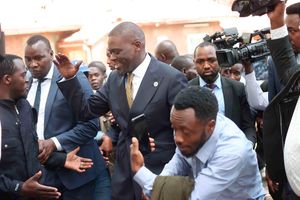
Nairobi Governor Johnson Sakaja (centre) leaves the Jaramogi Oginga Odinga Foundation Centre after a meeting with ODM Nairobi County Assembly members on September 2, 2025.
Photo credit: Sila Kiplagat | Nation Media Group
The President has in the recent past faced open challenges from his supposedly solid support base. He angered MPs with accusations that they have been taking bribes to pass or derail legislative proposals.
He then set up, by presidential proclamation, a team under his office to investigate corruption, a move that many assume is meant to catch MPs he says are on the take.
He has established by similar proclamation another committee to look into compensation for victims of riots, protests and other forms of political violence since the 2017 elections.
These moves raise eyebrows as they seem to have been dictated by internal and external pressure. This has raised questions over whether the President is serious in seeking to resolve festering sores.
Speaker of the National Assembly Moses Wetang’ula.
Photo credit: File | Nation Media Group
The question is why the President is making the moves at this time, and whether he anticipated the negative reactions that would follow. On the corruption claims, for instance, he should have foreseen the possibility of loyal troops in Parliamentary leadership as well as members openly calling him out. National Assembly Speaker Moses Wetang’ula and Senate colleague Amason Kingi – who have long faced accusations of reducing themselves to lapdogs of the Executive rather than heads of an equal arm of government, were put under pressure to reject the allegations by the President.
Members of both Houses, who usually sing Dr Ruto’s praises, were united in rejecting “baseless accusations”, demanding that the President provides evidence of their wrongdoing through established protocols.
National Assembly Majority Leader Kimani Ichung’wah of UDA and Minority Leader Junet Mohammed from Mr Odinga’s ODM – which retains the opposition tag despite having crossed the floor to the government side – were joined by their troops in dismissing claims of corruption in Parliament.
National Assembly Majority Leader Kimani Ichung’wah who has acquired a significant stake at Housing Finance Group.
Photo credit: File | Nation Media Group
It is not clear if the mood in Parliament could lead to a full-scale revolt. It might be instructive, however, that when Dr Ruto’s predecessor Uhuru Kenyatta, started his second term in 2017 by dressing down MPs for supposedly holding him hostage during his first term, he lost support and control of the populous base which had propelled him to office.
In a conversation with this writer while still Deputy President, Dr Ruto recalled how after the 2017 swearing-in, Mr Kenyatta summoned his Jubilee Party MPs and leaders for what turned out to be a raucous meeting. The president, in high spirits, essentially told the assembled politicians, and specifically the Mt Kenya bloc, that as he was serving out his final term, he did not need them and would govern without bowing to undue pressure.
The result was his losing a solid support base as Dr Ruto, who proved himself much more generous than the tight-fisted president, acquired the Mt Kenya base.
It was that Mt Kenya base which eventually propelled Dr Ruto to the presidency in 2022 by defying Mr Kenyatta’s campaign for Mr Odinga.
Things have turned upside down since then. Dr Ruto and Mr Odinga are working as a team, while the President’s 2022 running-mate, Gachagua, was ejected by impeachment last year and walked away with the with Mt Kenya vote.
President William Ruto with ODM leader Raila Odinga at the funeral of Mama Phoebe Asiyo, at Wikondiek in Homa Bay County, on August 8, 2025.
Photo credit: PCS
Mr Gachagua poses a serious challenge come 2027 as the acknowledged driving force of attempts to craft a new opposition grouping alongside Wiper Party leader Kalonzo Musyoka , DAP-K chief Eugene Wamalwa, former Interior Cabinet Secretary Fred Matiang’i among others
Mr Gachagua will not be a candidate for president, unless in the unlikely event that his impeachment as DP is overturned by the courts, thereby lifting the bar on holding of public office.
However, his hold on the Mt Kenya vote makes his support key for any opposition aspirant. He has so far indicated that his preferred candidate is Mr Musyoka, while the other strong aspirant is Dr Matiang’i who has won the support of Mr Kenyatta’s Jubilee Party.
Outside the united opposition to be unveiled next week, there are a number of other declared candidates angling to place themselves as third-party alternatives pursuing support of the Gen Z vote.
They include former Chief Justice David Maraga and Busia Senator Okiya Omtatah, both known to have turned down approaches from Mr Gachagua, and have been in conversation on a joint ticket. There is also the looming breakaway from the Ruto-Raila broad-based arrangement fronted by ODM Secretary-General Edwin Sifuna also looking to field a presidential candidate, and activist Boniface Mwangi.
It is also looks like former Cabinet Secretary Moses Kuria, who resigned as a Ruto adviser , is preparing to enter the fray. The cordial nature of Mr Kuria’s exit from Dr Ruto’s side has led to suspicion that he will be sponsored as a ‘Mankurian’ candidate as part of efforts to split Mt Kenya.
The fluid situation indicates a great deal of uncertainty on how politics will play out in the run-up to the elections that are still two years away.
Senate Speaker Amason Kingi, his National Assembly colleague Moses Wetang'ula and President William Ruto in Nairobi in March 2025.
Photo credit: File | Nation Media Group
There will be focus in coming weeks on happenings within the opposition where fragile coalitions could implode at any moment.
But Dr Ruto is not sitting pretty as his Kenya Kwanza coalition tries to manage numerous likely fissures.
That he had to move fast to save Governor Sakaja tells a lot about the headaches he has to confront at every turn.
Mr Sakaja may be safe for now, but one can be sure that it will be only a matter of weeks before new threats arise, especially when Nairobi MCAs and Members of Parliament aligned to Mr Gachagua decide to launch a fresh challenge.
Also looming are the two initiatives launched via presidential proclamation, which were clearly the result of political pressure.
One is the corruption investigation, which MPs facing blanket accusations of extortion , are suspicious about. The very fact that the Office of the President is in direct control of the investigations, as opposed to an independent commission of inquiry, says a lot.
It is the kind of mechanism that could be open to political manipulation, especially where some of the key institutions involved such as the Mr Renson Igonga’s Directorate of Public Prosecutions, Mr Mohammed Amin’s Directorate of Criminal Investigations and Mr Noordin Haji’s National Intelligence Service, have over the past two years demonstrated that they are lapdogs of the Executive.
The general assumption is that the investigation was formed to deal with corrupt MPs, but more likely in response to pressure from the World Bank and International Monetary Fund, which made reducing sleaze a major condition ahead of any deal to bail out an economy struggling to stay afloat.
Control of the process ensures that any investigations on corruption steer well-clear of powerful figures. Efforts might also be directed towards nailing key opposition figures, who could easily be silenced with threats of prosecution and seizure of their assets.
Then there is the task force looking into compensation for victims of political violence. It was set up to satisfy Mr Odinga, who badly needs to placate a large traditional support base unhappy with his entering into marriage with a regime responsible for abductions, torture, enforced disappearances, illegal confinements and killing of dissenting voices since the GenZ uprising of June last year.
The task force is headed by an Odinga aide and strategist Makau Mutua – one of the founders of the independent Kenya Human Rights Commission – who also became a beneficiary of the political union with appointment as presidential adviser on constitutionalism and human rights.
Concerns were raised early on that Prof Mutua would hardly been an independent arbiter, having widely parroted the Ruto administration’s narrative likening political protests to terrorism or the ethnic profiling blaming Mr Gachagua’s followers for all dissent.
Law Society of Kenya President Faith Odhiambo.
Photo credit: File | Nation Media Group
Both were constrained to explain why they accepted the appointments, and it is likely they will keep a sharp eye on any attempts to inject pro-government designs into the work of the task force.
They will also want to ensure that the assignment does not limit itself to compensation for victims while ignoring the need to identify and bring the perpetrators to justice.
Prof KIndiki was charged with the express mission of halting the Mt Kenya exodus, but it is becoming apparent that he has a mountain to climb ahead of the 2027 General Election.
Mr Mudavadi and Mr Wetang’ula, who represent the Western Kenya bloc, had been under pressure from their community to assert themselves at Prof Kindiki’s expense, but now face a different problem in having slid down the pecking order with Mr Odinga’s entry.
The opposition is keen to exploit growing disenchantment in Western, but so far has not made substantial headway in a region generally aligned to the Ruto-Raila axis.
Things could change dramatically, however, as political realignments take shape and it becomes apparent that Dr Ruto has no plans to elevate Mr Mudavadi beyond his current position.