Raila Odinga’s decision to testify against former Attorney-General, the late Charles Njonjo, a powerful figure in former President Daniel arap Moi’s government, over the failed 1982 Air Force coup, may have reignited the bad relations between the Njonjo and Jaramogi Oginga Odinga families.
Never mind that Raila’s father, Jaramogi Oginga Odinga, and Njonjo were politicians of different political persuasions but served in the same Moi-led Kanu government.
While Jaramogi, during their time, advocated for social democracy, Njonjo preached a different political ideology that favoured the haves – the bourgeoisie and their allies. The end result was an acrimonious fallout that saw Njonjo utter nasty things about Jaramogi.
Anybody from another continent would be surprised, but it is the normal flow – the DNA – of Kenyan politics.
But former Kabete MP Paul Muite says that despite the bad blood between the two politicians, Jaramogi and Njonjo, they would later enjoy a good rapport that extended to Raila, the former vice president’s son.
“It’s not just the late Njonjo having a good rapport with Mr Raila. It started with Mr Raila’s father in 1983,” says Mr Muite, a Senior Counsel and former close ally of Jaramogi, who served as his vice-chairperson in Ford Kenya.
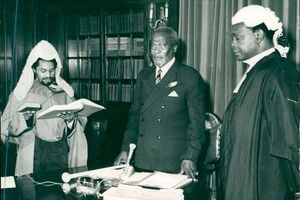
The thawing of the bad blood between Njonjo and Oginga began during the judicial commission of inquiry into Njonjo’s alleged role in the 1982 failed Air Force coup. The commission, chaired by Justice Miller, was formed by President Daniel arap Moi on November 9, 1984.
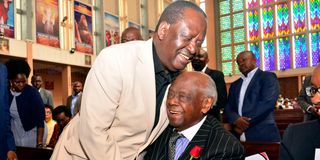
Raila Odinga (left) and former Attorney-General Charles Njonjo.
Photo credit: File | Nation Media Group
“Oginga came to the inquiry in Parliament and I was there when he warmly embraced Njonjo. They had a hearty talk just before the commission proceedings started,” says SC Muite, one of the counsels for Njonjo in the commission, alongside William Deverell, who later became a High Court Judge.
“In 1990, Jaramogi asked me to arrange a meeting with Njonjo at his Muthaiga residence. I did that, and the two met and talked, though I cannot tell what they discussed because I was not in that meeting,” says SC Muite.
It’s not clear why it took Njonjo and Oginga about seven years to meet after the embrace in Parliament. Nonetheless, the Muthaiga meeting happened – notwithstanding the fact that Njonjo had said very nasty things about Raila’s father, including that he could not imagine shaking Oginga’s hand and that he would never visit Kisumu for fear of contracting cholera.
By virtue of his position and influence in government, Njonjo was closely associated with the bad things that happened to Raila and his father – including detention without trial.
The animosity between the two politicians boiled over in 1982. Information from the court-martial that tried the Air Force officers implicated in the attempt to overthrow President Moi’s government revealed that there were two coups being plotted: one by the mutinous Air Force officers, and another by Njonjo.
The Njonjo coup was to happen on August 1, 1982, as Mr Raila testified before the Miller-led commission. The Air Force one was to happen on August 9, 1982. However, when the Air Force men learnt of Njonjo’s coup plan, they decided to bring forward their own – the infamous failed coup – to August 1, 1982.
Raila, who was detained over his alleged role in the planning and execution of the coup, testified against Njonjo as a state witness and implicated him.
The judicial commission of inquiry report captures the substance of Raila’s four statements against Njonjo:
“I stated that I had received information to the effect that Mr Njonjo had made plans to overthrow the Government of Kenya with the aid of South African and Israeli mercenaries and the General Service Unit (GSU),” the report captures Raila saying.
Former Attorney General Charles Njonjo.
Photo credit: Evans Habil | Nation Media Group
“To this effect, substantial amounts of arms had been smuggled into the country. Some of these arms were kept somewhere in the Aberdares, and the said coup was planned to take place on August 5, 1982,” Raila said in the report.
“I also stated that the same source had said that several South Africans and Israeli agents had come into the country to make arrangements for the coup.”
At the time of Mr Raila’s testimony on July 26, 1984, he had been lawfully detained since March 23, 1983. He was picked up by police for interrogation after the disturbances of August 1, 1982.
Raila told the commission that he had a conversation with one Kiprono arap Keino, the then Deputy Speaker of the National Assembly, in the gymnasium of the Hilton Hotel, Nairobi, in March 1982.
The two were friends, having met in Germany in the early sixties. They began discussing politics in general. Raila is reported to have told Keino that there were certain cliques in government attempting to intimidate and muzzle Parliament, “which was not in the best interest of the country.”
Keino retorted: “I know you people do not like Njonjo.” By “you people”, Keino meant the Luos, the report explains.
The report captures Raila telling Keino that the Luos had no reason to like somebody who had once said that he could not shake hands with them.
“Keino replied that whether the Luos liked it or not, Njonjo would become the next President of this country,” the report states.
Kisumu Woman Rep Ruth Odinga.
Photo credit: File I Nation Media Group
But how did Raila make up with Njonjo? Ms Ruth Odinga, the Kisumu Woman Representative and Raila’s younger sister, says that she could not recall the events of the time as she was too young to understand what was happening.
“I cannot tell you exactly what happened because I was young,” Ms Odinga told this writer some time back.
But according to Mr Muite, who would later become a close confidant of Raila, in addition to being his vice-chairman in the Ford Kenya party, after meeting Oginga, “it was only natural that Njonjo would extend the embrace to Raila.”
“Subsequently, there appeared to be a cooling off between Raila and Njonjo. Though I never got to discuss this with Njonjo, I can say that Njonjo supported Raila morally, financially, and otherwise in his political career,” says Mr Muite.
Raila and Njonjo would later reconcile. Being the nature of Kenyan politics, you “kill” and get “killed.” In Kenya, just like elsewhere in the world, no politician has never wronged or been wronged.
Just as Winston Churchill once said, changing one’s mind, position, or opinion will never cause indigestion to a politician. Perhaps Njonjo and Raila had read his words of wisdom and thought it was of no use to dwell on the past.
Churchill’s insight is affirmed by the fact that it is impossible to find a politician who has never eaten their own words – and that in politics, phrases like “strange bedfellows” lost meaning long ago.
It was around 2003 that the friendship between Njonjo and Raila started manifesting openly. They would occasionally be seen in public together. In 2007, Njonjo chose Raila over Mwai Kibaki in the presidential election. From then onwards, they became close friends.
Mr Koigi Wamwere during a past interview with the Nation at his offices in Nakuru County.
Photo credit: File | Nation Media Group
Former Subukia MP Koigi Wamwere says that they reconciled just as politicians would – because, after all, Njonjo had fallen from grace to grass following his sacking from the Cabinet by President Moi.
“He was in the opposition with Mr Raila, and the two were no longer fighting each other,” says Mr Wamwere. Before his sacking from the Cabinet, Njonjo was a powerful man in government.
“If you hold such a position and the government is detaining people it wants to get rid of, then definitely you are involved! The crimes against the people incarcerated were collective, not individual,” Mr Wamwere says of Njonjo.