For more than two decades, Kenya has been trying to reform policing, hoping to end police tyranny. But we keep failing, and police tyranny is getting worse. Nevertheless, we must not give up.
For we cannot, and will never be, free unless and until we reform our policing. Our freedoms mean nothing in the face of police tyranny.
I believe that we can use the constitutional remedy of structural interdicts (supervisory orders that provide ongoing supervision by a court until compliance is achieved) to realise police reforms.
As I see it, carefully designed supervisory orders offer perhaps the only viable institutional mechanism for realising police reforms.
Such orders would be accompanied by two implementation mechanisms, namely a Monitor (who would oversee the implementation of the supervisory orders under the supervision of the High Court) and a representative Community Policing Commission (that would champion the interests of the public in the implementation of the supervisory orders).
The criminal laws give the police blanket authorisations and the police pretty much do what they wish.
The Independent Policing Oversight Authority (IPOA) and the courts only intervene to correct instances of abuse of power and police malpractices after they have occurred.
This ex post governance model is designed to address individual instances of police misconduct as opposed to addressing the governance shortfalls that produce such misconduct.
This model is justified on the grounds that policing is unique and the service cannot be treated like other agencies of executive government. It is claimed that confidentiality in policing is both necessary and appropriate.
Hence, making policing transparent would allow criminals to evade police detection more skilfully.
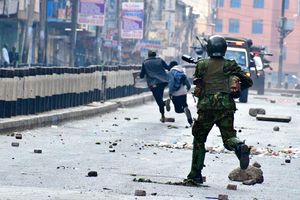
An anti-riot police aims a tear gas launcher at protesters in Nakuru City on June 25, 2025.
Photo credit: Boniface Mwangi | Nation Media Group
As a result, in our policing model, the police are simply authorised to enforce the criminal law and determine what enforcement actions they can take, without the public interrogating the rationality of policing policies and methods.
Hence, compared to other agencies of executive government, the public do not participate in the making of policing policies and rules, and the police do not have to justify their policing methods and practices.
The consequence is that the police largely get to do what they want, when they want, and how they want.
Our policing framework is decidedly undemocratic, Executive-dependent, and fails to promote the constitutional values of public participation and accountability.
In this policing framework, the government of the day is the state, and the state is the government of the day. The government of the day exclusively determines policing policy and operations.
The public is socialised to believe this must be the case – policing policy is siri kali and must remain so, in the interest of a nebulous concept called national, or is it, state security. And the line between policing policy and policing operations is invariably and deliberately blurred.
In this policing framework, police abuses are deliberate and calculated to enable tiresome bureaucratic microaggressions whose objective is to ensure that citizens submit to authority and do not criticise government.
However, it is important to appreciate that in a constitutional democracy such as ours, policing methods and operations are matters that embody political value judgements and require a careful weighing of costs and benefits.
They should, therefore, be subject to public debate, input and interrogation. Public participation in policing decision-making is also likely to enhance the legitimacy of police actions and public trust in the police.
Accordingly, the police should formulate their methods through binding policies and rules that have benefited from public participation. Ultimately, the objective is to ensure there are rules and performance benchmarks that guide policing actions and make their policy and operational choices transparent to the public. That way, the public will have a say in how they are policed.
But while rule-based and accountable policing is desirable in a democracy, attaining it is nevertheless a difficult task, for three reasons. First, even where policing policies and rules are made with the benefit of public participation, it is often difficult to enforce them.
Second, it is difficult to write rules for some areas of policing or ensure they are followed. Third, police agencies may be reluctant to enforce policies that they perceive to have been foisted on them by outsiders.
The question is, can we transform our policing framework and stop police abuses? If so, how?
Two decisions of the High Court suggest that we can use constitutional litigation and the remedy of supervisory orders to reform our policing once and for all.
If carefully structured, these orders can ensure that, under court supervision, the government and the police work with the public to reform policing.
The challenge, then, will be for the Law Society of Kenya, public interest litigation organisations, and IPOA to fashion and structure the appropriate remedies.
The first decision is Katiba Institute versus Attorney General where the High Court ordered the Cabinet Secretary, Ministry of Interior and the Council of Governors to, within six months, operationalise Community Policing Authorities established under the National Police Service Act.
A police officer aims his gun at protesters on Old Namanga Road in Kitengela during the Saba Saba protests on July 7, 2025.
Photo credit: Billy Ogada | Nation Media Group
Further, the Court directed them to file an affidavit in court within nine months indicating the status of their compliance with the order. Thus far, however, these government agencies have not complied with these orders. And so, the idea of institutionalised community policing remains stillborn.
The second decision is Law Society of Kenya v Kithinji & 5 others; Katiba. Here, the High Court determined that the law does not permit police officers to wear plain clothes and hide their identities in order to collect criminal intelligence while individuals are exercising their constitutional rights to assemble, picket and demonstrate.
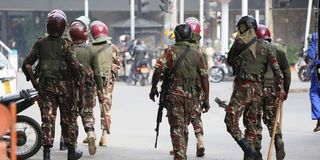
The court then issued two significant orders. First, it declared that police officers deployed to ensure law and order in the course of demonstrations must be uniformed and must not in any way hide or obscure their faces. Second, it prohibited the police from obscuring the identity of any vehicle they use in the process of dealing with demonstrators.
But the Police Service simply ignored these orders and have unashamedly and unapologetically continued to wear facial masks and use unidentified vehicles during demonstrations.
Police block Haile Selassie/Uhuru Highway roundabout to prevent demonstrators from accessing the Central Business District ahead of planned Saba Saba protests on July 7, 2025.
Photo credit: Dennis Onsongo | Nation Media Group
Evidently, the piecemeal approach of asking the courts to outlaw undemocratic policing practices as and after they have occurred will not stop the police from using these practices.
Perhaps, then, suitably crafted and comprehensive supervisory orders might be the solution.
The orders would stipulate a roadmap for reform, including performance indicators – the ultimate goal being to ensure that police services are henceforth delivered in a manner that complies with the Constitution and laws and promotes public confidence in the police.
Significantly, supervisory orders would provide institutional structures for their enforcement, namely a Monitor and a Community Policing Commission.
Police stand guard along Parliament Road in Nairobi on June 25, 2025 during the anti-government protest on June 25, 2025.
Photo credit: Dennis Onsongo | Nation Media Group
The Monitor, a person experienced in criminal justice, would oversee the implementation of the supervisory orders under the supervision of the High Court.
The key functions of the Monitor would be to develop a monitoring plan and performance indicators, and conduct regular compliance and progress reviews to assess the extent of implementation of the supervisory orders.
The Community Police Commission would be a representative body that brings together stakeholders. Its function would be to review the reports and recommendations of the Monitor and make recommendations to the Court on the implementation of the supervisory orders.
Nothing short of such a detail-oriented approach to supervisory orders with measurable performance indicators will ensure police reforms.
The envisaged institutional structures will identify shortfalls, review policing records, audit policing practices regularly, and force change.
It is only through such a transformative approach that we will be able to attain constitutional and effective policing.