February 15, 2026 marks exactly four months, or 122 days, since the death of former Prime Minister Raila Odinga. Life has never been the same for the Orange Democratic Movement (ODM), the party he founded.
ODM now finds itself in unfamiliar territory, grappling with internal disputes, questions of identity, and an uncertain leadership transition without the man who defined it for two decades.
What began as a period of mourning has steadily morphed into an intense internal contest that now threatens to redefine — or even tear apart — one of Kenya’s most enduring political parties.
'I'm still ODM Secretary-General'
At the centre of the storm is the party’s secretary-general Edwin Sifuna, whose dramatic removal by the party’s National Executive Committee (NEC) earlier this week, followed by a temporary reprieve from the Political Parties Disputes Tribunal (PPDT), has exposed deep fissures within the party.
The tribunal has barred ODM from implementing its resolution to oust Mr Sifuna, effectively freezing the power struggle and buying time for mediation. However, the underlying tensions remain unresolved.
The dispute over Mr Sifuna’s position is indicative of a wider ideological conflict within ODM: should it formally cooperate with President William Ruto and his ruling United Democratic Alliance (UDA), or remain an opposition force loyal to Raila’s legacy?
A faction aligned to party leader, Dr Oburu Oginga, has warmed up to the idea of working with Dr Ruto, and a pre-election coalition agreement is expected ahead of the 2027 General Election. President Ruto’s attendance and support during ODM’s 20th anniversary dinner celebrations signalled the deepening ties, which has also turned out to be the party’s Achilles heel.
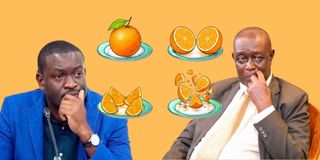
ODM leader Oburu Oginga (right) and immediate former party Secretary-General Edwin Sifuna.
Photo credit: Nation Media Group
Opposing voices, such as Mr Sifuna, Siaya Governor James Orengo, ODM co-deputy party leader and Vihiga Senator Godfrey Osotsi, East African Legislative Assembly MP Winnie Odinga, and Embakasi East MP Babu Owino, strongly oppose any alignment with the ruling Kenya Kwanza Alliance.
For them, cooperating with Dr Ruto would mean surrendering their ideology. he trigger for the latest turmoil was a NEC meeting in Mombasa that resolved to remove Mr Sifuna from his position. His allies dismissed the gathering as irregular and procedurally flawed.
“The illegal removal of Sifuna from office is not taken lightly by this team,” he said. “The meeting that took place in Mombasa was a kangaroo meeting set up to remove the current secretary-general of ODM.”
“The only mistake Sifuna made — and the only mistake we are making — is fighting for the downtrodden, the forgotten in society, jobs for our youth and the high cost of living.”
Governor Orengo said: “Do not be deluded. The secretary-general of Raila’s party, ODM, is Edwin Sifuna.”
“During the entire life of Raila Amolo Odinga, and during the period Edwin Sifuna has been the secretary-general, there is no single moment that Raila rebuked him in public while he discharged his duties.”
Orengo: Don't be cheated, Sifuna is the ODM secretary-general
Amid the escalating rhetoric, Ruth Odinga, ODM’s deputy organising secretary and a member of the NEC, on Friday struck a conciliatory tone.
“What many people do not understand is that my position remains clear. There is need for mediation to ensure we remain united and strong, so that even as we negotiate for 2027, we do so from a point of great strength,” Ms Odinga told Nation.
Her call underscores a growing recognition that protracted infighting could weaken ODM’s bargaining position — whether in opposition realignments or negotiations with Kenya Kwanza.
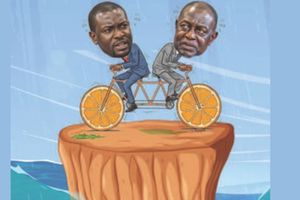
The turmoil has also cast doubt on Dr Oginga’s ability to steady the ship left behind by his younger brother.
Critics argue that the leadership vacuum created by Raila’s death has emboldened factions and intensified rivalries within the broader Jaramogi Oginga Odinga family, with political differences spilling into party affairs.
The open defiance by Winnie Odinga — Raila’s daughter — who has sided with the “rebels”, has been interpreted by some analysts as a symbolic vote of no confidence in the current leadership direction of ODM.
ODM's existential questions
“The party is in what you would call a high dependency unit,” said a senior ODM insider. “If we don’t manage this carefully, we might be talking about ICU before the end of the year.”
ODM’s resilience has long been a source of pride. In Kenya’s volatile political ecosystem — where most parties dissolve after one electoral cycle — ODM ranks second only to Gideon Moi’s Kanu in longevity.
Born as a reform movement, it evolved into a formidable political machine that rallied behind Raila’s presidential bids in 2007, 2013, 2017 and 2022.
But without its talismanic leader, ODM is confronting existential questions.
Is it a people’s movement, as Mr Orengo insists? Or is it morphing into a pragmatic political vehicle willing to trade ideological purity for strategic influence?
Siaya Governor James Orengo addresses journalists at Sarova Panafric hotel in Nairobi on February 12, 2026.
Photo credit: Billy Ogada | Nation Media Group
“The problem in ODM is President Ruto,” he said. “We are asking President Ruto to let ODM go. Let ODM alone.”
He accused the president of convening parallel meetings with ODM leaders while excluding dissenting voices.
On the other hand, ODM stalwarts in Dr Oginga’s camp have pointed an accusing finger at former President Uhuru Kenyatta, blaming him for the internal revolt within the party.
ODM chairperson and Homa Bay Governor Gladys Wanga, National Assembly Leader of Minority Junet Mohamed as well as Treasury Cabinet Secretary and former ODM chairpersonJohn Mbadi have publicly accused the Mr Kenyatta of financing dissent within the party — claims that have deepened suspicion about his relationship with Mr Sifuna.
Ousted ODM Secretary-General Edwin Sifuna addresses journalists at Sarova Panafric hotel in Nairobi on February 12, 2025.
Photo credit: Billy Ogada | Nation
“We know them, those meeting with former President Uhuru Kenyatta to try and break ODM. Uhuru lied to us in the 2022 polls that he would make Raila president. We cannot allow him to lie to us again,” Mr Mbadi said recently.
However, while acknowledging ideological tensions within ODM, Dr Oginga says there is no evidence that Mr Kenyatta is deliberately seeking to divide the party.
“I am not aware of any such scheme. I have no evidence to suggest that Uhuru Muigai Kenyatta, my friend, wants to divide ODM,” Dr Oginga said.
For his part, Mr Sifuna says his removal stemmed from his opposition to ODM’s working relationship with President Ruto’s UDA.
The party’s Central Management Committee had on January 12 tasked Dr Oginga to initiate coalition talks with Dr Ruto, a resolution later endorsed by the NEC.
“My only ‘crime’ is opposing schemes to support President Ruto’s re-election. I hold the firm view that this country cannot afford another five years of this costly, divisive and disastrous misadventure,” Mr Sifuna said.
“Raila would never have allowed ODM to become an appendage of State House, where decisions are merely rubber-stamped,” said Mr Sifuna.
For President Ruto, securing ODM’s backing could reshape the 2027 political landscape. Having lost ground in parts of Nyanza, and facing shifting dynamics in Mt Kenya, he appears keen to consolidate national support through strategic alliances.
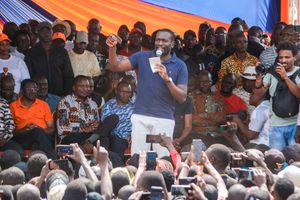
A section of ODM youth leaders in Nairobi, led by youth leader Brian Omondi Midiwo (centre), address the media at the Sarova Panafric Hotel on February 7, 2026.
Photo credit: Wilfred Nyangaresi | Nation Media Group
His presence at ODM’s anniversary celebrations in Mombasa was seen as both symbolic and tactical — a signal that former adversaries can become partners in Kenya’s fluid political arena. But that overture has unsettled ODM’s base.
Mr Sifuna’s predicament embodies a broader struggle. As secretary-general for nearly a decade, he oversaw the party’s affairs during two election cycles; in 2017 and 2022, and emerged as one of Raila’s most vocal defenders.
To his supporters, removing him is tantamount to rewriting ODM’s DNA. To his detractors, his confrontational stance against Kenya Kwanza undermines ongoing rapprochement efforts.
With the tribunal’s intervention, Mr Sifuna remains in office — at least for now. But the tribunal’s ruling merely postpones what promises to be a decisive showdown.
Advocate Chris Omore says: “The party must reconcile competing visions — cooperation versus confrontation, pragmatism versus principle, continuity versus reinvention. Failure to resolve these tensions could fragment a party that has long prided itself on unity in adversity.”
“In the absence of its founding leader, Raila Odinga, the party faces the ultimate test on whether it can reinvent itself without losing its soul,” he adds.