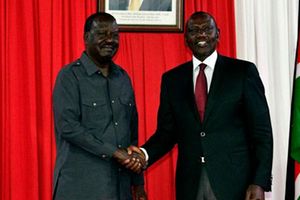
President William Ruto and Orange Democratic Movement (ODM) leader Oburu Oginga will on Tuesday provide an extensive pre-election coalition roadmap in readiness for the 2027 polls, Sunday Nation has learnt.
Interviews with top party officials indicate that the ruling United Democratic Alliance (UDA) and ODM Joint Parliamentary Group (PG) meeting to be held at the Kenyatta International Convention Centre (KICC) will provide a platform for “making major steps” in crafting a re-election vehicle for President Ruto.
But the embattled ODM Secretary-General Edwin Sifuna-led camp described the meeting as the height of betrayal to the late Prime Minister Raila Odinga . The camp – through co-deputy party leader Godfrey Osotsi – said proceeding to forge a coalition with UDA when most of the agenda items are yet to be implemented is meant to serve selfish political interests by some ODM officials.
Sunday Nation has further established that zoning, which is emerging as a contentious issue in the coalition talks, could also be a major topic of discussion.
UDA has ruled out such an arrangement, but ODM insists that respective party zones have to be ring-fenced to avert sibling rivalry, cannibalism and vote-splitting that could end up favouring opponents. Zoning is a political deal where parties in a coalition opt not to field candidates in each other’s strongholds.
National Assembly Minority Leader Junet Mohammed said ODM wants the same template deployed in the November 27, 2025 by-elections , where ODM fielded in Ugunja, Kasipul and Magarini constituencies, while UDA fielded in Mbeere North, Baringo and Malava races.
“Why have such an arrangement in by-elections and not in the general election? That was a template that we want implemented in the 2027 polls,” Mr Mohammed said.
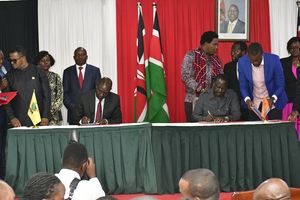
Mr Mohammed and his Majority counterpart, Kimani Ichung’wah, on Friday sent out invites to Kenya Kwanza and ODM Members of Parliament to attend the meeting that will also mark the first anniversary of the March 7, 2025, Memorandum of Understanding signed between President Ruto and the late Prime Minister Raila Odinga. Mr Odinga died in October 2025 .
“All members of Kenya Kwanza Coalition and Orange Democratic Movement (ODM) are hereby invited to attend a joint Parliamentary Group meeting on Tuesday, March 10, 2026, at KICC,” a message from Mr Ichung’wah to members states.
In the communication, Mr Ichung’wah listed a review of the 10-point Agenda Report as resolved during the recent Parliamentary Group meeting held in Parliament.
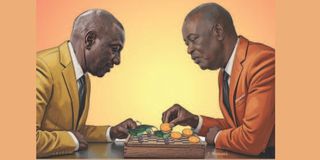
President William Ruto (left) and ODM leader Oburu Oginga.
Photo credit: John Nyagah | Nation Media Group
The PG will also consider policy implications of the resolutions contained in the report. The meeting will also discuss ‘other emerging national matters and parliamentary priorities within the framework of the broad-based engagement’.
Mr Mohammed told this publication that President Ruto and Dr Odinga will use the meeting to provide a coalition formation roadmap. The two leaders are expected to name their respective negotiating teams to guide the process as the two parties begin to craft a coalition.
“There is a major announcement that will be made in moving talks between UDA and ODM forward. A proper roadmap will be laid out, defining every step we are going to make going forward into the 2027 elections,” said the Suna East MP.
Energy Cabinet Secretary Opiyo Wandayi also hinted at the planned roadmap by telling critics of the arrangement that they will be ‘increasingly isolated’ as the pre-election coalition begins to take shape. He said the political journey by UDA and ODM to 2027 is unstoppable.
“The PG is a step in the right direction, and it will shame those who have been fighting the arrangement tirelessly. They will increasingly find themselves isolated going into 2027. The journey to the next election is now beginning in earnest,” Mr Wandayi told Sunday Nation.
Top organs of both UDA and ODM had already mandated President Ruto and Dr Oginga to begin formal coalition talks. ODM has since indicated its readiness to back Dr Ruto’s second term in office. The Orange party has, however, laid claim to the Deputy President slot, currently occupied by Prof Kithure Kindiki.
The UDA and ODM political arrangement is anchored on an ambitious 10-point agenda meant to guide reforms touching on governance, economic inclusion, electoral credibility and institutional accountability.
The MoU was designed to calm a nation shaken by protests, economic frustration, and a bitterly contested 2022 electoral aftermath.
President Ruto and Mr Odinga agreed on the full implementation of the Nadco (National Dialogue Committee) report, inclusivity in budgetary allocations and public appointments, and economic investment for the youth.
They agreed to protect and strengthen devolution, fight corruption, stop the wastage of public resources, and audit the national debt.
As part of the MoU, they agreed to protect the sovereignty of the people, stop abductions, respect constitutionalism and the rule of law, and respect press freedom.
Others included the right to peaceful assembly, compensation of all pending claims of rights victims and an end to lack of leadership, integrity, and opulence.
President William Ruto shares a light moment with Siaya Senator Oburu Oginga when he visited Siaya County on January 14, 2023.
Photo credit: Tonny Omondi | Nation Media Group
In his estimation, Mr Mohammed said that over 80 per cent of the agenda items have been implemented. He said some provisions in the report would require a referendum, and therefore are beyond their mandate as MPs.
He cited the creation of the Office of the Leader of the Opposition, the Prime Minister’s Office and the two-thirds gender rule as some of the provisions that can only be implemented following a vote by Kenyans.
“I think over 80 per cent has been done, and we will demonstrate that during the PG. One of the conditions of the document was the fulfilment of the Nadco report. Reconstitution of the IEBC has been done with the other eight items at different stages,” he said.
Despite legal challenges, he said, the issue of compensation for victims of police brutality has since been looked into and provisions made to start compensating those who lost their loved ones or were injured during the protests.
“The issue of compensation has been fully looked into by factoring in all aspects, including how to do it. The money is contained in the supplementary budget,” he said.
But Mr Osotsi disputed the estimation, stating that most of the agenda items have not been met. He indicated that a majority of MPs opposed to the arrangement will skip the Tuesday meeting.
“They are now telling us that the 10-point agenda did not have timelines when it is clear that the two principals issued a communiqué stating that a comprehensive report on the implementation status will be issued at the expiry of the first year of the arrangement,” said Mr Osotsi.
“This meeting will be a betrayal to Raila, the Gen Z who went to the streets and to the people of Kenya.”
Siaya Governor James Orengo, who is also a key figure in the Linda Mwananchi team, said they plan to hold a parallel rally to give their verdict on the implementation status of the agenda.
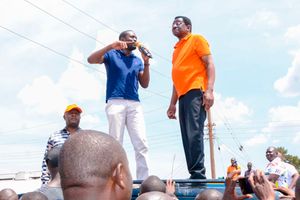
Siaya Governor James Orengo addresses a Linda Mwananchi political rally at Amalemba Grounds in Kakamega on February 21, 2026.
Photo credit: Alex Odhiambo | Nation Media Group
Mr Orengo said that the government had failed to fulfil the promises set out in the MoU and that they would be presenting an assessment carried out by members of the ODM party and other stakeholders.
“We are having a meeting of chairmen of ODM across the country to look at and review the MoU and come up with a document. And on March 8, we will report to the people of Kenya at a major rally at Jacaranda in Nairobi,” said Mr Orengo.
But Mr Mohammed dismissed the camp as a group of a few individuals who want to use the 10-point agenda for political expediency and to resuscitate their dwindling political fortunes.
“If they want to use it for politics, they are free to go on. There is nowhere in the document that says March 7 marks the end of the broad-based arrangement. In fact, the MoU was signed way after the formation of the broad-based government. The agreement was signed when our experts were already in government.”
“The era of using ODM and Raila as a bogeyman is long gone. ODM is a party that operates through its well-established organs. How many are they (critics)? Do we stop doing what we have to do as a party because of five people?” posed Mr Mohammed.
Committee on the Implementation of the 10-point Agenda vice chairperson Javas Bigambo, in an interview, noted that the implementation process has advanced significantly.
According to Mr Bigambo, there is much to demonstrate that the 10-point agenda issues are being implemented.
“The more than 85 per cent implementation status of the 10-point agenda is a door opener for confident coalition negotiations and will easily accelerate the process.”
“Some of the issues under the 10-point agenda should not be tied to the period from the time the MoU was signed. Because some issues within the 10-point agenda are perpetual governance issues which are a priority for the government,” said Mr Bigambo.
While the joint parliamentary meeting may provide the political signal, the formal decision on whether ODM enters a coalition with UDA will ultimately be taken by the party’s delegates.
In a notice issued by Deputy Secretary-General Catherine Omanyo, the party said the meeting will bring together members of the National Executive Committee, the parliamentary group, governors, county assembly leaders and representatives from the party’s youth, women and disability leagues.
The convention is expected to consider and ratify resolutions adopted earlier by the party’s National Governing Council.
If approved, the resolutions will give Dr Oginga authority to negotiate and formalise a coalition arrangement with President Ruto.
However, the planned convention has already attracted legal scrutiny.
President William Ruto (left) confers with ODM party leader Oburu Oginga during the Piny Luo Festival in Senye Beach in Nyatike, Migori County on December 17, 2025.
Photo credit: Alex Odhiambo | Nation Media Group
A Nairobi-based law firm acting for party member Vincent Chepkwony has questioned the legality of the notice convening the meeting. The complaint argues that the notice was issued by the Deputy Secretary-General rather than the Secretary-General, which the petitioner claims violates the provisions of the ODM constitution.
“The provisions of Article 49(b) are couched in mandatory terms, and no explanation has been given as to why the notice was not issued by the Secretary-General,” the letter states.
Even as coalition discussions gather momentum, ODM leaders have already set out their minimum demands. Among them is the principle of political zoning. But ODM insiders say zoning will be a non-negotiable issue in coalition negotiations with UDA.
The demand reflects broader concerns within the party about preserving its political identity while participating in a broad-based government.
Supporters of the emerging alliance say the cooperation between the two parties has already produced tangible governance gains.
Homa Bay Town MP Opondo Kaluma says most of the legislative reforms proposed under the Nadco process have already been enacted.
“All legislations proposed under Nadco, including amendments to the IEBC Act, Elections Act and Political Parties Act, have been enacted, and we now have a fully constituted IEBC,” he said.
According to Mr Kaluma, what remains are proposals that require constitutional amendments.
He argues that the broader reform process has also strengthened devolution and expanded development projects across the country.
However, critics of the political rapprochement say the implementation of the reform agenda should be assessed independently.
Suba South MP Caroli Omondi, a member of the Linda Mwananchi Movement, says they plan to release their own report evaluating the progress of the ten-point agenda today.
“It is necessary that the assessment of the implementation of the ten-point agenda gives an accurate and true position to Kenyans,” he said.
Rarieda MP Otiende Amollo said he would reserve judgment until the oversight team presents its findings. “I’m awaiting the team report on Tuesday,” he said.
Meanwhile, the government has also revived efforts to compensate victims of human rights violations during protests.
Earlier attempts to establish a compensation panel faced legal challenges after the High Court ruled that the process must be led by the Kenya National Commission on Human Rights.
Following the ruling, the government restructured the framework and established a new advisory panel.
In a gazette notice dated March 6, Chief of Staff and Head of the Public Service Felix Koskei announced the appointment of a Panel of Experts on Compensation of Victims of Human Rights Violations.
The panel will be chaired by constitutional scholar Makau Mutua and will work alongside the Kenya National Commission on Human Rights. Its mandate includes ensuring transparency and accountability in the process while submitting periodic reports to the President. The panel’s term will run for 90 days unless extended. Rights groups say more than 120 people died during the demonstrations.
For analysts, the sequence of events – from the reform agenda to the joint parliamentary meeting and the upcoming ODM convention – suggests a carefully managed political realignment.
The rapprochement between President Ruto’s camp and ODM has gradually transformed from a temporary political truce into what could soon become a formal governing coalition.
If the proposed arrangement is endorsed by ODM delegates later this month, it could reshape Kenya’s political landscape ahead of the next election cycle.