The extension of the Cold War to Kenya was a windfall to some African nationalists, especially Jaramogi Oginga Odinga and Tom Mboya, who received scholarships and huge sums of money from the East and the West respectively.
To hide his money from the scrutiny of colonial intelligence, Mboya used Nairobi lawyer Achroo Ram Kapila as a banker and secret channel for receiving funds while Jaramogi used his assistants as couriers and had a bank account in Switzerland to conceal his Communist money trail.
According to previously restricted records seen by the Weekly Review, the two did not only use clandestine schemes to cover their money trails from the British — who resented foreign interference in their Strategic Kenyan colony— but also jealously guarded their sources from encroachment. When Jaramogi attempted to visit America in 1959, Mboya successfully maligned him to the Americans as a Communist and he was denied a visa. Similarly, when Mboya visited the Chinese Embassy in London for permission to visit China in 1961, Jaramogi sabotaged the plan and went on to recommend Milton Obote of Uganda, the documents reveal.
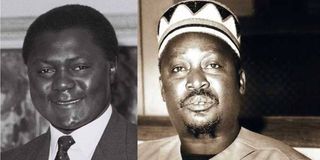
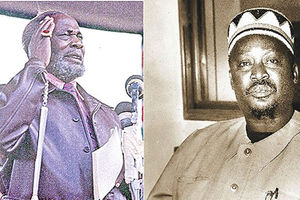
The late Jaramogi Oginga Odinga. Commonly known as the doyen of Kenyan opposition politics.
The Kenya colony was important to the Cold War protagonists who were keen in advancing their strategic and economic interests in the region. For this reason, the Western and Eastern blocs went well out to court selected African nationalists by supporting their activities and putting huge sums of money at their disposal. This was done in the belief that with proper assistance these nationalists could achieve power and help them achieve their goals in post-independent Kenya. While the US befriended Tom Mboya, the Soviet decided to cast their lots with Jaramogi Oginga Odinga.
Mboya was the first Kenyan nationalist to become a key channel for Cold War aid when he visited America at the end of his studies in England in 1956. He not only became a channel for US scholarships but also had access to financial resources, which were huge by Kenyan standards at that time. Most of these assistance came from Non-governmental organisations, such as trade unions and anti-colonial groups. The US government, out of fear of antagonising its British ally by interfering in its colonies, decided to channel money to fight Communism and support pro-Western leaders through such organizations.
When Mboya first visited America in 1956, he was little-known there. Officials from anti-colonial organisations such as the American Committee On Africa (ACOA) and American trade organisations who interacted with him during this visit were careful not to invest much in him and only gave him limited scholarships and funds for his trade union and political activities. But as his stature in Kenya grew after he joined elective politics in 1957, coupled with his determination to expand his contacts in America, the assistance he received from America grew steadily especially from 1958.
At the beginning of 1958 he had only Sh5,000 in his account and his application for a personal overdraft was rejected in March 1958 but by mid-1958, his financial situation had begun to improve as his American friends and trade union organisations began to send him huge sums of money. In May 1958, he acquired a stake in Afrika Bar at Mbotela estate, which represented an investment of Sh2,000, but as the Director of intelligence Kenya colony noted, “His actual stake covered by dummy shareholders may be large”. This bar was run by his village mate from Rusinga, David Wandago. By June 1958, Mboya had become a member of the Advisory committee to Rhodesia Africa Insurance and Provident Corporation Ltd, and by October he had become the company’s African advisor. He was also a partner in the Kabondo stores in South Nyanza and had a major stake in a fishing enterprise in Rusinga which was estimated to be worth Sh2,000 by September 1958.
More assistance was given to Mboya when he made his second trip to America in April 1959. He did not only receive financial aid and promises for specific items, but also promises of funds for investment in commercial enterprises in Kenya. A search conducted on him by the police when he landed at Nairobi airport in June, revealed that he had an account with CWS Bank in London in which he had deposited some money during his layover in London from America. Between June and July 1959, after his return, he had a spate paying off his debts such as Sh1,400 to Equatorial services, and Sh55 a month wage bill to his two personal clerks. He also acquired a new car, an Opel Record, and loaned his political allies Martin Shikuku and Dennis Akumu Sh200 and Sh100 respectively. He also had Sh50,000 in a building savings account.
Fearing that the colonial government had access to his bank account Mboya used A.R. Kapila as a banker and secret channel for receiving funds. For instance, when his American friend William Scheinman sent him $6,000 Mboya made the cheque payable to Kapila, who then transferred the money to him. Also when Mboya loaned Akumu Sh100, the cheque was made payable on Kapila’s account.
Mboya’s interests in the commercial field also became much wider after this second trip. Together with his American friends and Kenyan political allies, they established the African Wholesale Trading Company floated by the Trust Corporation Ltd (a Nairobi Financial House, responsible for its finance).
“The idea being that Mboya, together with Kiano would act as a covert backer who becoming a Director, might be called its patron,” the British Director of Intelligence explained in documents seen by the
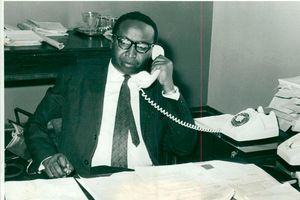
Tom Mboya.
Photo credit: File | Nation Media Group
The company was registered in November 1959 with seven African partners and a capital of Sh10,000. On a rather more personal basis, Mboya invested Sh12,000 in the Winam Hotel, Kisumu.
Mboya’s rising political star because of his success in obtaining scholarships and funds on a large scale from America in 1959, and the publicity given to his “airlift to America”, startled Jaramogi, who also made an attempt to visit America to solicit for the same to counter him. However, these plans were sabotaged by Mboya, who succeeded in tainting Jaramogi in the eyes of the Americans as a Communist. As a result, when Odinga applied for a visa, the American consul in Nairobi rejected it straightway. The intelligence believed that Mboya maligned Jaramogi not because he believed he was a Communist but he feared he could encroach on his American sources.
“Although some of the wilder statements made by Odinga could be interpreted as showing Communist influence, there was no evidence that he had been courting Communism in any way,” the Director of Intelligence wrote in a document marked secret. “He (Jaramogi Oginga Odinga) was the archetype in Kenya of the old pre-Emergency African politician to whom international affairs meant nothing except in a purely parochial context.”
Jaramogi made another attempt to visit the US at the invitation of an African American anthropologist called Marion Forrester, who wanted him to attend a Congress of World Church leaders, but the plan also fell through with Jaramogi suspecting Mboya of having had a hand in it. With the West shunning him, Jaramogi turned to the East who quickly embraced him. His trip to London in December 1959, for the first Lancaster Conference gave him an opportunity to establish contacts with Eastern diplomats and agents, who organised for him to visit countries behind the Iron Curtain.
However, it was not until around May 1960 when he became a key channel for funds and scholarships from socialist countries. Unlike the Americans, the Soviet and the Chinese were more open and direct in their support for African nationalists such as Jaramogi. By July 1960, Jaramogi had received hundreds of scholarships from the USSR and its satellite states and £ 50,000 deposited in his account by Moscow for his political activities.
Having established his position as the East’s key point man in East Africa, in November 1960 he finally got a chance to take revenge on Mboya, who had earlier undermined his plan to visit America. Mboya had visited the Chinese Embassy in London indicating his willingness to travel to China. The Chinese consulted their ally Jaramogi, who urged them to reject Mboya’s request and instead give the chance to Milton Obote of Uganda. In a letter marked secret and sent to the headquarters of MI5 — the British domestic intelligence service — at Leconfield House London, A.D Waugh, the spy in charge of Kenya and Uganda, wrote, “(Jaramogi) Oginga Odinga advised the ambassador against Mboya going to China and suggested that Milton Obote of Uganda would be more suitable. Obote who source reports is in East Germany may shortly visit China as the result of Oginga Odinga’s suggestion.”
To hide his Communist money trail from the prying eyes of British intelligence, Jaramogi always used his most trusted aides as couriers, and at one point opened an account in Switzerland, which is known for its banking privacy and strong financial secrecy laws. This account was held at Societe de Banque Suisse in Geneva and was opened on his behalf by his aide Dixon Oruko Makasembo assisted by a Swiss Bank official called Robert Israel. Jaramogi also had an account in London, which he used to hold money collected from Eastern Embassies in London before transferring it to his Swiss account. By 1961, his Swiss account had £23,000.
Apart from Makasembo, others who assisted him to clandestinely move money across continents were Wilson Okondo Onyango, Okuto Bala and Ndolo Ayah. For instance, around July 1961, he sent Okondo Onyango to collect £25,000 from the Soviet Embassy in Cairo and deposit it in his Swiss bank account in Geneva. Before heading to Geneva from Cairo, Okondo Onyango made a stopover in London where, on behalf of Jaramogi, he collected £3,350 in sterling notes from a Tanzanian called Dennis Phombeah of the Committee on Africa. Out of the £3,350 Okondo Onyango gave Okuto Bala £2,500, who in turn handed it to Wilson Ndolo Ayah to take to Nairobi. Jaramogi’s personal assistant BFF Oluande K’Oduol gave part of this money to Jomo Kenyatta and Fred Kubai.
Meanwhile, Okondo Onyango, who had proceeded to Geneva from London, tried to transfer some of the money held in Jaramogi’s Swiss account to the politician’s Kenyan account, but this was declined. According to an MI5 intelligence agent, who was monitoring the transactions, the reason given was that “the transfer could only be done on the recommendation of the Swiss Trade Commissioner in Nairobi who at the time of Okondo Onyango’s visit was not prepared to permit the transfer to Odinga’s name.”
The British spy went on, “It was then arranged that should the trade Commissioner be adamant in this respect, the account should be transferred in Onyango’s name under an account to be opened by him with the bank in Geneva.”
By 1962, the MI5 were already suspecting Jaramogi of purchasing a house in London. In a letter dated, January 18, 1962 ISM Henderson the Director of Intelligence Kenya, wrote to MI5 Security Liaison Officer for Kenya and Uganda requesting, “I have received a report, which I am unable to evaluate, that Oginga has bought a house in England and that Othigo Otieno is at present caretaking. I should be grateful for your comments. “
However, despite flirting with the Soviet and the Chinese, Jaramogi had nothing whatsoever in his background to suggest he was a Communist. His experience as a businessman showed his inclination towards capitalism. As the colonial Governor General of Kenya Malcolm MacDonald admitted, “He was most probably a genuine African nationalist seeking African solutions and flexible in his approach.”
MacDonald also revealed that during one private meeting, Jaramogi, in his typical honesty, told him that he only turned to the East after the West started supporting his main political rival Mboya, adding that if the East had supported Mboya he could have turned to the West to counter him politically.