Classified documents reveal the full extent of how rogue senior State officials coerced Kenya Police Pathologist Dr Adel Youssef Shaker to approve a falsified post-mortem report following the suspicious death of British tourist Julie Ward in 1988 .
Thirty-seven years later, the unresolved case remains the most mysterious high-profile killing of a foreigner in Kenya and the secret British government files seen exclusively by the Weekly Review following a Freedom of Information request in London provide fresh details.
After the discovery of the charred remains of the amateur wildlife photographer in the expansive Maasai Mara on September 13, 1988, Dr Youssef — an Egyptian national — conducted a post-mortem on September 15 and reached a conclusion of murder, a finding that irked influential individuals.
On September 21,1988, Mr John Ward, the murdered tourist’s father — who would later spend years and millions of shillings trying to find his daughter’s killers — landed in Nairobi from London and visited the City Mortuary to talk to Dr Youssef. Even though the Egyptian pathologist had not yet finished typing his post-mortem report, he confided to Mr Ward that his daughter could have been murdered, contrary to speculation that she had been killed by wild animals.
Knowing how sensitive the matter was and how senior government officials were determined to falsify the cause of death, Dr Youssef suggested a secret meeting with Mr Ward at Nairobi’s Coptic Orthodox Church to demonstrate his findings using a cast jaw. This meeting took place on the same day in the church’s compound on Ngong Road and was attended by Mr Ward, his business associate Mr Frank Ribeiro and Mr John Ferguson, who was the Second Secretary at the British High Commission. There was also an MI5 intelligence officer.
Contrary to his earlier promise of bringing a plaster cast jaw, Dr Youssef brought to the meeting Julie Ward’s real jaw and demonstrated the clean cut in it as evidence of murder. He explained to Mr Ward that his daughter’s lower leg and jaw had been clearly cut, most likely with a sharp object.
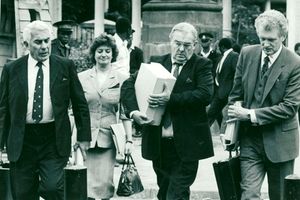
Ms Julie Ward’s father, Mr John Ward (second from right), with his lawyer, Mr Byron Georgiadis (left), Mr Ward’s secretary, Ms Christina Ridley (second left) and Mr John Ferguson, the acting counsellor at the British High Commission in Nairobi during the inquest into her death in August 1989.
Photo credit: Compiled by Maria Wambua
Dr Youssef feared that because of the publicity the case had generated, there was a likelihood of his findings rubbing powerful people in Kenya the wrong way. But he vowed to stand by the truth and assured all those present at the meeting that nobody could alter the report since he had intentionally signed it in Arabic and also had it off-head. However, his forthrightness became the source of his predicaments that eventually forced him to flee back to his country, Egypt. The doctor is now settled in America.
When Dr Youssef left Egypt to take up a job in Nairobi as a Kenya Police pathologist, he hoped for a better life given the higher salary. In Nairobi, when not at the City Mortuary, he could be found in the Coptic Church on Ngong Road where he worshipped and had a leadership role. Apart from his expertise in medicine and forensic pathology, he had also studied law.
Dr Youssef’s strong Christian faith and the professional code of conduct guided him in carrying out his work with great honesty. Perhaps what he did not realise as he took up the job was that he had just immersed himself into a system that was replete with state manipulation and in which honesty was an inconvenience. Julie Ward’s case eventually opened his eyes to this fact.
On September 22, 1988, the then controversial Chief Government Pathologist Jason Kaviti left his office at Kenyatta National Hospital and walked to Dr Youssef’s office at City Mortuary where he demanded to see Julie Ward’s post-mortem report. While going through the file he made some alteration to the document, which was then forwarded to Kenya Police headquarters. When Mr Ferguson from the British High Commission went to collect the report on behalf of Mr Ward at Kenya Police headquarters on September 23, he was shocked to see significant alteration, and the contents different from what Youssef had told them.
“Clean cut” in the original report, relating to the jaw, had been crossed and replaced with “cracked” while a similar reference in the lower leg had been crossed and replaced with “torn”.
“A curious factor in the alteration of this post-mortem is the manner in which it was altered. It would appear to have been done by a child or possibly someone under the influence of alcohol or similar. One would not expect such a bodged job to have been the work of a senior doctor,” Mr Ward remarked in one of the restricted documents.
In altering the report, Dr Kaviti’s aim was to make it appear as if Julie was killed by wild animals, contrary to Dr Youssef’s findings of foul play.
“He took the report. I heard him saying ‘no, no, no’ and saw him underline through some words. I wasn’t happy about this but Dr Kaviti was my boss,” Dr Youssef would later say.
Incensed by the alteration, Mr Ward, Mr Ferguson and John Lee — the owner of Lee Funeral Home in Nairobi, decided to confront Dr Youssef to demand an explanation. This they did at 3.15pm.
“We confronted Youssef Shaker with the report remarking on the two alterations and in view of what he had told us. He was very uncomfortable but immediately came clean and admitted his report had been altered by the Chief Pathologist Dr Kaviti,” Mr Ferguson wrote in a document marked restricted.
To absolve himself from any blame, Dr Youssef offered to take them to Dr Kaviti’s office at the Kenyatta National Hospital so that they could confront him on the matter.
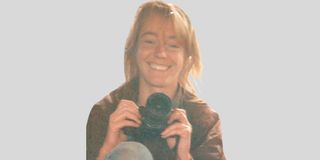
From left: Julie Ward who was killed in the Maasai Mara Game Reserve in 1988 and her father John Ward.
Photo credit: File | Nation Media Group
The Chief Pathologist was, however, dismissive, telling them that he had the authority to alter any of his reports and also pointed out that as an Egyptian, Dr Youssef’s English was not very good. An angry Mr Ward told Dr Kaviti that an independent post-mortem would be done in the UK. Julie’s body was consequently taken to the UK where Prof G.A Gresham of the University of Cambridge upheld Dr Youssef’s original findings that there was definite evidence of the jaw and the leg having been cut with a heavy instrument.
Following international pressure, considerable press interest and Mr Ward’s persistence in pursuing justice for his daughter, the Kenyan government finally agreed to hold an inquest. Throughout the inquest, the documents reveal Dr Youssef was put under immense pressure by Police Commissioner Philip Kilonzo and Attorney General Mathew Guy Muli to retract his evidence but he stood his ground.
Things became even worse for him after the inquest delivered a verdict of murder, confirming his post-mortem findings. He was continuously harassed, intimidated and even briefly jailed on trumped up charges of stealing money from a drunk taxi driver. The charge led to the confiscation of his passport and in his suspension as a police pathologist.
According to the documents, just a day after the UK’s Scotland Yard detectives visited Kenya to begin their investigations, Dr Youssef was summoned by the Commissioner of Police, who ordered him to issue a new statement stating that “after reconsidering all the evidence he now agreed with Kavitu‘s theory that Julie Ward was killed by animals”.
Dr Youssef played for time by asking Police Commissioner Kilonzo to give him two weeks to consider his position. The following day he was summoned to Sheria House where Attorney General Mathew Muli, who was rude and abrasive, spent almost 15 minutes berating him before ordering him to make a new statement otherwise he would face the consequences.
Dr Youssef was reportedly so frightened that he decided to remain silent as Muli rained insults on him. The pathologist was told that “this was the fate of one girl balanced against the fate of one nation” and therefore anything that could damage Kenya’s standing as a tourist destination could not be allowed. Three days later, Dr Youssef was picked up by detectives and taken to the Criminal Investigations Department (CID) headquarters where he was given a typed statement in his name but drafted by the Attorney General’s office.
He was then driven to the Panafric Hotel, where he was told to rewrite the entire statement in his own handwriting and sign it. He was threatened that unless he did so he would go to prison and that his wife and children would suffer. For his own safety and that of his family, Dr Youssef eventually complied by copying and signing the statement to the effect that Julie Ward had been killed by wild animals. His passport, which had been held by the police ever since he was accused of stealing money from a drunk taxi driver, was consequently returned to him.
Having complied, Dr Youssef thought he would be accepted back as a police pathologist, but the Kenyan government didn’t want anything to do with him because he was too upright for a dishonest system. Realising that he had no future in Kenya, and that he was at an even greater risk, he sold all his belongings and quietly left Kenya for Egypt. He didn’t even bother to claim Sh72,000 that the government still owed .
The disappearance of a valuable witness like Dr Youssef became a matter of great concern to Mr Ward, who still strongly believed that the pathologist had more information. According to the classified documents, on Saturday October 19, 1990, Mr Ward travelled to Egypt in the company of his associate Ribeiro to trace Dr Youssef. In Cairo, they got an Egyptian guide, Mohammed Abd L Dayem, who helped them trace Dr Youssef to his hometown of Minya, South of Cairo.
“We located Dr Youssef Shaker and his family living in poverty in a small apartment, which he shared with his wife’s relatives. We talked to Dr Shaker for several hours," Mr Ward revealed in a recorded account of his trip to Cairo. However, Dr Youssef was still hesitant to give more details, and instead chose to narrate his predicaments in the hands of Kenyan officials.
He wrote: “Even in Egypt, Dr Youssef is very concerned for his safety and believes that he is still not out of the reach of the Kenyan authorities. He was reluctant to talk to us and his wife was more apprehensive. I think we should respect his concern.”
One of the plans was to get him a job in Britain where he would be more secure to reveal further details. “I am hoping to bring him to England in January and attempt to find him a job. He is a clever chap, who not only holds a medical degree but also a Doctorate of law. However, it is in medicine that his real interest lies. At the moment, having lost everything in Kenya, he is living in utter poverty in a one-room flat, which he is sharing with some of his wife’s relatives,” Ward wrote in another restricted letter seen by the Weekly Review : “Of course bringing him to England would also give me the opportunity of wheeling him into Scotland Yard, where I would hope to persuade him to make a full and honest statement of all what happened to him since the onset of this nasty business.”
Dr Youssef currently works as a forensic pathologist in the State of Alabama, and also serves as an expert witness in cases related to criminal law, personal injury and civil rights.
Although two game wardens were later arrested but acquitted after the trial, Mr Ward was not satisfied with the process.
He believed that the two were simply being used as scapegoats to cover for a prominent person involved in the murder. Some of the questions he asked the Scotland Yard, according to classified documents were: who was paying the lawyers representing the two accused and did President Daniel Moi summon the Maasai Mara Chief Warden to his office the day after Julie Ward’s remains were found — and if so, why?
Jenny Jenkins, who was an officer at the British High Commission, would later state that the suggestion that the son of a prominent politician was involved “would have caused severe embarrassment to the Kenyan government.” The most outrageous theory came from David Rowe, a Kenyan of British descent who held a senior position in the security system as an Assistant Commissioner of Police and was also involved in the investigation of Tom Mboya’s 1969 assassination .
He told Mr Ward that his daughter was most likely struck by lightning before her body was eaten by hyenas, but an expert dismissed the theory as “nonsense.” Mr Ward died in 2023 at the age of 89, having spent 35 years and an estimated £2 million (Sh340 million) to find out who killed his daughter. The murder remains a mystery.