Kenya’s invitation to participate in the Group of 7 (G7) summit in Evian, France, which starts on Monday, June 15, has placed the East African country in the spotlight as some of the world’s most powerful economies discuss critical global issues.
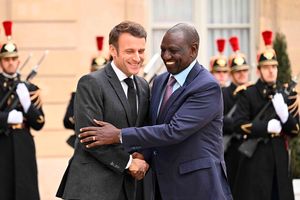
Kenya is the only African country invited to attend this year’s G7 Leaders’ Summit, taking place from June 15–17, 2026, reportedly replacing South Africa. French President Emmanuel Macron invited President William Ruto to ensure African perspectives on global financial reforms and equitable development are directly integrated into the G7 agenda.
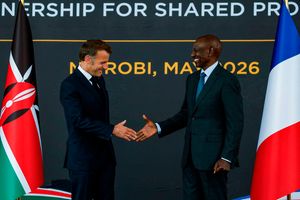
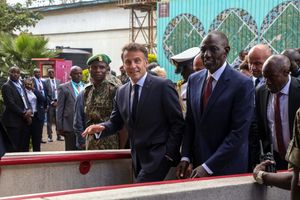
The meeting comes weeks after Kenya’s co-hosting of the France-Africa Summit, led by Mr Macron and Dr Ruto, positioning the country as a crucial bridge between Africa and Western powers.
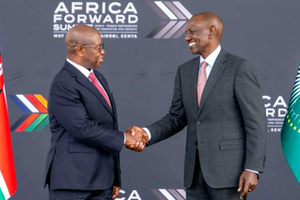
President William Ruto and French President Emmanuel Macron during a joint press conference at State House in Nairobi ahead of the Africa Forward Summit 2026.
Photo credit: Dennis Onsongo | Nation Media Group
Kenya joins South Africa, Senegal, Algeria, Egypt, Tunisia, Comoros, Ethiopia, Tanzania, Ghana, Nigeria and Morocco as African countries invited to the G7 summit over the years.
The G7, an informal intergovernmental forum, is made up of some of the world’s most advanced and industrialised economies: Canada, France, Germany, Italy, Japan, the United Kingdom and the United States.
Prime Cabinet Secretary and Foreign Affairs Minister Musalia Mudavadi told the Weekly Review that the G7 is a significant event that provides Kenya and Africa with an opportunity to raise important issues.
“There will be many global issues to be looked at. Apart from bilateral issues, President Ruto has become a significant continental voice for the African nations,” said Mr Mudavadi.
“He will be able to flag a few continental issues. One, I think he has an opportunity to articulate the consequences and the impact of global conflicts, particularly the Middle East war, on African economies.”
Mr Mudavadi said the US-Israel-Iran crisis is disrupting supplies of various goods, including oil.
Prime Cabinet Secretary and Cabinet Secretary for Foreign and Diaspora Affairs Musalia Mudavadi.
“This war is impacting us and significantly hurting African economies. It’s an opportunity for our President to convey to the G7 that this is not just a conflict in the Middle East—it is having serious and devastating consequences globally, and more so for African economies,” said Mudavadi, adding that there is likely to be discussion on how countries will recover from the impact of the conflict.
“Secondly, his call for relooking the global financial architecture will be another message he will want to emphasise,” he added.
Mr Mudavadi explained that the meeting will also provide an opportunity to present Kenya’s situation on debt.
He said the President “will also take an opportunity to talk about peace and security in the region. An example is the forgotten agenda about the Sudan war.”
International affairs expert Dr Calvince Adhere notes the significance of the G7 given that it is a collection of the most advanced economies in the world. He urges President Ruto to take advantage of the meeting and market Kenya’s potential on the international stage.
“In my view, Nairobi should go to this summit with the view that the platform provides an opportunity for Kenya to showcase what is possible in Kenya. Key areas include climate financing, with Kenya as a champion of climate action for vulnerable countries. Then there is the issue of our debt as well as highlighting Kenya’s economic position in East Africa,” said Dr Adhere.
“Some of the debt is also with the G7 countries so they can talk about how, for instance, they could even restructure it to suit domestic conditions. You know now almost half of the budget that was announced by Treasury Cabinet Secretary John Mbadi the other day is going into debt repayment, so there is a huge problem of debt and he can discuss it with partners and explore ways of restructuring it.”
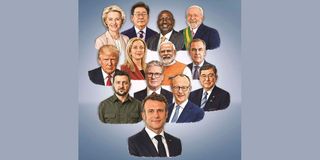
Kenya is the only African country invited to attend this year’s G7 Leaders’ Summit, taking place from June 15–17, 2026 in Evian, France.
Photo credit: Nation Media Group
The G7 Summit, coming weeks after Kenya successfully hosted the Africa Forward Summit in Nairobi, positions Kenya as a key regional economic and diplomatic hub in East Africa, with strategic importance in trade, peacekeeping, renewable energy and technological innovation.
“Beyond diplomatic undertones, I think Kenya also looks at the G7 as a primary platform to negotiate functional partnerships, most of them in the most pressing areas,” said Adhere.
Though Kenya has been invited to three G7 summits since 2017, its presence this year has been spotlighted by South Africa’s reported exclusion following US pressure.
“I think it is a good thing for Kenya!” Adhere says, adding that South Africa does not have a guaranteed slot at every meeting.
Chatham House, a world-leading policy institute with a mission to address geopolitical challenges and international problems, cautions that Ruto’s international ambitions rest on shaky domestic foundations.
“Recent protests—over a US-backed Ebola quarantine facility on Kenyan soil and a transport shutdown over rising fuel prices—show how external conditions continue to affect domestic politics,” wrote Fergus Kell, Research Fellow, Africa Programme, Chatham House.
“A purely symbolic Kenyan presence at the G7 would do little to alleviate these pressures. The summit’s headline focus on global economic imbalances, however, is a chance for Kenya to speak out on structural conditions that have constrained its domestic choices.”
“This G7 focus is particularly timely for Kenya. Kenya’s defining weakness in recent years has been its public debt burden, with servicing costs consuming over a third of revenues,” he added.
“As the largest bilateral lender to Kenya, China has attracted much of the blame. But this is not the full story. There has also been a parallel rise in Kenyan borrowing from international commercial markets.”
Kenya’s total public and publicly guaranteed debt comprises domestic obligations and external borrowing. According to Chatham House, the public debt has been on an upward trajectory since 2013.
“Kenyan leaders must shoulder the primary blame for the rapid accumulation of unproductive debt. But indirect exposure to global conditions has made the solutions more painful,” said Kell.
Alongside its debt stock, China is also Kenya’s largest trade partner and runs a widening trade surplus: 2024 figures show that Chinese exports to Kenya were $4.3 billion, against $196 million in imports. In May, China finalised an interim agreement extending zero-tariff access to 53 African countries.
“Kenyan agricultural exports are an obvious beneficiary of tariff removal—as the continent’s mineral and energy exports were already tariff-free—but Kenya’s middle-income status meant it had first negotiated a reciprocal agreement to open its market to Chinese imports,” said Kell.
Kenya’s G7 participation is also seen as a chance to ensure that the summit debates on global imbalances do not neglect shared responsibilities towards emerging economies.
Another more challenging objective will be to ensure that stricter European Union trade measures do not disincentivise Chinese investments in African export industries.
Kenya can also be expected to raise issues related to the Ebola outbreak in the Democratic Republic of Congo, which has also spread to Uganda.
President Ruto could further leverage the proposed US-backed quarantine centre to extract concessions from America, including progress on trade-deal discussions first proposed during President Donald Trump’s first term.