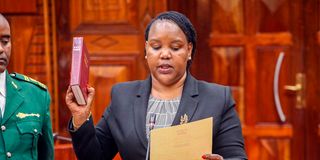
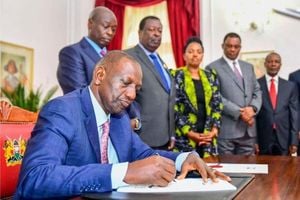
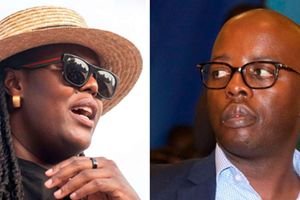
August 15, 2025 must have been a lucky day for former Cabinet Secretary and politician Florence Bore.
She must have found an avalanche of congratulatory texts flowing into her cell phone over her brand-new government appointment: she was going to “fly the flag” again.
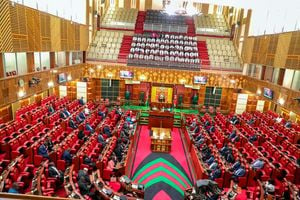
Last Wednesday, Parliament cleared the last hurdle and approved the nomination and that of eight other ambassadors and consul-generals.
It was the last constitutional hurdle before they collect their credentials from State House, sit down to lunches at the Foreign Service Academy, and pose for family portraits draped in the flag.
A year earlier, Ms Bore had been fired from President William Ruto’s Cabinet after the country erupted in anti-tax protests. Now, a terse communique from State House announced that Bore would soon take up residence on Robert Mugabe Avenue in Windhoek as Kenya’s ambassador to Namibia.
The same statement, heavy with the language of “optimising performance” under Ruto’s Bottom-Up Economic Transformation Agenda, reassigned more than two dozen other envoys.
Yet, to seasoned Nairobi hands, the real story was not a bureaucratic shuffle but the durability of a political ritual: turn yesterday’s casualties into today’s diplomats and, in the process, keep the wheels of loyalty well-greased.
Across the decades, Kenya’s embassies have functioned less as strategic outposts than as holding pens for useful allies, noisy critics, and unlucky election losers.
The habit began almost accidentally under Jomo Kenyatta, solidified into doctrine under Daniel arap Moi, acquired a technocratic sheen during Mwai Kibaki’s time, became outright bravado under Uhuru Kenyatta, and now marches on in the Ruto era. Each president inherited a foreign service staffed by career officers but chose, time and again, to reserve the corner offices for political survivors. For every diplomat who spent years parsing treaty clauses in Gigiri, there was a politician waiting to be rescued from domestic defeat by a one-way ticket to Paris, Riyadh or Ottawa.
Jomo Kenyatta’s generation framed the logic in the bluntest possible terms: an ambassador represents the President personally; therefore trust outranks pedigree.
His newly independent government filled embassies with provincial administrators who had fought for Kanu’s supremacy or tamped down dissent in the Rift.
When backbench firebrand Jean-Marie Seroney grew too restless in Parliament, Mzee Kenyatta dangled the Nigerian mission as a possible exile; Seroney declined, but the offer itself set a precedent.
Diplomacy was politics by quieter means, a place where problematic allies could sing the national anthem at cocktail parties instead of shouting at rallies.
President Moi grasped the power of that safety valve. Throughout the 1980s he dispatched dozens of Kanu loyalists abroad, often to neutralise regional kingpins.
Former State House Comptroller Franklin Bett.
Photo credit: File | Nation Media Group
Franklin Bett, for instance, left the turbulence of State House Comptroller’s office for the calm of Canberra, a journey he later confessed may have “blocked careers for honest diplomats.”
By the 1990s, embassies had become Nairobi’s preferred quarantine ward.
Those who had tasted President Moi’s displeasure—but still possessed votes, secrets or ethnic leverage—found themselves in Harare or Harbin, far from microphones yet close enough to be recalled at election time.
Then came President Kibaki, winning power on a promise of technocratic virtue. For a while it seemed the diplomats would finally inherit their own shop.
Simon Nabukwesi, a former high-school principal turned envoy to Canada, spoke glowingly of the Foreign Service Academy where new entrants—politicians included—received “crash courses” on protocol.
In 2006 Julius Sunkuli, a Cabinet minister-turned-envoy, landed in Beijing and later told the Sunday Nation that career officers “treated me as one of their own.”
Kilgoris MP Julius Sunkuli, a former Cabinet minister and envoy.
Photo credit: File | Nation Media Group
The soothing memory elided an awkward fact: every non-career appointee pushed a trained diplomat further down the ladder, and Beijing, Brussels and Canberra were hardly backwater stations.
Uhuru Kenyatta elevated the practice to near-art. His presidency arrived amid frosty relations with the West, yet when the chill thawed in 2014 he seized the moment to reward campaign warriors.
That August he dispatched former Finance Minister Njeru Githae to Washington, ex-Foreign Affairs chief Sam Ongeri to UN-Habitat in Nairobi, and one-time Transport minister Chirau Ali Mwakwere to Dar es Salaam.
One-time Transport Minister Chirau Ali Mwakwere.
Photo credit: File | Nation Media Group
The Daily Nation splashed the headline “It’s Payback Time,” noting that most of the new envoys had “stuck with Uhuru during campaigns, particularly in opposition strongholds.”
In 2018 another reshuffle filled Delhi, Brussels and Nairobi’s UN Office with politicians and civil servants pivoting from unrelated jobs. The outcry from Parliament’s Defence and Foreign Relations Committee was muted; as one opposition MP sighed during a closed-door vetting session, “It is just bad manners for this kind of thing to keep happening.”
Bad manners or not, the conveyor belt kept running. By the time Ruto took office in 2022, more than sixty Uhuru-era envoys held four-year contracts that could be extended at the President’s pleasure. Ruto’s allies bayed for a purge. His deputy, Rigathi Gachagua, threatened to recall under-performers unless they signed contracts to hawk Kenyan tea and macadamia abroad. Yet the promised house-cleaning proved selective.
Lack of diplomatic training
A Saturday Nation audit in March 2024 showed ten Kenyatta envoys had survived, among them Manoah Esipisu in London and Stella Munyi in Harare. Patronage, it turned out, was bipartisan.
The ambassadorship of Florence Bore thus lands in a long queue. Her path from Kericho politics to Cabinet and now Windhoek traces the lifecycle of a Kenyan insider: ascent, controversy, reshuffle, redemption. Critics point to her lack of diplomatic training; supporters counter that an envoy’s first duty is to secure presidential priorities, not to recite protocol from memory. The Ministry of Foreign Affairs will soon enrol her in its month-long induction at the Foreign Service Academy, the same crash course Bob Wekesa once described in these pages as “doing little to instill the intricate skills required for diplomacy.”
Four weeks of etiquette cannot replicate a decade spent drafting resolutions at the UN, yet the system shrugs and wheels on.
Why, then, do career diplomats seldom reach the coveted top slots? Partly it is arithmetic: Kenya maintains about sixty-five missions, and each five-year electoral cycle produces more political loyalists than cushy parastatal boards can absorb. Ethnic calculus also plays its part. An embassy in Doha or Dar es Salaam offers a discreet way to placate a region without elevating a local rival at home.
Add the perks—tax-free stipends, duty-free cars, a house with a flag—and the job becomes irresistible currency in coalition-building. Professional diplomats, by contrast, wield no electoral clout. Their union has lobbied for a merit-based system since the early 1990s, yet every attempt collides with the blunt reality of presidential prerogative.
The Constitution of 2010 tried to install a check: public vetting by Parliament. But in practice, committees comb through tax returns, political correctness and perhaps, moral probity, not policy acumen.
During Uhuru Kenyatta’s 2019 appointments, members fretted less about strategy than about whether Hassan Wario’s Rio-Olympics graft charges would embarrass Vienna. The host capital wields its own veto—Ottawa once rejected a nominee who lacked civil-service experience—but rejections remain rare because Kenya is careful to avoid diplomatic scandals abroad.
Younger officers whisper of “glass embassies,” missions they can see but never reach. A section head who joined the service in 2002 tells me, on condition of anonymity, that he has mentored four political appointees in six years, each arriving with fanfare and leaving before mastering the cables system. In 2018 he watched Sarah Serem, former chair of the Salaries and Remuneration Commission, sail through vetting to become ambassador to Beijing. “How do you argue merit,” He asks, “when even Beijing is a consolation prize?”
Defenders of the status quo reply that Kenya is hardly unique. The United States famously sends big donors to Paris and Rome, and Britain sprinkles life peers across the Commonwealth. In Nairobi’s logic, a politician who once wrangled budgets in Cabinet might lobby for Kenyan goods more aggressively than a protocol-drilled officer.
Former Cabinet Minister Julius Sunkuli framed it as a question of direct access: “Sometimes presidents need people they can call in the middle of the night.” Yet the evidence on performance is thin. Trade volumes rise or fall with global cycles, not with the charisma of envoys.
Meanwhile, the institutional memory of the Foreign Service bleeds as mid-tier officers rotates endlessly between Tripoli and Pretoria without ascending to ambassador.
This revolving door exacts subtler costs. Seasoned diplomats cultivate networks that last decades; political appointees seldom stay long enough to matter.
In 2014 Ottawa rebuffed Lucy Chelimo for lack of experience, forcing Nairobi to scramble for a replacement. In 2015 John Lanyasunya, originally ticketed to open a chancery in Algiers, was rerouted to Canada after the first choice fell through. Every shuffle delays trade missions, trade agreements, student exchanges, security pacts—hard currency in a competitive continent.
Occasionally reality intrudes so rudely that the patronage façade cracks. When the Ethics and Anti-Corruption Commission charged Hassan Wario over Olympic graft, the Austrian government quietly postponed his credential ceremony. Months dragged on while Vienna weighed whether to accept a man on trial for embezzlement. Back in Nairobi, junior embassy staff fielded frantic calls from Nairobi sports journalists seeking comment.
Former Sports Cabinet Secretary Hassan Wario at Milimani Law Courts in Nairobi on October 19, 2018.
Photo credit: File | Nation Media Group
The scandal faded, but the damage to morale lingered: promotions for professionals again stalled while political calculus played out in courtrooms.
And yet no president pays a political price for any of this. The electorate’s attention span rarely reaches Addis-Ababa’s Saladin Avenue or Brasilia’s Setor de Embaixadas Norte. Diplomats, by training, do not mount street protests. Parliament’s committees still invite nominees to recite Shakespearean oaths about serving Kenya’s interests; afterward everyone poses for photographs.
When, in 2023, lawmakers like Nelson Koech urged Ruto to reserve missions for “experts,” their plea vanished beneath the next day’s headline on fuel prices.
Perhaps the most potent symbol of this inertia is the residence on Tende Drive in Lavington, Nairobi, known among insiders as “The Boarding School.” Here outgoing envoys spend weeks awaiting visas, undergoing cultural briefings and fitting tailored suits. Some arrive triumphant, some chastened, all bound for capitals where Kenya’s flag will fly above yet more elaborate titles.
In the lounge hangs a portrait of Jomo Kenyatta shaking hands with his first ambassador to Washington. At the other end of the corridor a flat-screen television scrolls the latest dispatches from Muscat, Madrid and Maputo — a reminder that the carousel, once set in motion, never really stops.
If precedent holds, she will serve four years, maybe six, perhaps secure a quiet extension until retirement. She will attend Africa Day receptions, negotiate student quotas, and lobby for Kenyan avocados in Namibian supermarkets. Whether any of that advances Nairobi’s long-stated ambition of economic diplomacy is difficult to measure and easy to ignore. What matters, in the internal logic of State House, is that a loyal foot soldier has landed softly.
The Foreign Service she joins remains staffed by dozens of officers who studied disarmament treatises and trade law, fluent in French, Spanish and Mandarin, waiting for a call that seldom comes. Some will retire as deputy heads of mission, honoured for discreet service yet denied the ultimate posting. Others will quit for academia or the private sector, taking their institutional memory with them. In their place new graduates will arrive, eager, diligent, and already warned that upward mobility relies less on Grade 5 Arabic than on the unpredictable winds of politics.
It is tempting to imagine an impending reckoning. The global marketplace is unforgiving; Kenya’s export targets hinge on relentless advocacy abroad. In Brussels, envoys from Vietnam and Rwanda lobby the European Parliament with data-heavy dossiers; in Addis, Ethiopia’s diplomats leverage AU peace operations to sell their industrial parks. Kenyan delegations, staffed by revolving amateurs and overworked attachés, struggle to keep pace. Former Prime Minister Raila Odinga once floated the idea of oath-bound performance contracts for ambassadors, but the proposal died quietly in committee stages. Merit, like reform, is a word that glows on policy papers but dims in the heat of coalition politics.
So the embassy as soft landing persists, a bipartisan insurance scheme.
President Ruto, who himself entered politics as secretary of the Youth for KANU ’92, understands the arithmetic: winners need rewards, and even losers can be useful tomorrow. The day the Bore appointment was announced, her allies in Kericho celebrated with a thanksgiving service. The local paper quoted a pastor stating that “God opens new doors.” In Nairobi’s corridors of power, a less celestial calculation prevailed: the patronage machine had found another vacancy, the flag would keep flying, and the cycle would roll on.
From Jomo Kenyatta’s first forays into Cold War diplomacy to President Ruto’s realignments, Kenya’s embassies have mirrored the state itself: resilient, adaptable, and ultimately loyal not to abstract notions of merit but to the hand that signs the posting letter. For half a century the practice has survived coups, referendums, constitutional overhauls and the digital age.
The diplomats who trained for the job still believe, quietly, that one day the tide will turn in their favour.