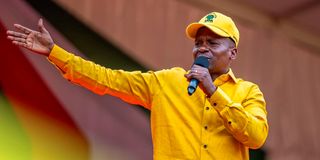
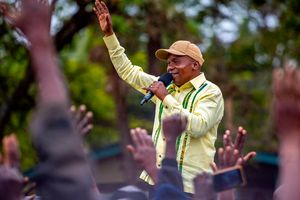
Kithure Kindiki has been travelling the around the mountain dressing supporters in party colours. At one meeting he is defending a road project; at another, he is answering Rigathi Gachagua . Elders have installed him as a regional spokesman , and politicians from Mount Kenya East have warned President William Ruto against choosing another running mate in 2027. For a deputy president fighting to retain his place on the ticket, the activity is understandable. It is also a trap.
To start with, Kindiki needs the mountain to prove his electoral value. But the more his public identity becomes the defence of one region, the easier it becomes to ask whether he still serves as a national deputy. Kenya has seen this narrowing before. Mwai Kibaki, Josephat Karanja, George Saitoti and Jaramogi Oginga Odinga took very different routes out of the vice-presidency. Each discovered that the office could lose its political force while its occupant still bore the title.
Kibaki’s experience is especially instructive for Kindiki. By the mid-1980s, long before Daniel arap Moi removed him as vice-president in March 1988, Kibaki’s political activity had become increasingly concentrated around Nyeri. It made him vulnerable to the charge that he was an “Othaya vice-president.” Kindiki faces a similar charge. Sirisia MP John Waluke recently accused him of limiting his political visits to Tharaka Nithi, Meru and Embu, arguing that a deputy president should have a national reach.
Ugandan President Godfrey Binaisa (centre) is escorted to his plane at Jomo Kenyatta Airport by Kenya’s President Daniel Moi (right) and Vice-President Mwai Kibaki after his visit to Kenya on May 8, 1980.
Photo credit: File | Nation Media Group
ODM leaders want the deputy presidency as the price of backing President Ruto in 2027, and Cooperatives Cabinet Secretary Wycliffe Oparanya is among the names they have floated. Other figures in Ruto’s coalition have their own ambitions. For Kindiki, the question is whether he can deliver more votes than any of them—and make himself harder to replace.
To survive, Kindiki’s response should be to make himself useful beyond the counties where his support is most secure. While he needs a sustained presence in Mt Kenya West, where his claim to regional leadership will be tested, he should also build working relationships with ODM figures, even as they contest the deputy president’s slot. As he will find out, public defiance may rally his allies, but his strongest case to President Ruto is that he can deliver votes across the country and that dropping him would cost the President support he cannot afford to lose.
DP Kindiki: I will no longer respond to insults
Of course, we all know that Kindiki is not Kibaki, and Kenya is not living under Moi’s one-party state. He has appeared beyond his home area and has national duties that no county rally can erase. Yet he should notice the danger in having every political journey interpreted as a trip to reclaim the mountain. Once big rallies in Tharaka Nithi or Embu becomes the measure of his worth, his opponents need only keep asking why a national deputy must struggle so hard to be accepted at home. Kindiki should know that a shrinking of his influence is dangerous. It led to Kibaki’s formal demotion after the contentious mlolongo elections when Moi moved him to the Health ministry and appointed Josephat Karanja vice-president.
And that is where Kindiki can learn lesson number two. Dr Karanja relied on borrowed authority, just like Kindiki. When Karanja’s political weather changed, the title could not organise a constituency to defend him. Those who had welcomed his appointment were under no obligation to protect him. Nor was public loyalty to Moi sufficient to silence the politicians attacking him.
Then President Daniel arap Moi (left) and his vice-president Dr Josephat Karanja during a past function at State House, Nairobi. Dr Karanja died of cancer on February 28, 1994.
Photo credit: File | Nation Media Group
Kindiki’s predicament is subtler. He was chosen after Gachagua’s impeachment precisely because he looked capable of doing the job without turning the deputy presidency into a rival headquarters. He has been measured in speech and faithful in service. Yet if restraint leaves him dependent entirely on State House for his political identity, it gives him little leverage when State House considers its 2027 options.
The other problem is that Kindiki cannot simply copy Gachagua who made the mountain’s claim to government so explicit that “shareholding” became a shorthand for his politics. After Gachagua’s fall, Kindiki knows the cost of appearing to own an ethnic veto over the presidency. He must therefore show that he carries meaningful support without presenting himself as a regional landlord entitled to collect rent from Ruto.
Prof George Saitoti presents a third lesson for Kindiki. For years, he served Moi with formidable discipline. He survived political storms, including a period after the 1997 election when Moi left the vice-presidency vacant before returning him to office. While longevity encouraged talk of succession, it never produced a promise.
At the KANU delegates’ meeting in Kasarani in 2002, the party created four vice-chairmanships after its merger with Raila Odinga’s National Development Party. Saitoti, the sitting vice-president, was left out. Moi then promoted Uhuru Kenyatta as his chosen presidential successor. Saitoti’s years at the President’s side could not overcome the electoral and factional bargain Moi believed Uhuru offered. By August, he was out of the vice-presidency.
President Daniel Arap Moi with his Vice President Prof George Saitoti.
Photo credit: File | Nation Media Group
For Kindiki, the point is immediate. A president may praise his deputy on Sunday and revise the ticket when the numbers change. Again, and most important, loyalty earns a hearing but hardly settles an election. The 2027 running mate will be chosen for what Ruto believes that person adds to his chances, and that calculation will be made against the possible cost of dropping Kindiki.
There is, however, a danger in treating the voters of Mount Kenya as a parcel that any politician can deliver. Kindiki’s endorsement by elders is politically useful, but an installation is not a ballot. Gachagua’s claim to speak for the region is contested too with the rise of Ndindi Nyoro. Again, the mountain has eastern and western interests, competing politicians, and voters who may judge the government by prices, taxes, roads, work and trust before deciding which leader speaks for them.
Kindiki’s vulnerable position
The same uncertainty applies to an ODM alternative. A party endorsement cannot guarantee every supporter’s vote. The question that Ruto must ask is whether a new running mate would bring enough votes to offset the anger caused by discarding another deputy from Mount Kenya after Gachagua. The other thing he knows is that Kindiki’s position is vulnerable, but the question is: Would replacing him carry a price?
In case pressure increases, he can check out the early history of Jaramogi and bolt out. Jaramogi quit in 1966, KANU replaced his single party vice-presidency with eight provincial posts. He resigned from government and party and helped form the Kenya People’s Union with allies from outside Nyanza, among them Bildad Kaggia. After that, the government contained Jaramogi’s politics to Nyanza province.
Kindiki faces neither that repression nor Jaramogi’s ideological rupture. The comparison matters because regional confinement can become a self-fulfilling story. Once every appearance is framed as a defence of one’s backyard, political rivals can describe national concerns as somebody else’s business. A leader may still have a nationwide argument, but fewer people will hear it.
Deputy President Kithure Kindiki delivers his speech after he was installed as the Mt Kenya spokesperson at Kirigiti Stadium in Kiambu County.
Photo credit: DPCS
So what should Kindiki do? He should travel across Kenya as the deputy president, answer for the government’s record wherever he goes and make a case that reaches beyond the question of who owns Mount Kenya. At home, he should treat support as something to be earned from citizens, rather than bestowed by elders or enforced by allies who threaten to split the region. His usefulness to Ruto depends in part on whether he can hold a substantial share of that vote. His stature depends on showing what he will do with the office for the whole country.
At the moment, the Constitution gives him room to try. While Moi could dismiss a vice-president and announce a replacement, even by the roadside, Ruto cannot remove Kindiki at will for his tenure is protected by constitutional procedures. But at the next election, a presidential candidate nominates a running mate afresh. Kindiki knows that security until the end of this term is no guarantee of a place on the next ticket.
The take home from Kibaki is that the fight for a backyard can consume a national reputation. The Karanja case shows how quickly a title without durable political support can become lonely. Prof Saitoti proves that long service is no succession contract. Jaramogi shows how a leader’s national reach can be squeezed until the public sees only his region.
There is a positive lesson from Kibaki’s story. His demotion did not end his career. In 1991 he left KANU, formed the Democratic Party and eventually won the presidency through a coalition far wider than Nyeri. The man who had been pressed back into his district escaped by finding a larger political language. Kindiki cannot follow the same route while serving Ruto. He can, however, learn from its logic: a politician’s future expands when citizens outside his immediate constituency see their own concerns in his voice the way some people find solace in Sifuna. That is a better defence than any ceremony proclaiming him the owner of a mountain.
Having said that, Kindiki’s task is to escape that sequence. The crowds at home may help him keep his place in Ruto’s arithmetic. But if he comes to stand only for the mountain, someone else will be invited to speak for Kenya. He should know that the old vice-presidential trap closes long before the chair is taken away.
John Kamauis a PhD candidate in History, University of Toronto. Email: [email protected]