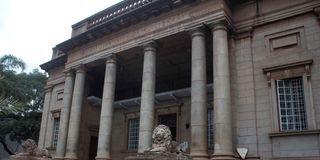
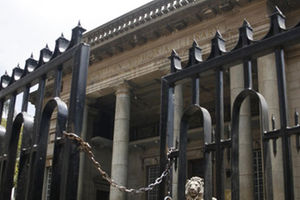
From the outside, the McMillan Memorial Library in Nairobi stands as an architectural gem. Clad in Nairobi blue stone, the building exudes an air of aristocracy while its neoclassical design lends it a timeless elegance. Yet, within its walls lies a library in decay. And that’s an understatement.
That is not what Lady Lucie McMillan – she of Juja Farm and Ol Donyo Sabuk- had in mind as a legacy to her husband, Sir Northrup McMillan. This is not what she bequeathed to the people of Nairobi.
For years, friends of this historic institution have warned that without urgent intervention, we risk losing a vital piece of Nairobi’s heritage. Not the brick and mortar, but the soul of the library. That is why Governor Johnson Sakaja’s recent visit—and his pledge to restore the library— brings hope for historians and the city’s residents alike. Should he succeed, and we sincerely wish him well, this could be his most significant contribution to the preservation of Nairobi’s cultural legacy.
Nowhere else in eastern Africa, not even within the bowels of our National Archives, does a single library house a newspaper collection as vast and historically significant as McMillan’s. Where else can you get all the copies of the East African Standard since 1903? Where else can you get copies of the colonial newspapers and magazines?
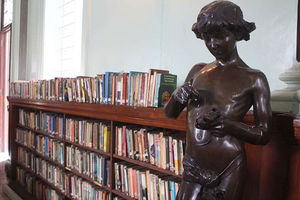
The sculpture of a woman near a bookshelf at the McMillan Memorial Library in Nairobi on July 17, 2019.
Photo credit: File | Nation Media Group
Yet when I last walked through its doors last year and was allowed to the basement, I was met not with the grandeur of a meticulously preserved archive I had seen years back, but with the sorrowful spectacle of decay. I hope Governor Sakaja saw how the once-pristine arrangement of newspapers in the basement—meticulously catalogued relics of bygone eras—had vanished. During my visit, I realised that some of the rare newspaper collections had been reduced to a forlorn heap and sat abandoned in dusty corners, stripped of their dignity. Broken shelves stood as silent testaments to neglect.
The delicate wooden frames, once secure sentinels of knowledge, stood cloaked in layers of dust—so thick that merely breathing in the musky, dimly lit air felt like an endurance test.
Some years ago, I ventured to the summit of Ol Donyo Sabuk to cover the desecration of McMillan’s grave, where robbers had attempted to open his grave alongside Lady Lucie. From their resting place, one can still gaze upon what was once their grand farmhouse—an architectural behemoth, one of the largest settler residences I have ever encountered in Kenya.
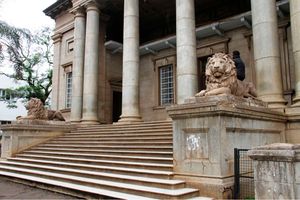
A lion sculpture at the McMillan Memorial Library in Nairobi on July 17, 2019.
Photo credit: File | Nation Media Group
Yet, what I found there was a heartbreaking portrait of neglect. The McMillan house, a place of storied history, stood in quiet decay, too. I had read that it was within these very walls that former U.S. President Theodore Roosevelt once scripted passages of his book, yet it was languishing and its grandeur fading into oblivion. The Muka Mukuu Cooperative, which inherited the estate, seemed blissfully unaware of the property’s historical and commercial worth, letting time and the elements conspire in its slow undoing. Later, Tourism ministry rescued the McMillan house and had it gazetted as a national monument. But still, we don’t know what to do with the site.
The same fate, tragically, has befallen the McMillan Library. Until 1962, it was nurtured by the Carnegie Foundation, a beacon of literary and intellectual pursuit. But since then? One would be hard-pressed to find any evidence that the city of Nairobi has invested in its preservation—aside from merely keeping its staff on payroll. And so, what was once a repository of knowledge and heritage teeters on the edge of obscurity, a forgotten relic in a city that should have known better.
I asked a librarian how McMillan’s basement ended up this way. During the days of Governor Mbuvi Sonko, I was told, a misguided attempt at floor restoration left the basement, where the newspapers were once neatly arranged, in a state of perpetual disrepair. The contractor, nay tenderpreneur, with no sense of history, left the library in disarray, was paid and vanished. The tiles he left, so poor in quality, cracked on every step — to an extent that only a few visitors are now allowed to that basement. Today, the scattered debris, both of historical documents and poor construction turn the library look like an abandoned construction site rather than a dignified temple of wisdom. Some bound volumes have lost their covers and some of Kenya’s most rare collection of books – some of which can sell for a fortune are scattered on the tables.
A catalogue shelf at the McMillan Memorial Library in Nairobi.
Photo credit: File | Nation Media Group
Setting politics aside, rescuing the McMillan Library from further deterioration is a matter of utmost urgency. Built between 1929 and 1931, McMillan was the second library established in Kenya and remains the only one safeguarded by an Act of Parliament—a testament to its historical importance. Certainly, we don’t want McMillan to follow Desai Memorial Library which vanished from Nairobi as we watched.
It is commendable that Governor Sakaja has recognised the McMillan Memorial Library as an intellectual cornerstone of Nairobi—a silent custodian of the city's rich and layered history. Macmillan holds the power to draw international scholars, offering rare and invaluable materials unavailable elsewhere. However, before it can assume its rightful place on the global stage, it must first be transformed into a world-class library. The staff, need to be thanked for keeping this facility running. Their dedication is still amazing.
To achieve this, a crucial first step is the alignment of the McMillan Memorial Library Act with the 2010 Constitution, as libraries are a devolved function. It then falls upon Governor Sakaja’s administration to collaborate with the national government in fulfilling the state’s duty to nurture libraries and other cultural institutions—not merely as repositories of knowledge but as vital expressions of national identity and cultural heritage.
It is also important to note that the McMillan Library has such a wide mandate that could benefit Nairobi and its residents. If you read Mcmillan’s Act of Parliament, you find that its objectives and scope reveal an ambitious vision—one designed not merely for the storage of books but as a dynamic hub for knowledge, discourse, and artistic expression. The County government can enact its own law to allow McMillan Library to have its trustees and fundraisers. Why do we need that?
First, the library was envisioned to organise, promote, and encourage an array of educational endeavours, ranging from public lectures to cinematograph performances. This is something that Governor Sakaja can explore. It could also establish other libraries and collaborate with institutions of learning for the advancement of knowledge.
We also know that Macmillan’s mission extended beyond mere preservation; it sought to forge strategic alliances—collaborating with and enriching other libraries, institutions, societies, corporations, and trusts. With strong management and rethinking, McMillan Library can be a citadel of knowledge on its own. It is strategically situated at the heart of Nairobi and it is a solid heritage. That previous authorities saw no value in its heritage is a scandal. That attempt to rehabilitate it led to its near destruction, but it can be reversed.
Typewriters in the McMillan Memorial Library in Nairobi.
Photo credit: File | Nation Media Group
Some years ago, the visionary Nairobi-based NGO, Book Bunk, set its sights on breathing new life into this historic library. Their dedication has already seen the triumphant restoration of Eastlands and Kaloleni libraries. Now, the mantle falls upon the Nairobi County government to reclaim and rejuvenate this architectural gem—for any discerning governor worth their salt would recognize its profound significance.
Governor Sakaja’s pledge to step in and salvage the iconic McMillan Library is, indeed, a victory for history. For we must not, under our watch, stand idly by as the rich city’s past fades into oblivion. Cities, the world over, take advantage of their history to drive tourism. This is a huge, untapped gem.
John Kamau is a PhD candidate in History at the University of Toronto, Canada.
John Kamau is a PhD candidate in History at the University of Toronto, Canada. @johnkamau1 Email: [email protected]