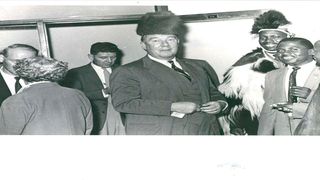
Only two months after the first Lancaster House Conference — which ended with the British Government’s decision that Kenya would become independent as soon as possible — the Kenya African National Union (Kanu) party was formed in May 1960.
In the main, it was composed of the two biggest tribes, the Kikuyu and Luo. The Kenya African Democratic Union (Kadu) was formed a few weeks later, bringing together the smaller tribes, apprehensive about Kikuyu/Luo domination. Sir Michael Blundell joined Kadu, pledging his New Kenya Group’s support.
The Second Lancaster House Conference was held in February 1962. Its main business was to outline a constitution for a truly independent Kenya. The Kadu delegates were led by Ronald Ngala.
In his memoir, A Love Affair With The Sun , Blundell describes Ngala’s reaction to the British government’s decision to grant independence. The incident happened when a number of delegates in that First Lancaster House Conference were taking part in a BBC broadcast: “Ronald grabbed the microphone, sweat was standing out on his forehead, his hands and his whole body were shaking and he almost shouted down the mic a passionate paean of emotion and excitement at the thought of African advance of such magnitude.”
Reginald Maudling, who had taken over from Ian MacLeod as the British government’s Secretary of State for the Colonies, chaired the second conference. In his opening statement, he referred to his recent visit to Kenya. He said he had sensed there “a fear of discrimination, fear of intimidation, fear of exploitation”. These fears, he said, had caused the economy of the country to run down.
This is how Blundell, in his memoir, described the situation in the months following the first conference: “In the farming community many farmers abandoned all development, fine dairy herds were sold off as beef, workers were dismissed and an air of gloom was prevalent. The road from Nakuru to Nairobi, which now carries a constant stream of traffic, was almost empty of vehicles, only forlorn numbers of African workers who had lost their jobs were to be seen trudging hopelessly along the road sides.”
Given this situation, Maudling reminded the conference participants of the responsibility he was carrying.
“For our part, as Her Majesty’s Government, we recognise our own responsibility to all Kenyans. This responsibility cannot be discharged unless we can be sure that when the time of independence comes, we shall be handing over authority in Kenya to a stable regime, free from oppression and violence, and free from racial discrimination,” he said.
Before the conference had started, Maudling had asked Blundell if it would be possible to do away with the formal introductory speeches and get straight down to business. The move failed and the introductory speeches took two weeks.
In their own opening statements, the two leaders of the two main delegations made clear their different positions. Ngala, for Kadu, began by making reference to other African countries that had achieved their independence and, like Ghana, had increasingly centralised power.
He argued that the constitution they would be devising should ensure a decentralisation of power. He pointed out that peoples of Kenya were many and various, and that there would be a risk of conflict if one tribe sought to dominate.
This argument was countered by Jomo Kenyatta, leading the Kanu delegation. He argued the case for unity rather than fragmentation: “We believe that Kenyans are of one nation, whose various elements — racial or tribal, religious or social — must integrate for the good of all.”
At a later point in the proceedings, Kenyatta’s views about Kenyan peoples’ unity were rocked somewhat when he stated that the Kikuyu should be free to move into the Rift Valley and purchase farms left behind by Europeans.
Blundell would later tell me in an interview that there was a murmuring among, particularly, the Kalenjin participants, that quickly became loud protests. One European member took on the role of a football referee — he took a whistle out of his pocket, blew a shrill blast and stopped the protesting.
Jaramogi Oginga Odinga was especially incensed by Ngala’s opening arguments. Always an excited speaker, Blundell described to me how Jaramogi quickly got into his stride and made an impassioned speech lasting over two hours.
“What do we care if we do have communism?” he asked. “What’s wrong with dictatorship? What’s wrong with Ghana?”
He turned on Ngala with the taunt, “As for you, you were only my karani (clerk) once!” He was flailing his arms as he spoke; he was foaming at the mouth.
In So Rough a Wind, Blundell records how during this Jaramogi performance, Tom Mboya “sat with a frozen look on his face, as if a relative was committing a terrible social gaffe on some notable occasion”.
Mboya himself, in an attempt at reconciliation, focused on the values and principles shared by both Kanu and Kadu representatives. He suggested that there are three tests for appraising a constitution: whether there are safeguards to ensure stable government; a built-in machinery for an individual to protect himself if aggrieved; and built-in checks to ensure that the constitution cannot be overthrown.
In one of our one-on-one conversations, Blundell talked of his respect for both men: for Jaramogi’s passionate commitments and for Mboya’s cool positioning. He related their different personalities to a distinction between two groups of the Luo people: the traditional ones and the educated ones. Blundell says he became friends with both Jaramogi and Mboya.
For five weeks, Maudling listened to the statements and the debate — the arguments about whether the new Kenya should have a federal or a unitary government. He then said it was time for him to make a contribution. He proposed a compromise:
“I believe that our objective must be a united Kenya nation, able to make progress — economic and social progress — and a united Kenya in which men and women have confidence in the sanctity of individual rights and liberty, and in the safeguarding of minorities. That is our objective. I recognise that it does not exist at the moment — that Kenya, although in a sense one nation, is divided by many feelings of suspicion and fear, which I think is genuinely felt fear.
“Therefore, we must seek a system now which takes account of those fears and those differences and provide for them in the constitution, but does not provide for them in such a way as to prevent the growth of a united nation,” the colonial government official said.
He added: “A constitution which made people more divided would, I believe, be the most likely way of producing a Congo situation. On the other hand, a constitution which tried to unite the nation by means which would lead to dictatorship would be equally dangerous. We have to steer a course between these two dangers.”
He suggested that a case had been made for devolved governance structures that would be larger in scale than the existing district authorities. What he was advocating was neither the highly centralised unitary policy of Kanu nor the very decentralised, federal policy of Kadu. He expressed his hope that in the follow-up discussions, there would be give and take on both sides:
“I believe it is the duty of those who stress the need for strong central government to be prepared to concede the decentralisation of such functions of government as are not vital to the sound government of the Kenya nation. And it is the duty of those who proposed regionalism to limit their claims for the devolution of powers to the minimum necessary to safeguard legitimate local interests from unfair neglect or oppression by the central government,” he said.
After another two weeks of discussion, an agreement was reached on a majimbo constitution along the lines indicated by Maudling.
Blundell told me an interesting story about how the minds of the Kadu delegates were eventually made up.